At the end of World War Two, the Danish Madsen company wanted to replace its production of licensed Suomi submachine guns with a design of its own. The result was the Model 1945, a quite unusual design with a pistol-like slide. The nearest similarities would be the Polish PM-63 and the German VG1-5. The Madsen design also used an unusual hammer firing system. It was chambered for 9mm Parabellum, feeding from Suomi box magazines (not drums). Both a fixed wooden stock version (seen here) and a folding stock version were made, but only a few sales came through (apparently to Mexico and El Salvador).
Danish M1941 Madsen video:
Madsen M1950 video:
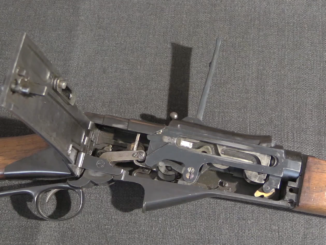
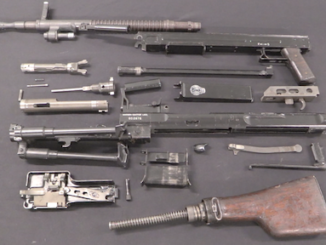
“folding stock version were made,”
https://www.firearms.96.lt/pages/Get_Em_Puppy's%20World%20SMGs.html shows said variant in Madsen m/45 and attribute design of fire-arm to Marius Gunnergaard-Poulsen.
“(…)only a few sales(…)”
According to https://modernfirearms.net/en/submachine-guns/denmark-submachine-guns/madsen-m45-eng/
…Madsen model 1945 submachine gun was one of the last “old style” submachine guns, designed for expensive old-style manufacturing techniques that included plenty of milling and machining of steel, rather than stamping and welding. Not surprisingly, this gun was quite expensive and saw little success – it was sold in very limited numbers to Mexico and el Salvador, and within a year after its introduction it was replaced in production with much more simple and inexpensive weapon, the Madsen model 1946…
Which implies it was replace in just next year, by totally different design. Was that quickest replacement w.r.t. commercially sold sub-machine guns or there was some other design which was replaced even faster?
I’m going to go out on a limb and suggest that the guy who thinks you unscrew the front swing swivel and remove the front sight base over on YouTube has it right.
I very vaguely remember seeing something about these submachineguns in Shotgun News, about the time that Peter Kokalis was writing about his experiences in El Salvador for Soldier of Fortune and Shotgun News; as I recall, this SMG figured in one of the articles, and that front sight base has a key inside it that locks the barrel into it and prevents it from rotating.
YMMV, and I may be conflating the whole thing with another gun, but I remember there was a chunk of an article where Kokalis was regaling his audience with all the “cool stuff” he’d found in the armories of El Salvador. The main focus was on the German MG stuff, but there was mention of the “weird little SMG from Denmark”, and I remember a comment to the effect that the 1945 was an interesting first attempt, but the 1950 was the real deal.
No idea where the hell that article is, now. I used to have a whole set of three-ring binders that I kept interesting magazine articles in, but those vanished in a military move, years ago.
There is ‘Weapons Tests and Evaluations: the Best of Soldier of Fortune’ by Kokalis. It’s for sale on Amazon. You might take a gander at its TOC. There is likely to be serious overlap between it and your lost articles
Kirk:
May I pick your brain WRT the M240?
I was just reading a book by an SAS veteran. He wrote that in the Falklands War he was ordered to advance under the covering fire of a GPMG on a tripod. The only problem being that the gunner had cleaned the gas system beforehand and reassembled the gas block backwards, so it would only fire one shot.
Whilst this story shows that even the SAS can make mistakes, it is not something I associate with the FN MAG design. I know it is possible to assemble the M60 with the gas piston backwards, so it fires one shot then stops, but I have never heard of such a design flaw coming from FN. I assumed they knew that if a component can be assembled backwards, then it certainly will be. Do you have any thoughts on this? I asked a friend with military experience, but he had never heard of it happening.
@JohnK,
There are detail differences between the L7 series and the M240, but… Were someone to tell me that story in a bar, I’d smile sweetly at them, mutter “Walter Mitty rides again…” under my breath, and then take everything else they said as utter boolsheet.
Someone told me that story in an instructional setting, I’d pull out the gun, show them this part, and inquire politely how it could possibly be put into the gas block backwards…
https://beltfeds.com/product/m240-three-position-gas-regulators/
I do not believe that story, not one little bit. There is, to my knowledge, only one gun then available on the world market that could be capable of that feat of stupidity, and that was the M60. Which, I believe, was then in use on UK variants of the CH-47, so it’s just barely possible that there were examples of it in the British Army, but the odds of anyone pressing one of those weapons into use as support for an SAS assault? Slim to none. I may be mistaken, but one of the things that made the Falklands what it was would have been the loss of most of the then-new CH-47 fleet in theater with the sinking of the Atlantic Conveyor. I vaguely remember that the UK had not yet certified the L7 for flight operation on that aircraft during those years, and the M60 was still the only thing available as a door gun. I do know that some of those were on the books for other British helicopters purchased from the US as late as the early 1990s, because one of the acquaintances I made during a Trumpet Dance exercise at Fort Lewis was a guy who’d come over to us looking for parts for some that he could take back to the UK; I gathered that the process to order them through channels was incredibly lengthy and torturous, so it was kind of fun to take him down to the local gun show and let him pick out a stock of odd little things like pins and sling swivels.
So far as I know, and I’m pretty sure of my facts, the anecdote you’re relating is physically impossible and situationally suspect. Yes, the UK had a tiny number of M60s on the books, but I am pretty sure that the odds of one of those being used to provide supporting fire to anything the SAS did was highly unlikely. Especially from a tripod in any ground role…
Kirk:
Thanks. The story did not ring true to me either. It was definitely referring to our standard L7 GPMG. AFAIK the M60 was still used as a door gun in British Chinooks as late as the Afghan war, but I don’t know if it still is.
@JohnK,
There are detail differences between the L7 series of guns, the MAG58, and the M240. I do not believe that any of those relate to the basic functioning of the gas system, and I’m pretty sure that the parts are mostly interchangeable even with those differences.
I’d rate that anecdote as “Not f*cking likely…” to be honest. I’d also take anything else from that source with extreme suspicion.
Hi Kirk:
Now I think about it, maybe the SAS were using M60s. It’s lighter than an FN MAG, and they do like to use non standard kit. They also have their own armourers, who could have kept it going, more or less.
The guy’s memoir has it that it was a MAG, but he was not the gunner, and in his story the gunner admitted he put the gas block in back to front. Since the M60 has that “design feature”, it must have been an M60. The pig strikes again.
In the Falklands, this SAS trooper was issued with an M16, but wrote he would have preferred an SLR. British soldiers really did love the L1A1, but I think he was better off with the M16.
In his memoir, the operation in question was an attack on an oil storage facility near Port Stanley one day before the Argentine surrender. He felt the order was stupid, as the war was as good as won by then, and Britain would need the oil storage facility for its own use, rather than destroying it. Anyway, the attack failed due to intense Argentine resistance, not helped by the support machine gun malfunctioning.
I did notice a few factual errors in the book when it came to describing the ships used in the Falklands (obviously not his area of expertise), so it is quite possible he was recalling something which happened, but misremembering the machine gun used.
The main comfort I draw from this is that the MAG cannot be reassembled backwards. That is the one fact I really wished to establish. Thanks for confirming it for me.
@JohnK,
It would take a lot of convincing evidence before I believed that the SAS ever used the M60 in combat during the Falklands campaign, and then I’d still be questioning the veracity of it.
One, the only UK purchases of that gun I have ever heard of were for various helicopters procured from the US. Two, the SAS was far more likely to get something along those lines from the fine gentlemen at HK, and three, if they were to have taken the M60 along with them, it would have been in the “assault belt-fed” role, and thus highly unlikely to be fired in a support role from a tripod.
I would lay my next paycheck that whoever told you this story is full of shiite. I mean, show me the money/evidence for this truly extraordinary claim, and I’ll believe it. Hell, just show me where the British Army ever used the M60 in any role other than as a door gun somewhere, and I’ll entertain the possibility.
If I were an SAS trooper, I’d have chosen the GPMG for doing supporting fire with, just because of the familiarity factor. Not to mention, the parts/armorer support that could come from any other unit in theater with SAS. You only use the one-off Gucci stuff where you absolutely have to, and there is zero reason for anyone to have put something like that into a support-by-fire position. Let alone, had the gear along to do it…
I mean, OK… Possible? Anything is. Likely? Oh, hell no…
Hi Kirk:
You may very well be right. I doubt we will get to the bottom of this one, after all memories fade over time, and even a story someone swears is true may not be.
As to where the SAS might have “acquired” M60s? Well, they had their own procurement process, hence the M16s they used. If they wanted M60s, for whatever reason, they would have got them.
Often its technical details as such that set off the bullshit alarm,
I’ve mentioned few months before a local war-stories guy that claimed he had repaired a scratch on a shotgun receiver with cold blue (while telling the most fantastic story about it ever, like finding the gun randomly hundreds of miles from the battlefield – recognizing it by that scratch), yet he neglected the fact that said shotgun model had aluminum receiver, so cold blue wouldn’t work s..t, thus the whole story was a complete fabrication.
Unfortunately, you start to doubt anything that comes of of the mouth of such characters (or is written in book).
Second guy coming to mind was some kind of self proclaimed survival expert-wildlife explorer who was busted after 2-3 years for lying about everything. I didnt watch any of his interviews because from the start it was all fishy to me, but afterwards after he was exposed (there was a huge uproar on youtube, where they started analyzing his videos frame by frame and word by word),
I stumbled on one “podcast interview” part where he described some knife (calling it “ninja”?!), and it was instantly evident he basicly does not know anything about knives or weaponry and is pulling the details out of his ass; just like what was later understood with everything else he presented.
It reminds me a lot of the Mendoza HM-3, which Ian will surely cover one day.
How hot do those serrations on the slide get after a few rounds?
The Madsen M50 show up in all places on the Star Trek episode Bread and Circuses.
Also the Dean Martin Matt Helm spy movie The Silencers (1966). They were the early model with the straight magazine.
Stembridge Gun Rentals seemed to have had a couple of dozen of them for some reason.
cheers
eon
There’s a definitive list of firearms used in movies, with the list for the Madsen M50 here:
https://www.imfdb.org/wiki/Madsen_M50
To disassemble, stop the slide in an intermediate position using the button.
Push the barrel back and turn it.
Citation on that, if you would?
Or, just an educated guess?
Thanks! No offense intended…
Other proto pistolish SMG is polish ww2 Bechowiec, also hammer fired !