
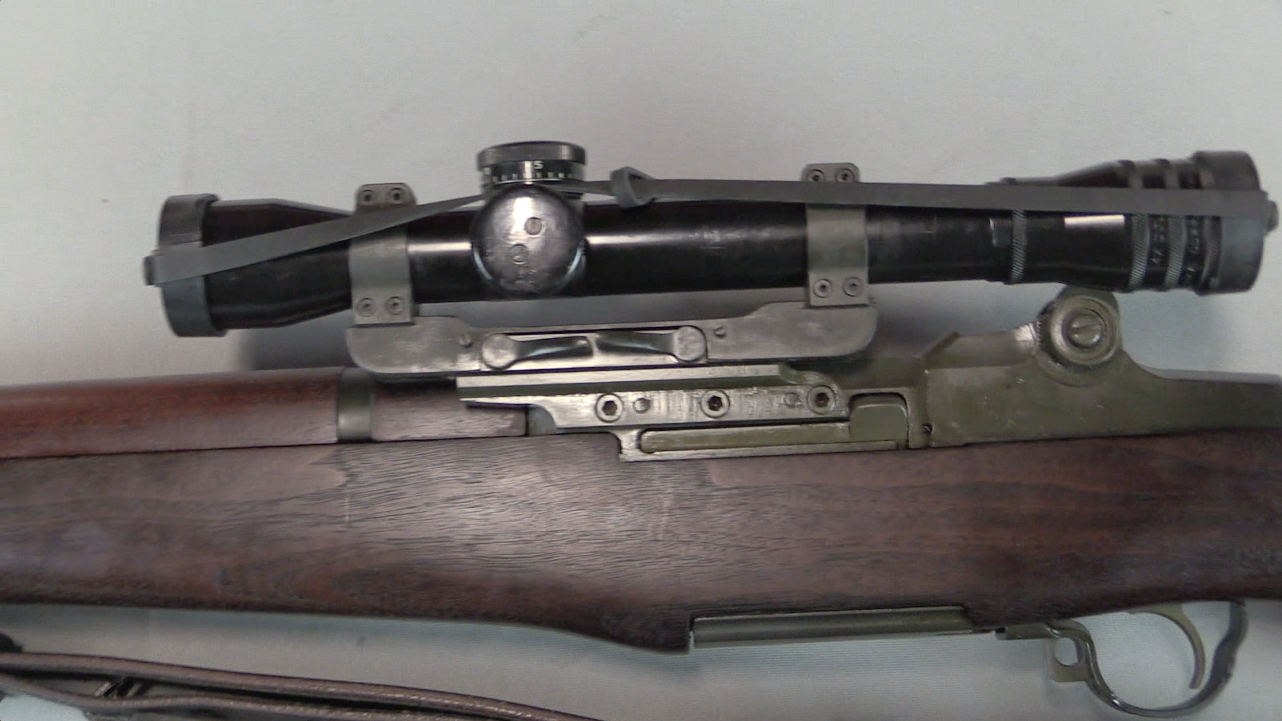
The E-series Garands were a series of prototypes made at Springfield Armory to test all sorts of different changes to the basic rifle design, from flash hiders to folding stocks. The M1E4 is a design that uses a new gas system developed by J.C. White in the 1930s, and adapted to the M1 by Earle Harvey (better known for his later work on the T25 rifle designed to replace the M1 after the war) in 1941. The was intended to remove the dog-leg bend from the operating rod to improve manufacturing efficiency. It is a gas expansion and cutoff system, and it was tested at Aberdeen in 1943.
The M1E4 did not pass initial testing, but the system was revisited in 1944 with some improvements as the M1E9. It is tested in 1945, but the war ends before development can be fully finished. However, Earle Harvey used the system in his T25, and it was also used in the T44 – which became the M14. The M1E4 here is the origin of the M14 (and M60) gas system.
Thanks to the Springfield Armory National Historic Site for giving me access to this truly unique specimen from their reference collection to film for you! Don’t miss the chance to visit the museum there if you have a day free in Springfield, Massachusetts:
https://www.nps.gov/spar/index.htm
JC White Gas-Operated Prototype: https://youtu.be/rXAmnoMR2aI
JC White Prototype LMG: https://youtu.be/ZHR_kDlEUrw
JC White Prototype Toggle-Locked Rifle: https://youtu.be/I6o4TW36dBc

So… Ian. Friend. Pal. Documentarian of arms…
Just how in the hell does this gas system design do anything at all to remove the dogleg in the operating rod? From what you’ve shown us here, that dogleg is still there, with its intrinsic force-bias to the right of the action, which either indicates that I don’t know what the term “dogleg” refers to, or… I dunno. Confusing as hell, TBH.
This has always been the downfall of the Garand and Garand-like weapons, to my eye. The force path is not straight; because of that, there’s a built-in torsion to the whole system that creates problems that a straight force path would have solved from the beginning.
It would probably have been a great idea to have a standard Garand stripped for disassembly alongside this one so we viewers could see the differences.
“(…)Documentarian(…)”
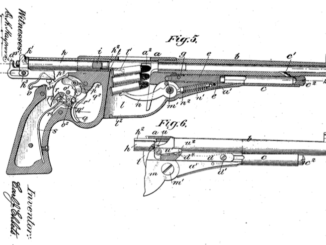
Mentioned in description Earle Harvey received US Patent 2582989 GAS PISTON FOR FIREARMS available at https://patents.google.com/patent/US2582989A where he envision that
…adapting this. actuating mechanism. to a series of different guns, or to similar guns firing different charges the major diameter of the piston and the diameter of the gas port remain constant. The effective piston area is adjusted to the requirements of a particular weapon by varying the diameter of the piston portion 24 and stem hole I5. Thus a number of weapons difiering widely in ballistic characteristics may be actuated by a gas cylinder assembly of which all basic physical dimensions excepting two may be identical in all cases…
Judging from what I’m seeing in the diagrams and reading in the description, Harvey’s goal was to have a single pattern of gas-piston system, with one set of standardized components, that would be used in all gas-operated weapons from lightweight carbines on up to (probably) Squad Automatic Weapons (BAR?) and (possibly) medium machine guns (gas-operated replacement for Browning M1917 or M1919?).
The only things that would be different on any of the above would be the cannelured rod sticking out of the front of the piston face (part 24) and the front plate with a hole for same (part 15). (I’m reading this as best I can while navigating his strange syntax and numerous typos.)
From what I see, the result would be rather like the variable gas system of the ZB26/Bren or the later FAL, except that the gas volume would be “set” for each individual type of weapon at the factory and not be changeable in the field. it would in essence be a “one size fits all” gas piston assembly with different pre-determined fixed settings for each weapon’s specific cartridge, breech pressure, and etc.
This would seem to have all the drawbacks of a variable gas system (complexity, etc.) and none of the advantages (unlike such variable systems, its “designed-in” inability to vary gas throughput to deal with environmental conditions, wear, different lots of ammunition with different powders, etc.).
In the end, you would have carbines with a larger and heavier gas system, rifles with a largely equal mass and dimension gas system, and SAWs or MMGs with lighter and physically smaller gas systems.
This would probably increase the weight of the carbine unacceptably, while probably making it more reliable in terms of cycling, particularly on full-auto.
It would seem to have little or no effect one way or the other on a purely semi-automatic full-caliber rifle.
It might lighten the SAW and MMG a bit, but I suspect it would not stand up to sustained full-auto cycling as well over time.
And as Kirk points out, the off-center operating rod issue is not mentioned at all.
Given extremely good QC on ammunition, this system might result in a better gas-operated GPMG than, say, the M60.
But a “One Gas Piston To Rule Them All” system?
No, I don’t think so.
clear ether
eon
true modularity
The principles that are being used here;
a metered amount of high pressure gas being fed into a cylinder,
a cut off operating after a short distance of piston travel,
then adiabatic expansion of that gas, to do work,
Were arguably worked out by Murdoch, then developed into working form and commercialised by his young friend, Richard Trevithick, in the last quarter of the 18th century, for steam engines.
Neither Murdoch nor Trevithick achieved the elegance of using the sleeve of a trunk piston to achieve both the metering and cut off.