
Joseph White’s experiments in handgun design did not begin with the White-Merrill 1907 submitted to US handgun trials. In 1905 he submitted a patent (US #888560) for features in these two .38 caliber semiauto prototype pistols. These are both short recoil actions, one with a C96-like locking block and one with a rotating barrel. They are both unusual designs, and pretty interesting to look at…

Light MGs
Vintage Saturday: Unsure
Forcemen of 5-2, First Special Service Force, with an M1941 Johnson light machine gun on the Anzio beachhead, Italy, April 1944. They are in the process of disassembling (or reassembling) the gun. Thanks to Michael […]
Light MGs
T52E3 – An M60 Prototype
There is no doubt that German machine guns of World War II were superior to American machine guns of the period. The BAR, with its 20-round magazine and fixed barrel was much under-equipped for use […]
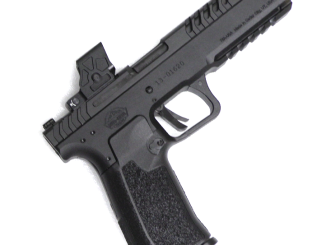
Semiauto pistol
RIA 5.0E: A Very Nice Pistol, But For Whom?
Rock Island Armory is best known for its Philippine-made 1911s, but expended into US pistol production with a novel design a couple years ago. The call it the 5.0, and it uses an interesting vertically-traveling […]
“In 1905 he submitted a patent (US #888560) for features in these two .38 caliber semiauto prototype pistols”
Notice that patent shows that this is weapon for rimmed cartridge.
Were not rimless automatic pistol cartridges not available in 1905 in USA or its popularity were so small so it was decided it is better to use rimmed?
I suspect conservatism had something to do with it. Most officers still used revolvers, which used rimmed ammunition. Browning pistols were still considered a novelty at the time and were likely more expensive than the revolvers of the day. Did I mess up?
From all indications, White was hoping for an Army contract, as he entered a later version in the 1909-1910 trials. At the time, the Army stipulated that any new design had to use the standard-issue ammunition. Which in 1905-1907 was still the .38 “Long” Colt cartridge, as used in the Model 1892 and 1894 revolvers.
In fact, the cartridges shown in the patent drawing are .38 Long rounds. This probably explains the magazine.
Note that the rotating-barrel locking system showed up on the Roth-Steyr 1908 and later the Steyr-Hahn 1911. Not to mention the even later Mexican Obregon. The question is, who came up with it first?
I suspect White may have been its originator.
cheers
eon
“I suspect White may have been its originator”
Locking via rotation might be found in Krnka automatic pistols:
-civilian known as Krnka-Sauer model 1900 (second name is after manufacturer): http://www.hungariae.com/RothSau.htm
it fired proprietary cartridge, ballistic-wise similar to .32 Auto; due to own cartridge and complicated (=expensive) design in comparison to other same-era .32 automatic pistols, so it was relatively fast dropped from production and replaced by Sauer Modell 1913 which use normal .32 Auto cartridge and is blow-back operated
-used by Austria-Hungary Repetierpistole M.7, considering that Steyr-Hahn was not new in that respect – most probably this feature was borrowed from said Repetierpistole M.7; fired 8 x 19mm cartridge (unique to this weapon)
“The question is, who came up with it first?”
Assuming that patent date decide:
I will say that it was probably Wasa Theodorovic, which got patent in 1895, this design was later developed by Krnka.
Bit time liter J.M.Browning got US Patent 580925 FIREARM. (Patented Apr. 20, 1897).
Early Krnka pistols were generaly “Rotating Breech” locks, should not be confused with “Rotating Barrel”. First widely produced rotating barrel locked pistol should be Steyr 1907.
Pins, levers, flat springs, coil springs, plates, screws, striker with separate plus canted firing pin… It seems, Mr. White was fond of playing puzzles.
Are you legally barred from posting photos of the firearms? I don’t always want to view a film, but I would love to see a decent photo.