https://youtu.be/gnDE-3kEaVc
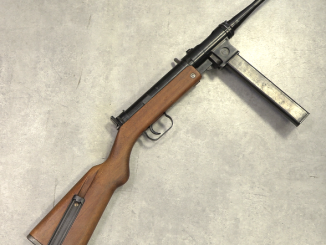
The ZK-383 as it is known today is a side-magazine SMG with a bipod, but that is not how it began its life. The gun was originally designed for Czech military trials in 1938, which it lost to the vz.38. After the trials, the factory looked for export sales, and found a potentially interested party in the Bolivian Police. A batch of samples were made in anticipation of a larger contract, and this is one of those samples. It is a simple blowback gun with a double-feed magazine and removable bolt weight to adjust rate of fire. The sale to Bolivia was interrupted by the Wehrmacht marching into Czechoslovakia, and the gun ended up undergoing further iteration before being produced under German occupation as the ZK-383 we are familiar with today.
Thanks to the Czech Military History Institute (VHU) for graciously giving me access to this very rare prototype to film for you! If you have the opportunity, don’t miss seeing their museums in Prague:
https://www.vhu.cz/en/english-summary/
vz.38 SMG video: https://youtu.be/NPBzN2-6zh0


Attempt of opening https://youtu.be/gnDE-3kEaVc results in video not available.
https://www.youtube.com/watch?v=BMKSI31-E2s
This one works.
Spring in stock was earlier used in Steyr-Solothurn S1-100 https://guns.fandom.com/wiki/Steyr-Solothurn_S1-100
Externally this weapon is similar to later UD M42 https://modernfirearms.net/en/submachine-guns/u-s-a-submachine-guns/ud-m42-eng/ with both having vertical grip and rifle-like stock, but U.S. one having said grip in front of magazine rather than around magazine.
Providing police with full-auto-only sub-machine gun in 1930s seems odd. Did anybody outside Bolivia did this in 1930s, if yes where, if not why Bolivia was special in that regard?
The whole concept of the submachinegun was still in nascent form. I don’t think anyone outside of the United States was really looking at arming police with them or actually doing it, and that was mostly because the people behind the Thompson had so many that they needed to sell.
The literature does not indicate a whole lot of interest in the submachinegun until at least the mid-1930s. I suspect that a lot of “gendarme” forces didn’t even consider them for serious use until enough of their opposition had adopted something similar. Up to that point, there was a concern that if they handed out state-of-the-art weapons to rural police, then they’d fall into the hands of the banditry with great speed.
Example of this would be that recent surfacing of what looks like a mint Colt Monitor in Haiti. Where the hell the gangs got that? I’d love to know; I think there were some that were procured by the Dominican Republic, and maybe from there…?
Right after The Great War, there wasn’t much interest in the “machine carbine” in U.S. police circles for three reasons.
First, the primary long arm of most police departments was still a Winchester lever action in one caliber or another. The Model 1894 in .30-30 WCF was common, but even more so was the Model 1892 in .44-40 WCF. By 1920-25 it had mostly replaced the older (and by then worn out) Model 1873s, and there were “old-line” agencies (notably the Texas Department of Public Safety) that still used Colt revolvers in .44-40.
Second, if rapid fire beyond pistol range was required, the Winchester Model 1907 and 1910 semi-automatic carbines in .351 WSL and .401 WSL were in most agencies’ inventories. Generally ten to fifteen rounds of either caliber (both more powerful than any .45 ACP or 9 x 19mm SMG) decided the issue pretty quickly.
Finally, if up-close, right-now “burst fire” was needed, as in quelling a prison riot, there’s a reason we used to call short-barreled patrol shotguns “riot guns”. Loaded with No. 0 buckshot (“double-ought” wasn’t used as much as Hollywood and mystery writers would have you believe), they did all the damage necessary out to forty yards or so.
Generally, the one concession to volume of fire was the semi-automatic shotgun, as opposed to the pump-action. The Browning Automatic-5 was the usual choice, as nobody particularly liked the T.C. Johnson-designed Winchester Model 1911SL’s barrel-cocking evasion of the Auto-5’s bolt-mounted cocking handle. ADs were almost guaranteed when the 1911SL was loaded with the then-standard paper cased rounds which swelled due to humidity. And when officers (like hunters) tried to force the barrel through the cycle by planting the butt on the ground and bearing down on it like a stuck butter churn- boom, right in the face.
Although most agencies just bought Army surplus Winchester Model 1897 trench guns. The ’97 had no disconnector, so just holding the trigger back and “tromboning” the action generated all the rapid fire most officers could handle due to recoil.
(Yes, that “trick” has been disproven in recent years, notably by Ian & Co., but back then it was still believed. I know I used to surprise Browning Automatic users on the trap range with my father’s ’97 with a 26-inch full-choke barrel by beating their times on doubles…)
In short, the submachine gun got no traction in law enforcement here in the U.S. because it didn’t do anything better than what they already had in the arms rack.
This changed slightly with the “Gangster Panic” of mid 1933 to late 1934. The paranoia about the likes of Dillinger and the Barker gang caused some agencies, notably in the MidWest, to buy Auto-Ordnance (actually Colt-made) model 1921 and 1928 Thompsons. Not to mention the newly-reorganized U.S. Agency Which Must Not Be Named under You-Know-Whoover.
Five years later, the confrontations between LAPD, L.A. County Sheriff’s Department, and the “Chicano” community (mostly over where the new freeways were being planned) resulted in orders for TSMGs by those two agencies.
(The Showtime fantasy/horror series Penny Dreadful: City of Angels covers this period with a high degree of historical accuracy. The demon Magda and her opposite number, Santa Muerte, are fictional; the events shown in the 1938-39 time frame in L.A. County are absolutely not.)
But even those purchases were a drop in the bucket compared to Auto-Ordnance’s inventory of over 20,000 component sets, delivered by Colt but still not actually paid for.
They were still sitting in the warehouse when the British Purchasing Commission showed up in a blind panic in 1940.
clear ether
eon
It’s not panic or paranoia if they are actually running around killing your people.
Portugal, for instance. Their gendarmerie force (similar in role to the Spanish Guardia Civil), the GNR (Guarda Nacional Republicana) got SMGs in the 1930s. The civilian police (PSP) got Steyr-Solothurn SMGs at about the same time, together with Madsen LMGs.
“(…)civilian police (PSP) got Steyr-Solothurn SMGs(…)”
Were these full-auto-only weapons?
It was selective fire.
https://en.wikipedia.org/wiki/MP_34
cheers
eon
United States and Germany, for example.
As as far as Germany is concerned, after WW1, not only civil war conditions erupted at a number of places, but also violent crime became a serious problem. Due to the Versailles Treaty, Police was the only government body that was allowed to have SMGs guns.
I have seen photos of Freikorps troopers with SMG’s, apparently leftovers from the Great War. Either not everything got turned over at war’s end, or there was migration out of police arsenals.
Ian, several mistakes, A.S. means akciová společnost, what is actually: joint-stock company. Some of these guns got somehow to the Slovak National Uprising. They are in historical books and one of them is in the museum of Slovak National Uprising. Do not ask my how. I just know that the Slovak State was temporarily a German ally / to avoid occupation / and at that time Slovakia bought some ZK 383 from occupied Czech part of ex Czechoslovakia. this is valid definitely for the side magazine ZKZ 383, but some pictures are with the ultra rare “bolivians” in hands of antinazi insurgents in Slovakia.