
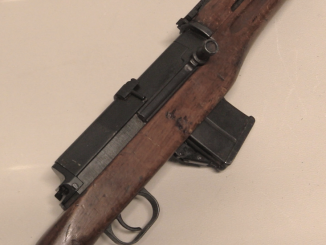
After World War II, Egypt experimented with several types of new rifle as a series of leaders bought arms from both Western and Communist nations. They included FN49 rifles from Belgium and vz52 and vz52/57 rifles from Czechoslovakia before a deal was made to license production of a copy of the Swedish AG-42B Ljungman rifle in 8×57. This licensed copy had a few changes from the Swedish model, and was designated the Hakim. Later a smaller variant in 7.62×39 was made, under the name Rasheed (or Rashid), and finally the country adopted the AKM with tooling provided by the Soviet Union. We have examples of all of these rifles, and we’re taking a look at them today.
Semiauto Rifles
The Rasheed: Egypt’s Semiauto Battle Carbine From Sweden
Egypt purchased tooling for the Swedish AG-42 Ljungman in 1952, and adapted it to their 8mm Mauser caliber as the Hakim rifle. Later, they scaled the rifle down to 7.62x39mm as the Rasheed, and manufactured […]

Commentary
What I Didn’t Buy Last Weekend
So this past weekend was a Regional auction at the Rock Island Auction house, which I neglected to post about beforehand. The Regional auctions are the ones with typically lots of less valuable guns packaged […]
Single Shot Rifles
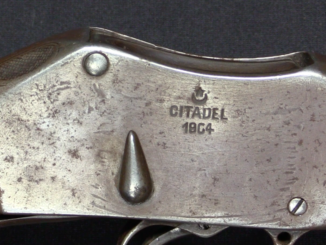
Citadel Martini – British Guns Rebuilt in Cairo
This rifle is part of a lot coming up for auction at Rock Island here. In 1903, the British government shipped a load of spare/surplus Martini parts and tooling to Egypt, where it was set […]
Thanks for posting this interesting video, Ian. The Rashid is a really neat little carbine, isn’t it? As for the Egyptian AK, while I understand the advantage of having a side folding stock instead of the original Soviet underfolder design, its design is utterly hideous. The side folding stock of the Chinese Type 56-2 looks less flimsy and a bit better ergonically speaking.
Thanks for the review , it is really interesting!
Forgotten weapons nothing, I’ve got one of those in a case under my bed. Very smooth shooting characteristics for a semiautomatic 8mm, though the absurd length of the thing has led me to variously describe it as “a telephone pole” and “a boat oar”.
It looks nice to boot.
From time to time we are going to cover some guns that are not at all forgotten, because understanding them is often very helpful in understanding why others were not successful.