
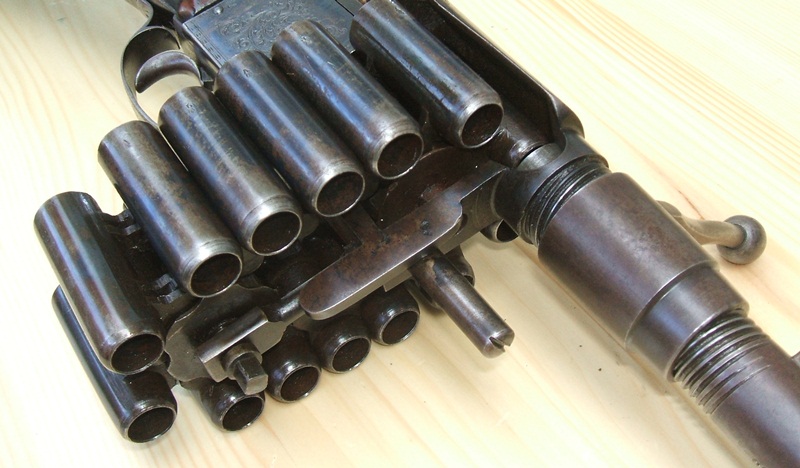
The Treeby chain gun was a .54 caliber percussion rifle that could fire 14 rounds in rapid succession. Designed in 1854, it was unlike anything else available at the time. Only two were ever made, with the hope of receiving a contract from the British Army. The gun was tested and found wanting, and no further production was ever undertaken.
We posted a video on the Treeby a few months ago, and I’ve been meaning to follow it up with some detailed photos.
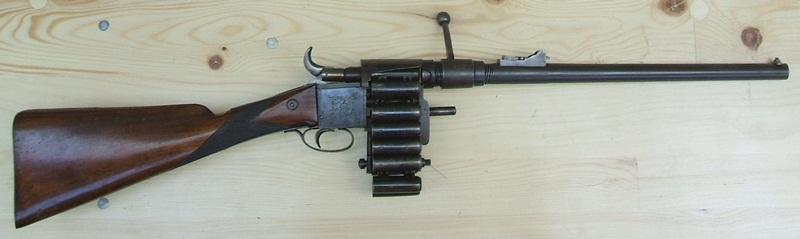
Firing the Treeby rifle requires following a specific process. First, of course, each of the 14 chambers must be loaded with powder and ball, and a percussion cap placed on the firing nipple on each one. Once the weapon is all loaded, the lever on the barrel must be rotated up. The barrel is connected to the frame by way of a very coarse thread, so lifting the barrel lever pulls the barrel forward, away from the chamber. Next, the hammer is manually cocked, which rotates the chain of chambers and indexes one into position. Then the barrel lever is rotated back down, pulling the barrel in and sealing it against the chamber. Only now can the trigger be pulled, which fires the round currently sealed up to the barrel.
After firing, the process repeats until all 14 rounds are expended. It is very important to lock the barrel onto the chamber BEFORE firing, and forgetting this critical step in the heat of battle could happen pretty easily, with unfortunate consequences. The manual of arms for this rifle is likely one of the reasons is was not pursued by the British Army. It also lacks any sort of usable front grip or stock, although this could have been addressed with further development.
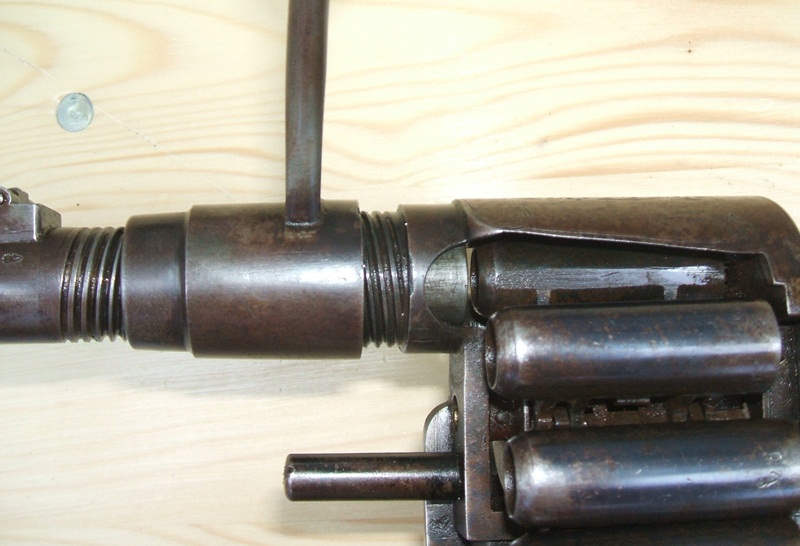
Despite its somewhat complex nature, the moving barrel offers several significant benefits. First, by sealing the chamber for each shot it provides higher velocities than revolver-type designs with a gap between barrel and cylinder. The Treeby also would be very unlikely to suffer from chain-firing, in which the spark from the main chamber ignites one or more adjacent chambers (which can be a problem in percussion revolvers when they are not loaded carefully and properly). Since the chamber is fully sealed, no sparks or blast can escape in the vicinity of the open chambers.
One Treeby (which we have photos and video of) is in a private collection, and the other resides at a museum in Hampshire, UK.
Photos
You can download the complete gallery in high resolution here.
[nggallery id=172]


It is really interesting that a genius who thought a very innovative mechanism
being ahead of that time, could not think a simple disconnector lever clearing
the way forward for hammer when the barrel at fully screwed back position.
Although it has no forarm, I am sure the intent was to hold the barrel with the left hand. I would expect singed fingers and in the event of a chain fire, loss of the left arm. All the ‘virtues’ of the Colt Revolving Rifle!
Very neat entry. Looks like that rifle is tough to keep rust free.
Interesting that they could come up with the chain drive repeater but not a simple receiver that would individually load the pre-loaded self-sealing chambers. Picture this rifle dropped in mud, you’d need a pressure washer to get it up and running again.
You haven’t visited our other store yet Ian, but we at the Royal Armouries also have a Treeby – in the white, possibly a prototype or trials weapon.