
After he failed to win US military adoption of his toggle-locked rifle design, John Pedersen went looking for other countries that might be interested in the gun. One of these was Japan, which experimented with toggle-locked Pedersen rifles and carbines for several years in the early/mid 1930s. This particular one is serial number 8, and has a scope mounting rail attached to it. It functions like a normal Pedersen rifle, but has a rotary magazine instead of the en bloc clip used in the US trial and British-produced rifles.

Semiauto pistol
C96 High-Speed Video and Smith-Condit article
Now that I have this high speed camera to use, I am going to be making high-speed video a regular weekly feature, at least until I run out of guns to film this way. Today’s […]
Prototype
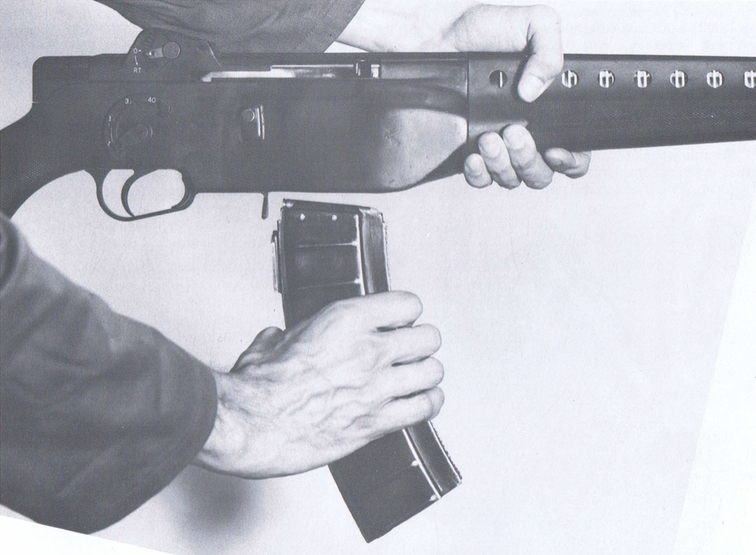
Magazine for an XM19 SPIW Flechette Rifle
The XM-19 was one of a series of Special Purpose Infantry Weapon (SPIW) prototype designs in the 1960s and 70s – a project which was attempting to increase the hit probability of infantry weapons. Several […]
Accessories
Ultralight Silencer: the Carbon Research CR9T
One of the cool new products we found at SHOT Show this year was the CR9T from Carbon Research. This is a small research company that has figured out how to bond metals to carbon […]
Toggle system seems reinvented in this rifle. Front joint, the key factor of delaying action with superimposed supporting points working succesively from lower to upper units looks very different from British sample. If made by Japanese staffs it deserves high grade of admiring. Though the overall concept is unchanged, same genius of design approach is also present at other differences made at other sections of the rifle.
Is that a scope rail on the side?
I don’t know about this example, but there was a war manga short story depicting a Japanese Pedersen with a scope offset to the left. The story, taking place at Guadalcanal, is purely fictional, but I do appreciate the author having done some sort of tech research. Americans attempting to bum rush the sniper late in the story get ventilated because they don’t know that his weapon is a semi-auto and not an old bolt-action. The Japanese sniper wasn’t even sitting in a tree while emptying his magazine. Sadly, he dies in a duel with a one-eyed American sniper armed with a scoped Garand. Both guys headshot each other.
What is the name of that manga? It sounds really interesting.
I can’t read Japanese, but the overall series’ title could be roughly translated as “battlefield tales.” The manga was drawn by Leiji Matsumoto, and apart from some elements in the individual stories that popped up in Matsumoto’s later works, each story is unique in having very “killable” main characters. Very few of the war stories have a happy ending.
Beautiful, intricate machining. Probably too much so for an issue service weapon. And considering the decline in quality of materials and machining Japan showed during the war, I think getting issued a substandard Pederson would get exciting as soon as you pulled the trigger…….
As mentioned by others I too like level of machining and fit. The only question I’d have is how well would this mechanism work when contaminated.
On contrast of other toggle systems in which the joints are fixed in their recesses, Pedersen concept contains most of those enagements as movable. This may produce a roller and swager effect under pressure for disintegrating the contaminating particules.
Regarding the extraction issues with the Pederson rifle, it just struck me but could those have been overcome with a fluted chamber? I’m not sure if the concept was invented yet (I know the FG-42 had one), but I was just wondering if that could have been a potential tweak that would have improved it’s chances of being adopted without the need for lubricated cases (not the actual solution wasn’t already quite ingenious and adequate in itself.)
I wish they made a non-detachable rotary mag rifle today.