In January 1944 men of the 93rd Infantry Division field-modified an M1 to give it a shorter (18″) barrel, and the rifle was sent back to the US and tested by the Infantry Board. The idea was that a rifle like this might be of use to paratroopers, being more powerful than the M1A1 Carbine they were already using. The job of exploring the idea was given to John Garand at Springfield Armory, and he began work that same month.
One example was made in the spring of 1944, using an underfolding stock designed by Garand (for which he received a patent in 1949). It was 5″ shorts and 1.2 pounds lighter than a standard M1, but exhibited excessive blast and concussion. The initial design used the folding stock with a traditional grip, and this was found uncomfortable (no surprise there). The rifle was refitted with a rather off steel pistol grip, but this was also not a great solution. By this time testing found the whole thing undesirable and it went no farther.
Thanks to the Springfield Armory National Historic Site for giving me access to this truly unique specimen from their reference collection to film for you! Don’t miss the chance to visit the museum there if you have a day free in Springfield, Massachusetts:
https://www.nps.gov/spar/index.htm
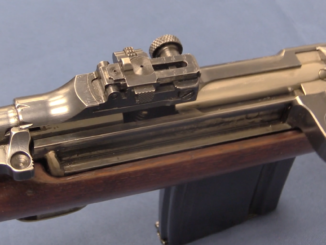

The reason for the weird pistol grip design might have been to discourage using it with the stock folded. I think it was really meant to be used as more of finger rest when gripping it more conventionally around the extended stock. It might have been gripped fully with the stock folded by, say, a vehicle crewman, but it would have been really difficult to control.
Yet again, you have to reflect on the fact that the Italians got there first with an issue version of the Paratrooper Garand, and that they did it better/cheaper…
On the whole, I think it’s rather a miracle that Springfield Arsenal ever even produced the Garand in the first place, given all the other BS they managed to mismanage.
BM-59….The best Garand design.
The Beretta BM59 in both folding-stock and fixed-stock versions had a much better-designed pistol grip. In fact, most pistol grips seen on tactical shotguns today seem to have been copied more or less directly from that one.
The Type III under-folding stock on the M14 ( Small Arms of the World, 9th ed., p. 649) looks like a pretty straightforward copy of Garand’s folding stock on the M1E5 prototype. The pistol grip looks to be longer and a bit better-shaped, allowing a proper grasp with stock open or shut.
The whole thing still is not a great solution to the “infantry rifle” or even “squad support weapon” problem.
clear ether
eon
The Garand was not the “finest battle implement ever devised”, but more the “finest implement ever devised for our imaginary fantasy of how to fight”.
The cartridge should have been a mid-range intermediate, leaving the too-big .30-06 to the mission it was designed for: Long-range volley fire. The rifle should have had a box magazine, been light and handy enough to do close-range snap shots with, and it should have been lethal out to around 400m, in order to keep the weight/power levels down to a manageable on full-auto point on the continuum.
As it was, the Garand was merely the “best that the US military could do, within the bounds of its fantasy world”.
.276 Pedersen or .280 Brit in an anorexic FAL with a belt fed SAW based on a bulemic MAG58.
.338 Lapua Mag in a MG42 clone (with Lafette!) and a Stg57 based DMR.
Add a Japanese knee mortar/French 50mm mortar hybrid, Panzerfaust 3, M2 Flamethrower, and Energia rifle grenades including thermobaric rounds. Lightweight underbarrel GL in 30mm like the Rooskies. SA Ball ammunition to same quality as Swiss GP11.
Mix and match to suit.
As already said, in 1930 the US already had the right cartridge for decades. They should have adopted the .30 Remington for infantry rifle and LMG.
Powerful enough for anything on two legs at realistic combat distances. Shorter and lighter than 30-06. Can be used in a carbine short and light enough for Marines and paratroopers. With a 150 grain bullet it has practically the same trajectory of the 30-06 up to 150 yards, and drops only 10″ more at 350 (data for the 30-30, that are more readily available. Those of the .30 Remington should be even better, due to the better ballsitic coefficient). All that happens beyond that is not of rifleman’s interest.
.30 Remington is practically what the Italians tried to do right before WWII with the 7.35 Carcano.
As Roy Dunlap relates in Ordnance Went Up Front (Samworth 1949, now available free online), the Garand was an armorer’s nightmare to keep running, second only to the BAR.
Both worked reasonably well Stateside, although their performance in the Texas and Arizona desert training areas foreshadowed the problems that cropped up in North Africa.
They functioned OK in the ETO- except in winter.
Neither one wanted to work worth a damn in the Philippines. But not much of anything wanted to work there.
In the jungles, BAR gunners kept disabling their weapons inadvertently by just pouring gun cleaner into the buffer tube in the stock, then turning it over and shaking it out, which quickly rusted the Hell out of the buffer’s innards. Most often on the 1918A2s they “lost” the low (550 R/M) fire rate and were stuck with only the “high” 750, which Dunlap states was closer to 850-900 with wear on the gas tube and bolt locking assemblies.
Lt. Col. John George had a similar opinion of both in Shots Fired in Anger (Stackpole 1954, also available free online today). Based on his experiences on Guadalcanal and later in Burma with Merrill’s Marauders, he concluded that neither weapon had been designed or built to cope with the heat and humidity of jungle operations.
Dunlap stated that the M3 “Grease Gun” was poorly built and too fragile, especially its spring-return cocking crank system. (Note that this “feature” was deleted on the M3A1.) He was of the opinion that the German Mp38/40 was better, and the Beretta M1938 designed by Tullio Marengoni was a lot better. He was not impressed by any version of the Sten gun, and thought the Thompson even in the M1A1 version to be too heavy and overcomplicated. Dunlap regarded the Reising as a PoS.
Dunlap and George agreed that the M1/M2 Carbine was probably the best, or at least the least-worst, weapon in the U.S. inventory for jungle warfare. Neither man thought much of “combat shotguns”.
Both agreed that the Arisaka Type 99 rifle in 6.5 x 50SRmm was a very good, well-designed, reliable weapon that fired a cartridge more than powerful enough for its job. Both considered the safety “drum” on the Arisaka bolt to be the most intelligently-designed safety on any military rifle.
They also agreed that the 1911 .45 automatic, while no great shakes in accuracy beyond about ten yards, was a good weapon because no matter how beat up it got, it still went “Bang”, feeding, firing and ejecting in any and all conditions. Dunlap relates that one radioman wanted his pistol fixed after it was hit by a rifle bullet. The armorer hammered the slide and frame straight, filled cracks and holes with brass brazing and welding, and straightened the bent barrel. The result looked like Hell but it still shot reliably.
Dunlap had a lot of respect for the Beretta M1934 in 9 x 19mm aka .380 ACP. Reasonably powerful, decently accurate, and nearly indestructible. He also considered .380 more than adequate as a “man-stopper” at close range, based on actual experience in North Africa.
Neither man thought much of any version of the SMLE/ Rifle No. 4 “family”. Both thought the Bren was an excellent LMG, but both also thought leaving it in 7.9 x 57 like the Besa would have been a better idea just from a feed reliability standpoint.
Both men thought the supposed Japanese emphasis on grenades was exaggerated. In fact, the Japanese soldiers knew how poorly designed and manufactured their hand grenades were, and tended to use them as booby traps just on the grounds of being nowhere near them when they decided to “go off”.
Both also thought that anybody, even a sniper like George, who tried to “engage” any target beyond about 100 to 150 yards in a jungle was just kidding themselves.
clear ether
eon
Eon:
I am interested to know why these American officers cast shade on the Lee Enfield family. It is my impression that they were the best practical bolt action rifles around, with a ten round magazine and the quickest bolt to use. The rimmed .303 round was unfortunate, but in practice did not case many problems.
Dunlap & George’s major problem with the Enfields was their bolt lugs and locking recesses. While the SMLE/ No.4 bolt could be worked considerably faster than a Mauser-type (Mauser, Springfield, M1917, Arisaka, etc.), its very looseness tended to result in excessive battering of the bolt lugs, notably rotating in and out of lock. This of course resulted in excessive headspace with all its attendant problems.
The Mauser type bolts had the same problem to a lesser degree, except the Arisaka which an “interceptor lug” in the left side which guided the bolt back and forth with more evenness, as well as impacting the bolt stop in rapid fire; in all the others, the left locking lug hit the bolt stop head-on every time.
Dunlap stated that he saw and serviced SMLEs, No. 4s, Springfields, and Mausers in both North Africa and the Pacific, especially the Philippines, with badly battered locking lugs requiring welding up and reshaping, but he never saw an Arisaka with the same problem.
He stated that the biggest problem with the Garand (other than being too heavy and having that wonky eight-round en bloc clip) was that all U.S. issue .30-06 ammunition was corrosive primed. Combined with the heat in North Africa and the heat and humidity in the Pacific, it duly rusted the Hell out of the Garands’ bores and gas pistons, particularly the head end of the latter.
Sooner rather than later, the gas piston’s rust buildup would either cause it to jam, or enough of the steel in the piston head would rust away that most of the gas from the port in the barrel was going around the piston rather than pushing it back. Cleaning the piston (mainly by literally grinding off the rusted part) reduced the piston diameter so, again, gas leakage. The short-tern solution was cutting up to 2″ off the recoil spring and stretching it slightly, to reduce the resistance and more-or-less restoring cyclic function at least temporarily. The real solution, of course, would have been non-corrosive priming, but the only ammunition in U.S. small arms at the time with that was .30 USC. Yes, Carbine ammo.
And the Garand also had the bolt-lug battering problem. After all, it was really just a turnbolt action that just happened to have a gas piston to move the bolt back and spring to run it back forward into battery. Garands really battered the living daylights out of their locking lugs. Shearing the roller bearing off the right side (the one the operating rod pushes on) was a common problem as well.
The Carbines didn’t have the same problems, due to non-corrosive priming and overall lower operating stresses, but their original “flat” bolts tended to crack just behind the lugs. The result was the full-round bolt introduced late in 1944 and carried over to the M2 selective-fire version. Most histories of the Carbine say the beefed-up “round” bolt was originally designed to strengthen the bolt for full-auto fire. No, the “round” bolt came along before the selector switch did.
As far as other countries’ semiauto rifles went, Dunlap considered the German G41M and Russian Tokarev to be about the best in service. He encountered both in North Africa (Yes, the Germans actually sent captured Russian rifle, LMGs, and SMGs to Panzerarmee Afrika) and found them to be significantly more reliable than the M1 Garand. The Tokarev was lighter, as well.
As for the M1 Carbine, with its non-corrosive primed ammunition the only real problem with it other than the “flat” bolt was the tendency for the Philippine mud-dauber wasps to build their little mud apartments in the barrel. The result of firing was usually a “ring bulge” in the bore where the wasp had settled in overnight. The rule of thumb was to discard any barrel with four or more “rings” in it.
No word on what happened if the wasp happened to be in residence when the trigger was pulled.
😉
cheers
eon
Eon:
Thanks for that very full reply.
It seems the Arisaka was a much better rifle than it is ever given credit for. I still like the Lee Enfield.
I am surprised at the credit given to the G41, it normally gets written off. I am also amazed that the Germans sent captured Russian guns to North Africa. Were their logistics not complicated enough? In any sane world, they would have kept that stuff on the Eastern front.
@JohnK,
From what I remember of the texts, it was more-or-less down to “older and less elegant” than anything else. Also, bolt-action. They had to talk up the Garand, being American.
From my perspective, there were few (if any…) pundits back in the day who really recognized things for what they were, down on the firing line. All of the “authorities” here in the US were wrapped around the idea that the National Matches at Camp Perry were the ne plus ultra of the rifleman’s craft, and that was the ideal everything including design ought to be working towards.
The idea that they’d fundamentally screwed up when they allowed the simulation to lose fidelity with reality never occurred to them. Nor did it ever occur to any of them that maybe, if the National Matches were to truly support better and more effective marksmanship for the infantry, then maybe they ought to be integrating things like support MG fires and fire control across squads, as well as spotting random targets rather than the usual known-distance BS with big black bullseye targets…
I mean, sensibly? I have always thought that if you’re going to have the junior enlisted qualify on their weapons and give them badges for proficiency, then by rights? The leadership ought to be forced to qualify on their weapon, the squad element or platoon.
And, there ought to be unit proficiency badges, denoting how well your unit did at observing and engaging targets as a group.
One of my more instructive experiences as a squad leader was the time we did a squad live-fire range at the end of a 72-hour exercise that kept us up and on our feet doing missions for evaluation. It culminated in a road march, at the end of which was a range where you had to have your entire squad firing at targetry simulating an attack on your defensive position. If you hadn’t gotten your MG team across the line for actually finishing the road march, then it was just down to rifles and the M203.
You really did not want to observe how different a set of results that gave for some elements of ours that exercise gave. As I recall, the squad which had the highest individual marksmanship scores in the battalion actually did close to the worst on the squad fire portion, because the squad leader had no idea how to do fire control across his squad.
And maybe it should have had a stun setting and a photon torpedo launcher and a light saber bayonet and a….and a…
All an infantry rifle needs is;
1. To go BANG when the trigger is pulled
2. To shoot where the sights are looking
3. To put an enemy down out to about 200 yards maximum
and
4. To be as difficult as possible for the individual soldier to fuck up at 0200 on the darkest night of the year.
Because that’s pretty much guaranfuckin’teed to be when the other guy will assault your position.
5. (PS) You can make all the jokes you like about how dumb the Enemy is, as long as you remember that he’s really no stupider than you are and may even be a bit smarter.
If he screws up, be ready to take advantage of it, but if your Brilliant Plans all operate on the principle of him screwing up, you’re likely to lose.
clear ether
eon
Garand rifle firing .276 cartridge https://www.nramuseum.org/guns/the-galleries/world-war-i-and-firearms-innovation/case-36-great-inventors/us-springfield-t3e2-semi-automatic-rifle.aspx was considered for adoption before rework to 7,62×63 was ordered
In brutal honesty, the .276 Pedersen wasn’t the ideal cartridge, either.
Honestly, the basic issue with everything goes back to the conceptual level: They (the procurement authorities) were asking for the wrong things. Just like with NGSW, today.
There was nothing technically stopping anyone from designing and building something like the SKS in the early 1920s. Hell, it could have been accomplished far earlier, but the problem was that nobody in any military was asking for such a thing…
If you start out with a deranged idea of how combat is being conducted, because you never went down to do any actual observation or investigation, then don’t be awfully surprised when the stuff you design for combat doesn’t actually, y’know… Work.
The entire idea of combat that the Garand was meant to integrate with was flatly delusional and insane. The idea was “Give everyone a heavy rifle that they can use to engage individual targets in onesies and twosies onward to victory, out to 800 yards…”
Uhmm. Yeah. About that… The real deal was that the recoil impulse and the weight really precluded being able to perform the actual individual weapon mission, that of close-in combat, and also led to the ineffectiveness at long range, because instead of delivering nice, tight (and, highly effective) bursts of fire onto easily targeted specific points of terrain, the Garand necessitated a diffuse “Yeah, enemy’s over there, fire at the hillside…” sort of long-range work.
As I keep telling people, that’s not how it works. Assuming you want to win, that is.
Which is better? Eight guys firing volleys at eight different things they think they see, or a closely-controlled fire delivered consistently and effectively from a tripod-mounted weapon that allows for precise controlled fires?
The real secret of the MG34/42 system’s primacy in combat wasn’t just the belt feed and the high rate of fire; that tripod was the real killer. It afforded the team and leadership the ability to position themselves and then dominate terrain effectively and affordably. One MG42 on a tripod compared to even a company of riflemen armed with the Garand? Exponentially more effective, simply down to fire control. Every one of those Garands would have had to have been in the hands of a marksman like Carlos Hathcock and telepathically linked, somehow, in order to present the same sort of capability that one MG42 and a tripod could achieve against a target. The Garand-armed side’s fire was simply too diffuse, too hard to coordinate.
The really telling thing about the mid-century small arms mis-match wasn’t so much with regards to the weapons, but in the understanding of how war was fought. The Germans were the only people who really managed to honestly appraise the situation down at the front lines, come up with a solution to it, and then implement it.
The Garand was never a good answer. From the specifications out, it flatly did not answer the mail.
I don’t think that people really understand this, married as they are to their fantasies of martial prowess in terms of “I can one-shot anything out to a thousand yards with my trusty musket…”
That’s not even remotely significant in tactical terms. Maybe it would be if every single soldier involved was similarly capable, and somehow able to see through cover and concealment out that far, but the reality is that few are that talented, and the enemy has ample cover. The “Perfect Rifleman” is, in the final analysis, irrelevant: You need to have a tactical system that works, and during the 20th Century, that system required either a tolerance for vast casualties in your infantry, or using your machineguns effectively.
Of all the contenders, the only people who really pulled that off were the Germans. Everyone else blew it, especially the American military. Also note, the Germans got away with issuing a weapon to their infantry as individual arm that dated back to pre-WWI, and did so because of where they’d invested their money and effort, the General-Purpose Machine Gun.
There are windrows of dead scattered across Europe because of that choice, which speaks for itself. You have to shudder at the thought of what would have happened had the Allies not possessed the plethora of supporting arms and coordination that they did, because the casualty lists in Western Europe would have been orders of magnitude higher, had they been forced to do the necessary with just their small arms.
The Garand was a false branch on the technology tree, like everything else that came after it. M14, NGSW, all that delusional crap. You do not need an individual weapon capable of killing out to a thousand meters, and if you buy one, then ninety-nine percent of the time that capability won’t be used, won’t be effective, and will actually wind up preventing you from being effective with the weapon you issue for it’s actual job doing the close-in fight. NGSW is going to recapitulate the same issue that saw the infantry of WWII grabbing up and using the M1 Carbine for front-line combat vs. the Garand. Just like the M4 with regards to the M16A2, light and handy beats big and heavy for that fight, every single time.
The problems here aren’t with the weapons or the cartridges, but in the conceptions and mindsets of the people doing the specifications. The NGSW debacle is totally in keeping with the same idiocy that led to the Garand and M14. It will get solved the same way as the M16A2 got solved; they’ll take up the weapon meant for “support troops” and give them the too-big, too-heavy, and utterly irrelevant NGSW in the place of those (likely…) legacy M4 carbines that have finally made their way to where they were supposed to have gone in the first place…
History repeats itself, time and time again… Every iteration more ridiculous than the last, because morons won’t learn. Because, mostly, they’re morons who also won’t observe and then think rationally about what they observe.
“In brutal honesty, the .276 Pedersen wasn’t the ideal cartridge, either.(…)”
It does not have to be, but shows that idea of using cartridge smaller and lighter than 7,62×63 mm and bigger than .45 Auto usage in common infantry weapon was in reach of thinking then active decision-makers, unlike “light saber bayonet”
What if they had chosen .300 Savage, an available cartridge at the time?
At over 3000 joules energy at the muzzle, the .300 Savage is a full blown cartridge. Hotter than the .276 Pedersen, that would have been already too powerful. It would have been only marginally better than the 30-06.
.300 Savage, rather than .30-06, was the direct ancestor of 7.62 x 51mm NATO. In fact, the original T65 cartridge was merely a .300 Savage with slightly less taper in the cartridge’s profile;
https://en.wikipedia.org/wiki/7.62%C3%9751mm_NATO
So yes, you would have exactly the same problems that later showed up in 7.62 x 51mm rifles.
clear ether
eon
As a paratrooper, this abomination offends me deeply. I’d rather jump a regular M1 exposed or even broken down than be seen by a respectable enemy with this thing. The M1 truly was the greatest infantry rifle in history, and if you talk to infantryman who used them on other infantryman you know that. The truth is, no other rifle was as effective at turning cover into concealment on a mass scale. You can talk about MP44s or SVT-40s all day long, but they were novelties. The M1 was the standard and was ubiquitous. It worked well, and everyone who ever actually used it called it a “Grand”. Sermon over.
Actually my father and two uncle were in the war. Assorted neighbors too. I never heard anyone who used the word ‘Grand.’ Most of them spoke favorably of it; to none was it the Holy Grail. Superlatives rarely reflect reality. Too much glitter
The phrase “Greatest battle implement ever devised” is generally attributed to General Patton, but according to both photographs and my uncle who drove his Dodge WC-57 command/reconnaissance (radio) vehicle, the General’s own rifles were all bolt-action Mausers, both commercial and at least two Kar98Ks no longer required by the Wehrmacht.
My uncle was issued a Colt M1911A1 .45 pistol. He carried a .25 ACP “Baby Browning” behind the pack of cigarettes in his left breast pocket, a holdover from his prewar civilian trucking experience.
As was the double-barreled, sawn-off ten-gauge shotgun in a leather “holster” inside the driver’s-side footwell outer wall, next to his left leg.
So far, every 1/35 scale model kit of Patton’s “Beep” has missed that detail.
clear ether
eon
The greatest battle implement ever devised was the Motorola SCR-300, the original “walkie talkie”, that allowed forward observers and platoon officers to “call for Arty”.
My other uncle who was over there, commanding a troop of Shermans, said that his primary weapon against Tiger IIs and etc. was the 15th Air Force.
Nothing said “goodbye, Fritz” quite like a half-dozen 4.5in rockets from a P-51 or P-47, according to him.
cheers
eon
Eon:
That’s an interesting anecdote. I had never heard of Patton liking Mausers before. Truly, I would take a Garand over one, but perhaps he was attracted to using the enemy’s captured weapons.
The ten gauge was an interesting choice, ammunition cannot have been easy to come by, but then again was it ever used?
My uncle found that even with the short barrels, it threw No.6 shot far enough with enough pattern for grouse, duck, etc. out to 25 yards.
😉
cheers
eon
Patton could hardly complain about anyone else using unusual personal guns!
“(…)called it a “Grand”.(…)”
Oh no. My hope that this was already fixed https://www.forgottenweapons.com/garand-pronunciation/ is ruined.
Y’know what really turns “cover into concealment”? An effective MG team. And, it does so with the added benefit of doing that for the entire element surrounding the one guy you managed to spot…
I mean, it’s cool and all to be able to play Daniel Boone or Carlos Hathcock, but I’m rather more interested in winning the goddamn war than living the dream of the fantasy “Lone Rifleman”.
What you’ve missed here is that we’re not talking about some ridiculous ideal of one-on-one combat; we’re talking about the engagement of combat systems. And, history pretty thoroughly refutes the ideas embodied in your revered Garand; they don’t work at scale. They can’t work; people are not supermen capable of spotting every single individual target out there at 800-900m, and then engaging them at all effectively. And, that’s what you need when you are relying on the diffuse fire of individual weapons. Command and control, to direct that fire, is also virtually useless on that scale; if the riflemen are dispersed enough to survive, then they’re also dispersed enough that they can’t hear you, and if they do fire, they’re just as likely to be firing at something that makes sense to them, where they are, and will utterly ignore that mass of men you’ve spotted from your position as squad or platoon leader.
I don’t think any of you people have actually ever been in combat, or tried directing the fires of a squad. Y’all apparently think that men in combat have some sort of collective clairvoyance going on, and that the thirty or so riflemen in a platoon are just going to somehow “know” where to direct their fire. As opposed to MG teams, that are hopefully under the direct control of the leadership and actually doing the job that you think thirty random guys spread out on the battlefield are going to do…
Systems, people… Systems. That’s the issue here, and the system conceptualized behind the “individual rifleman” simply does not work. If we were telepathic ants, maybe it would, but as we are not… It does not.
The “individual rifleman” was the direct follow-on to massed musketry, Napoleonic style. Or as you once so accurately called it, the “organic machine gun”.
When the actual machine gun (as opposed to the mechanical types like the Gatling, Gardner, etc.) showed up, most armies kept on using the new guns the way they’d used the old “crankers”; as flank support weapons to prevent end-runs, as opposed to putting them out front and in the center as the primary killing tools.
The primary means of inflicting casualties was still massed musketry by the infantry. Bolt-action repeaters and then self-loaders just speeded up the process a bit over single-shots.
The British Territorials, trained in a wickedly-effective volley-fire technique, savaged the Germans in the “Retreat from Mons”. But when trench warfare set in,that many men on a fire step, repeating the performance, would either be mowed off by heavy machine gun fire or blown to bits by counterbattery artillery. (The first rule of trench warfare is that you pretty much have to assume that the enemy knows exactly where you are, even before you commence firing or whatever.)
In short, almost nobody made the conceptual leap from “organic machine gun” to “real, actual, gobs-of-concentrated fire machine gun”. A paradigm shift had just happened, and basically nobody noticed.
Only the Germans really more-or-less managed it. They developed the doctrine in the Flanders trenches, and then in the 1930s figured out how to make it “mobile”.
To this day, everybody else is mentally still back at Marengo and Malvern Hill. And the Germans are now rushing to join them.
Winning tactical doctrine?
More like a fool’s parade.
Most likely, eventually they’ll have lost enough men that somebody says “F**k this s#!t, send in the drones”.
And another paradigm shift will smack everyone else in the face. The question is, will they notice this time?
clear ether
eon
@eon,
Likely, not.
This is precisely the same sort of idiocy that led to the “idolatry of the sword”. Sword standing in for “Kentucky Long Rifle” BS, the reality has always been that the sword was mostly always a badge of nobility, romanticized beyond all contact with reality. To this day, everyone focuses on the sword, while the real “weapon of decision” was always the polearm in some form.
The Romans moved the dial, a bit, but they still relied on the faithful old pilum for a lot of their combat power.
It is an unfortunate fact that the human mind tends to obsess on “story” and “narrative”, and the narrative has been “rifle uber alles for most of the 20th Century. It’s a romantic thing, those Old Contemptibles there at Mons, quite the same as Alvin York and the fantasies about how the Kentucky Long Rifle supposedly won the Revolutionary War for the United States.
Which was so much twaddle, really. The Continentals and the French regulars won that war, while the various rifle-armed guerrilla forces nibbled the Brits around the edges.
Ain’t nobody wants to admit to that set of facts, however. Nor do they want to acknowledge that the individual rifleman, shooting at some singular target, is a sideshow thing, irrelevant to win or loss. You want victory? Kill the enemy; you kill the enemy by hitting them, and you do that most effectively with area weapons like the MG and the mortar. Even trying to leverage individual riflemen against enemies you can’t actually spot as individuals is a waste of time and effort.
You want to win in a 20th Century small-arms only engagement at range, then you need to be in control of effective MG fire. If your enemy is stupid enough to come in close without a firepower advantage, then you can maybe win with individual weapons alone, but they better be light and handy enough to engage. There were reasons that the WWII infantry formations loved the M1 Carbine, and why the M4 got selected by the guys out in the light infantry during the late 1980s-early 1990s. “Handy” trumps “long-range heavy” every single goddamn time. Taking an M16A2 into a close infantry engagement was about like trying to run rapids in a kayak using an oar from a racing shell… Totally inappropriate tool for the environment.
If they’d have issued something like the SKS in place of the M1 Carbine, I can about guarantee you that every single M1 Garand would have gotten left by the wayside, with rare exceptions. Too big, too heavy, too hard to wield effectively for the close-in fight. The long-range fight should have been doctrinally and practically left up to better MG systems, certainly something that could be tripod-mounted in a hurry. Said tripod being rapidly adaptable to whatever firing base you might find…
We didn’t have to fight WWII the way we did, but since the “powers that were” weren’t actually paying attention, well… There ya go. I am still in a bit of an outrage that anyone could have looked at combat conditions in WWI, and thought “Yeah, what we need is a honking big semi-auto…”. I mean, did they not just get done with the whole Pedersen Device thing, which was supposed to be “war-winning”? Did that fact not point the way towards where they should have been heading, looking for an intermediate cartridge in a handy package?
All you can do is shake your damn head at the sheer delusional lunacy of it all.
I’ve often thought that a decent self-loading infantry rifle could have been based on the Remington Model 8/81, which they actually made twenty-round magazines for in police applications;
https://cdn.rockislandauction.com/dev_cdn/82/403.jpg
I think it wasn’t considered at the time because everybody was all in on gas operation, and the Remington is of course a long-recoil system.
As for caliber, around that time Vladimir Fyodorov was saying that the .25 Remington (6.5 x 52mm) was just about the ideal military rifle cartridge, regardless of what sort of rifle you put it in. With a typical 117-gr. @ 2,350 and 1,400 FPE, that’s not far off the typical 124-gr. 7.62 x 39mm.
You can’t even argue much about durability. That receiver/safety design seemed to work well enough on the Kalashnikov…
A “militarized” Model 81 in 6.5 x 52mm in the 1930s might just have changed our concepts of infantry small arms a decade or so before the German Maschinen Karabiners showed up.
cheers
eon
Problem of the Remington Model 8 was that John Browning, for how much a genius he was, would have designed a firearm easy to field strip only at gunpoint. The Model 8, to be a viable military rifle, would have needed the same treatment Franchi did to the Auto 5, turning a disassembling nightmare into a lightweight, bulletproof and easy to service shotgun (the Franchi 48AL). For the rest, it would have probably been an ideal choice. One of the advantages of long recoil, IE, is that’s indifferent to barrel length, so, to make a carbine, it would only have needed a shorter barrel.
As for the cartridge. I still prefer the .30 Remington.
Power-wise is in the same ballpark than 7.62X39 and the Czech 7.62X45, sometimes a bigger hole counts, there was more expertise in .30 caliber bullets, and in the bigger bullet is easier to squeeze special features (armor piercing, tracer, incendiary…).
@eon, second pass:
Thinking about this, I believe that a fundamental problem with the way “they” ideated the issue back when was that the understanding they had of what was going on with infantry combat was transitional; there was only the shortest ephemeral moment between the time when they were doing mass formation volleys with muskets and the advent of the machinegun, and that did not afford them much time to really internalize things.
There was a period there, during the late 19th Century, when you used your infantry formations as actual weapons; the volley fires they delivered were direct and indirect fire tools that you could use pretty effectively. That was why they had those weird-looking (to us…) “volley fire sights” on a lot of the later smokeless rifles. They were actually using those, in conjunction with tight infantry formations, in order to deliver effective fires in combat.
And, so long as you could keep your formations nice and tight, under control and close supervision? That was perfectly usable, a real thing; an entire company firing en masse at identified targets as directed by their leadership? Perfectly workable, perfectly lethal.
That was the mindset that formed the preconceptions that they had for the individual weapon; they saw it as a tool for what amounted to formation-on-formation combat, as well as a tool for individual-on-individual.
So long as you could put your troops together in formations that could conduct these fires, everything worked well enough. The problems came in once you could not, and the things that made gathering men into volley-fire formations impossible were weapons like the French 75mm quick-firing cannon and the machinegun. Once those got out there on the battlefield, volley fires were dead doctrine.
Unfortunately, the mindset lingered. Probably due to the smooth transition there had been between the old-school musket-based “Line up and shoot at the enemy a hundred meters away” and “Lay there and shoot as a unit against an enemy over 500m away…”
The dead hand of tradition kept the long-range fire specification in the rifles they purchased, and nobody really wanted to either investigate or acknowledge the fact that the individual infantryman was now more of a close-quarter combatant than someone who could really influence the battle at range; because of that, and the perceived need to be able to kill horses, the big cartridges and rifles stuck.
Conditions changed, fundamentally. What didn’t change was the assumptions or the thinking about those.
Which is a problem with the military in general; few involved in the affair are really original thinkers, and even fewer are people who can take original thoughts and make them palatable for the masses. Everyone idolizes Alvin York and Carlos Hathcock because those are individual guys who could seemingly “do something” effective on the battlefield; nobody wants to be “just a cog in the machine”, even if that is all they’re truly capable of. The siren song of the “Lone Rifleman” is insidious and so very deeply attractive because the alternative, acknowledging that the battlefield is an impersonal place where your contribution is basically beneath notice? That’s anathema, not to be admitted or acknowledged.
In that regard, perhaps we should look at this stuff like the NGSW and M14 as cries from the heart, railing against the reality that one man has very little impact. Even so, catering to that BS is no way to go about winning a fight.
I think the Germans did a better job of recognizing reality and adapting to it. The real deal is that the MG and mortar working together are far more influential on the battlefield than some guys with rifles, and that’s all that they M1 Garand “philosophy of fire” really amounts to.
You have to contrast the idea of 9 guys with Garands scattered about the terrain, versus one guy controlling the fires of an MG42 team. You’re going to be exponentially more effective and destructive of the enemy with that MG team than you are trying to herd cats carrying the “finest battle implement ever devised”.
Unpleasant to acknowledge, but true nonetheless.
I’m about to go all heretical and say that the most intelligently conceived military small arm of the 20th Century was the German Mp38/40.
It was lightweight, compact, easy to handle, had a decent magazine capacity, fired a round with fairly light recoil that still hurt like Hell when it connected, and was overall pretty durable.
It also wasn’t much use beyond 150 meters, and most importantly of all did not have a single-shot setting.
These two were the most important attributes. There was nothing about the Mp that encouraged delusions of being Davy Crockett or Daniel Boone.
A smart soldier armed with an Mp held his fire until the targets were at most 75 meters away, then hosed them good to make sure they went down and stayed down.
A squad with two or three men with those made an efficient flank guard for the MG team. Letting them get on with the business of, well, winning the battle.
If you look at the M4 today, conceptually it’s a lot closer to Mp38/40 than it is to even the original M16, let alone the A2 “Camp Perry Wonder” version.
The Russian PPSh-41 came so close to being just about right- except for the 71-round drum that transformed it from a seven pound machine pistol to a thirteen-pound boat anchor. The Russians showed good sense in ditching the 71-round drum in favor of a 35-round “banana clip” box magazine in the last year of the war.
Generally, an “infantry rifle” should be no more than 80cm long, weigh no more than four kilograms fully loaded, have a thirty-round magazine, have no more recoil impulse than a 5.56 x 45 mm weapon, and have an effective range of no more than 300 meters, with its best range being anything up to half of that.
And oh yes, instead of a choice of Safe/Single/Triburst, it should probably be Safe/Triburst/Full-Automatic. Probably with a pull-through trigger like the Steyr AUG.
Training with it should emphasize when to use “burst” and when to just hose the area in front of you.
Leave the fancy shooting to the DM (if any) and saturating a target area 1000 meters out to the MG team- or the 155 battery six kilometers behind your FLOT.
Just concentrate on not letting them sneak up on you.
cheers
eon
@eon,
I don’t want to, but I find I have to agree with you, looking at the whole thing from a “system of combat” point of view.
Which is the actual problem with all this… The rational choices are not made because the people making them do not want to admit that those are the rational choices.
Raw fact? You’re really not accomplishing much by issuing every single soldier what amounts to a DMR. Yeah, some of them probably feel more manly about things, and are comforted by the fact that they could, if only they saw the bastards, reach out and kill someone at 800m.
The rub is, however, that nowhere near enough of the enemy shows themselves up like that, for it to matter in the grand scheme of things.
Yeah, it’s way cool and such that the Marines were potting terrorists with headshots all over the place in Fallujah. However, seriously huge ‘effing comma, did that make a bit of difference to “winning the war”? Or, even the campaign?
I’d submit that it did not. What made the difference in Fallujah was grinding the place flat with armor, air, and artillery. The proper role for the infantry in that entire situation was not in retail-level killing of the enemy, but in providing security for close-in attacks by said enemy on the heavy hitters.
If our TTP (Tactics, Techniques, and Procedures) had consisted of going in and surgically killing every single terrorist in Fallujah with a projectile to the head, then maybe all that precision shooting would have mattered. As it was, we used firepower and standoff, and the end result came because of those. Opting to go in, up close and personal, was purely a choice we made, and which we didn’t have to make. Flattening Fallujah and turning the place into a parking lot did not require individual attention, in any way. And, I’d submit, might have been way more effective in terms of obtaining and maintaining results: If you’re a Muslim fanatic in the Middle East, there’s a lot more satisfaction in going all mano-y-mano with the kafir than there is in being slowly suffocated in the basement by the uparmored D9 that is slowly turning your hidey-hole into a tomb. “Die killing an infidel…” vs. “Die like a rat in a collapsed tunnel…”
Final analysis, you have to evaluate the whole thing as a “system of combat”, as though you were working out which was better, a Hapsburg Spanish Tercio or a Swiss pike Gevierthaufen. Practical experience tells us that the Spaniards did it better, for awhile there…
Eon:
I am not sure if the Germans really knew how to use the MP40. They only built about a million, as against ten million Mausers. Britain and the USSR built over five million Stens and PPSh41s. I agree with you, the MP40 must have been cheaper than a Mauser, and more useful. The job of the German infantryman was to carry ammunition for the GPMG, and to defend it. A squad armed with MP40s could have done that very well, but the Germans never tried it.
@JohnK,
I think the Germans rightly recognized the point that the MP38/40 were useful weapons for the “very close-in fight”, under 150m. Out in that range band where you were further out, yet not so far out that the riflemen could profitably engage, the Kar98k reigned supreme until the optimized solution of the MP43/StG44 showed up.
If you were to posit an MP40 firing something capable of being useful out to 300m, then that could have done the job entirely. Until you had that, the high-low mix of the MP40 and Kar98k was a tactical necessity.
Regarding Kirk’s observation that an SKS or similar could have been available in 1920, if anyone had wanted it, I propose a thought experiment:
What if, instead of the ’03 Springfield “not-a-Mauser”, the united states had entered world war I with a Winchester model 1907 or 1910 as their primary issue rifle? Would they have fared better? Also, given what was available at the time, what would be the best LMG, SMG, and handgun pairings for the winchester?
I also have another question, of a much more tangential nature:teen Over the last fifteen or so years, craft manufactured firearms such as the FGC-9 and similar have improved dramatically, both in manufacturing quality and in documentation. Given that the Winchester 1907 is straight blowback, it seems like one could design a craft built version to be relatively easy to assemble (provided on had a 3D printer, some harbor freight power tools, and an internet connection). If such a weapon existed, would it be a good “standard” to choose for a guerrilla organization (in much the same way as the PDF in Myanmar seem to have standardized of the FGC-9)? also, what modern cartridge would be the best fit for this weapon? (I guess what I am really asking is “could one make an intermediate cartridge carbine ala-SKS using a simple to build straight blowback action?”)
I think that if you were going to go that route, for a blowback weapon, you’re really going to need to restrict yourself to low-pressure cartridges like those in handguns. A truly effective intermediate cartridge is going to require a locked breech of some sort.
I think there’s a path through the forest, though: If you could come up with a “just good enough” solution, like the inclined path the Jatimatic uses in order to delay the bolt going back… Maybe.
In all honesty, though… I think you’d be way better off going for a STEN sort of solution, with the idea that your not-so-well-trained troops are going to be closing with the enemy at close range, and then that they’ll be looting the ever-loving snot out of those enemy formations.
Anything short of that? Not likely to really work on a systematic basis. Hastily produced semi-improvised weapons are not a good basis for going forward in that situation; what you want are “just good enough” things to go forward, slaughter the regime troops, take their weapons, and then move forward from there once you have enough on hand, along with the time to actually train your hopefully motivated manpower.
Of course, there is also a german anti-wunderwaffe Vg 1-5 (that Ian made 2 videos about)
Both that or something similar, and this imaginary diy carbine gun absolutely cannot be built with plastic 3d printing and “harbor freight” junk.
Maybe 3d printing can be used for grips, stocks, sights and such, but for anything else in rifle calibre range parts, its useless and dangerous.
If 3d printing improves up to the point that households could 3d print steel, then maybe, but governments gonna throw a monkey wrench in such schemes quickly by restricting the sales of machines, or holding back some vital technology.
could one make an intermediate cartridge carbine ala-SKS using a simple to build straight blowback action?
If you are care solely if it does shot and not about safety margins and so on, then yes because https://guns.fandom.com/wiki/FaB_556 or even https://guns.fandom.com/wiki/Teterycz_machine_gun
“could one make an intermediate cartridge carbine ala-SKS using a simple to build straight blowback action?”
At the end of WWI the French decided that would have been the best option, see the Rybeyrolles 1918. Blowback operated, 25 rounds detachable magazine, and whose round, the 8×35mm Rybeyrolles, was a .351 Winchester Self Loading necked down to accept the 8mm “Balle D” projectile.
Any small arm that is unpleasant to fire, should never have been issued to soldiers
!!!!!!
Opinions are like a-holes. We all have one. Few weapons were developed for hot, humid, jungle fighting. Non-corrosive ammunition/primers help. For all the bashing done here of the weapons systems, the U.S. still kicked ass. Accurate fire from a rifle at longer ranges is a good thing, especially if your MG was knocked out.
Lloyd, the Allies won not because of “superior small arms”, but due to the fact that their other choices made small arms fundamentally irrelevant to the outcome of the war.
Had it been down to small arms alone, for the infantry engagements in the ETO? The casualty lists would have been exponentially higher for the Allies than they were.
What you and all the other proponents of the “individual rifleman” miss is that this discussion is addressing the fallacy that “individual riflemen” actually matter in the fight out past 300-400m. They do not, and the reason that they don’t is that that range band has to be systematically addressed with area weapons in order to take advantage of the fact that at that range, you’re probably seeing one where there are actually five to ten other men you’re not seeing; by shooting that one guy, you’re effectively wasting an opportunity and if that is how your tactical system is set up…?
You’re going to lose the fights you get into. Yeah, you’ll have that nice warm, manly feeling as you get rounded up (should you survive to that point) for the POW camps, knowing that “…you got your man…” while your leadership totally ignored the fact that by setting you up to “get your man”, they gave up the opportunity to actually eliminate a bunch of the enemy before they got into range to do anything.
War isn’t won by individuals; it’s won by teams and systems. No matter how great your skills are with a rifle, if you’re one-shotting the things you see out there in that range band, you’re skipping the work that your overall “system” ought to be doing, which is using that opportunity to engage and eliminate the surrounding enemy troops.
This fascination with “individual rifleman” stuff is why we keep losing wars. In Iraq, nobody paid attention to the fact that every time we “developed intelligence” and set the line combat troops on a target, that they were hitting dry hole after dry hole. Meanwhile, every goddamn night, the logistics bubbas were getting hit on their LOGPAC runs in between the FOBs. We were effectively running a training program for the insurgents, because instead of running the ambushers to ground and eliminating them, the logistics weenies would blow through the ambush. While the “combat” crowd ignored the fact that there were ample opportunities for them to engage, should they bother to do so, when the loggies got hit.
That is the same sort of category error you’re making when you suggest that doctrine ought to include emphasis (to the point of there being nothing else…) on individual rifleman targeting things out in the 300-800m range band. It simply does not work as a system of engagement with the enemy.
Oh, you can do it… But, you’re gonna lose. Just like we have, every goddamn time.
You want WWII-style victories? Then, you need to inflict WWII-style casualties on the enemy, every chance you get. You’re not going to “change minds” until you’ve killed 15% or better of the population, and rubbled most of their buildings.
Every time the enemy shows himself, he needs to be engaged and killed. Period. You’re not going after the one deer on a hillside here; you’re going after the whole damned herd.
And the stupidity still holds sway in Planning;
Increasing Small-Arms Lethality in Afghanistan; Taking Back the Infantry Half-Kilometer
Maj. Thomas Earhardt 2009
https://apps.dtic.mil/sti/pdfs/ADA512331.pdf
Put bluntly, you can’t “take back” what you never had to begin with.
clear ether
eon
I’ve commented on this essay a bunch of times.
What never ceases to amaze me about the US Army and a lot of other forces around the world is just how much credence they all put on these guys going through the various command courses. A lot of this “critical thought” crap exists not because these assclowns are actual, y’know… Subject-matter experts, but because they have to write a thesis paper for the course they’re in. And, a lot of them aren’t all that ‘effing bright to begin with; odds that they’re going to contribute useful and original information to the corpus of military thought? Yeesh… Minimal, at best.
This specific dumbass? Jesus H. Christ… Go read that “seminal” monograph, the one that warped the US Army’s approach to small arms for decades to come: Is there anything in there, at all, about how to properly use individual weapons or machineguns, let alone in concert with each other? Nope; it’s all “individual rifleman”, all the damn time. This Major spent the majority of his time (likely, the bare minimum, too…) as a company-grade officer without ever understanding that the machinegun was his primary small-arm weapon, not the diffuse firepower of his riflemen.
The whole thing is a marker for how poorly we train our officers, and how delusional they are about what’s going on around them. I’d about guarantee that this Major would not and could not wrap his head around how he should have been using his machinegun teams, and likely was one of the ones that left his tripods in garrison rather than try to achieve over 800m fire supremacy…
@kirk
Another hypothetical question, this time regarding your particular area ot expertese: If you were given a free hand in the matter, what GPMG would you sellect for (insert genaric NATO member here) and why? Furthermore, what other equipment would you issue to the gun team, and what specific models of said equipment (which current production tripod would you choose)?
To me, on paper (it had not been fielded in large enough quantities, but I’ve never heard about problems), the best western-made GPMG is the SIG MG710-3 (modernized MG45). All the advantages of the MG42/MG3 but 2.5 kg lighter and 8cm shorter.
We’re on the same page here.
cheers
eon
@the_snork,
That’s an issue worth a multiple-page answer, and I’ll try to keep it down to something that would fit here.
The issue of machinegunnery and the modern deficiencies thereof is a multi-axis problem.
One, the weapon itself is really only about a third of the equation; you also have “accessory equipment” that’s really not “accessory” but “essential”, and then you have the training/doctrine piece.
First of all, the weapon: I am an agnostic on the issue of “which one” because I don’t think anything currently on the market really meets the needs.
Characteristics it should have: True GPMG, of sufficient caliber to dominate terrain out to about 2000m. Should be capable of bipod-mounted deployment and easy carriage/employment by one man in an AR/LMG role. Should further be capable of easy transition to fully supported and controlled fire from a tripod. Should have fleet-wide spare barrels, as in the MG3. There should be no such thing as having to match barrel to gun/bolt; they all work, no matter what gun they get installed in. This is critical. The gun itself ought to be easily maintained, all the way down to the user level. Repair ought to consist of swapping components with zero fitting required. The gun teams ought to be able to carry selected spares with them, and have them be light enough to make for easy carriage.
Rate of fire ought to be variable such that you could go from 600rpm up to about 1800rpm at the flick of a switch. This is vital in order to achieve real effectiveness out at long range; there were good reasons that the Germans specified this feature.
Sight arrangements should be such that the gun is usable from the bipod, and yet enable getting the gunner as far below the line-of-sight when on the tripod. This probably necessitates two sights, one of which would be periscopic.
The tripod is a key element: It needs to be light, easily carried, and useful enough to enable accurate fires out to the max range of the cartridge. It should be adaptable to terrain, such that you can put it down and change leg heights to get a stable platform about anywhere. Command height should be adaptable; you should be able to fire it from about 25cm up to 75cm, and the T&E/firing platform should have bubble levels built-in such that getting them level is a matter of seconds. Something like a modernized carbon-fiber Lafette?
Additional “nice to have” tripod features would be a way for the firing platform itself to drop down from the firing position so that the gunner and assistant gunner could do reloading and other things while behind cover, while maintaining positioning for rapidly returning to controlled effective fires. Think “put platform on something like one of those old disappearing mounts for coastal artillery”, and you’d have it.
Of course, odds are that the US military will never countenance developing any such common-sense arrangements, so what you’d have to come up with by way of actually fixing this is some high-tech Remote Weapon Station sort of affair, maybe a US Robotics “Big Dog” with full-range control via both wireless and fiber-optic cable to the control tablet. You could do this as a hand-carried tripod affair, or as an actual UGV.
As to the “accessories that aren’t really optional” you have to address a couple of the requirements for an effective gun team. You have to have good observation skills coupled with an easy means of communicating fire control. This means “binoculars with reticles”, and it means giving them to everyone. I’m fond of the US Army itty-bitty M24 binoculars for everyone on the team who isn’t shooting, with one of the bigger M22 models for the gun-team leader and the platoon leader. As well, they need night observation gear that has the same reticle setup for fire-control corrections and the leadership needs rangefinding gear built in.
Other critical accessories address other needs: You have to have a good, fireproof blanket that blends into terrain in order to cut down dust/smoke signatures, and your ammo ought to be as close to flashless as you can manage. As well, you need to have equipment to dig in with, and to carry ammo and things like the tripod; it’s a system, across the board. You have to integrate it all, and train on it. No leaving the tripod behind; no leaving the binos back in the tent, you’re going to need them.
Other key accessories are things like internal comms such that everyone can easily communicate what they observe.
Probably the biggest “fix” would be better training and doctrine: Right now, it’s all inadequate, to put it mildly. Gun qualification is basically done from the standpoint of static defense, which is absolutely not what we should be doing; qualification should consist of a gun crew moving forward against opposition in a full-blown tactical scenario where the gun crew has to identify firing positions, get into them, and then use them effectively to flank and engage the enemy. None of our machinegun ranges support anything like this, so fixing that would be expensive as hell. The training needs to be dynamic, and include the rest of the element, particularly the leadership. If you don’t know how to use the machinegun as a squad or platoon leader, then the rest of the “fixes” are utterly irrelevant.
Right now, the mentality is that the MG is a “supporting tool”, instead of “my primary firepower”. The leadership mentality is “I’ll use my guns to shoot ourselves onto the objective”, which is absolutely a waste of lives and material. The mentality ought to be “Let me get my guns to where I can dominate the engagement and kill the maximum number of the enemy”, not “Yeah, big gun, lotsa bullets, hey-diddle-diddle, straight down the middle…”
The entire crew/element needs to be trained such that the mentality is more “Yeah, I see a good target for the MG team, out there at 400m…” and then they pass that on effectively to the team while correcting fires. Riflemen should not be “taking shots” at something they see, because the reality is that there are likely a bunch more enemy clustered around the one guy who skylined; best to get them all, with the machinegun, and not play Carlos Hathcock. It’s a war of systems, and the best system is the one that kills the most at the furthest ranges. Emphatically NOT the one that tickles its egos by killing onesies and twosies out there in the range band beyond 300m; all you’re doing there is killing the slow ones, and providing the enemy with some really effective training opportunities.
We’re talking full-blown culture shift, here. The US Army stuck the M240 and all the rest on top of a slightly revamped titanium version of the M122 tripod, which is itself just a marginally-updated version of that which we stuck under the M1919A4. It’s an inadequate POS that doesn’t do nearly enough, and which I frankly blame for getting a lot of gunners killed going back to Vietnam and the M60.
Large part of the problem is how “they”, the leadership, frame the machinegun. The understanding they have of its capabilities and usage is primitive and entirely mistaken.