
The FAMAS G1 was developed as a lower-cost option for FAMAS export sales. The original F1 model had been offered for international sale, but it attracted little interest largely because of its high price. In response, GIAT created the G1 with many of the extra features left optional. This allowed them to reduce the price by up to 40%. Specific feature reductions included:
– Omitting the bipod legs
– Omitting the grenade launching sights and barrel fittings
– Omitting the night sights
– Omitting the burst fire mechanism
– Replacing the trigger guard with a molded whole-hand trigger guard
The mechanism stayed the same, and all of the omitted features could be included as options. This still failed to generate any export sales, in part because GIAT came under ownership of FN, and FN’s competing assault rifle options were more profitable than the FAMAS.
The G1 did contribute elements like the whole-hand trigger guard to the mid-1990s G2 model adopted by the French Navy, however.
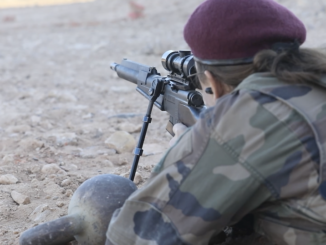
Many thanks to the IRCGN (Institut de Recherche Criminelle de la Gendarmerie Nationale) for allowing me access to film this FAMAS variant for you!

unrelated: is Utreon / Playeur out of business?
Yes
The whole thread of “Develop national arsenal system” to “sell off national arsenal system to private industry” to “private industry sells to multinational conglomerate” to “oh, look… The multinational shut down our former national arsenal, and we can’t build our own small arms any more…” is yet another example of the failures of rational thought processes in regards to small arms procurement.
GIAT going unviable and then selling itself off to FN? Entirely predictable; the French government didn’t want to support its small arms production, so they sold it off to “industry”, thinking magically that that would save everything, and save the government money. In the end, what happened? Indigenous design and production inside France is mostly dead, on any militarily useful scale, and the French military is now using a German-produced American design rifle and a Belgian-designed MG system…
Use it or lose it… That’s the lesson of GIAT and Royal Ordnance, both of which went the way of the Dodo due to bureaucratic fantastic thinking. Too bad, so sad…
A realistic government would take a long, hard look at their needs in case of a worst-case scenario war, and then make sure that they had something going which would support that “war for national survival”. If that meant supporting a civilian arms industry, and widespread civilian shooting sports, so be it. Because, the price of a unilateral disarmament and destruction of internal arms production capacity means “Yeah, Mr. X Bad Man, we have to surrender because we have nothing to fight with besides rocks…”
Both the UK and France screwed this up. They had strong indigenous arms industries, once upon a time. Now? Look at them; odds are that both nations are going to be fielding some variant of the M16 when this is all over, and I’m just going to have to laugh my ass off.
Even the US is in an “interesting” position with regards to this; I strongly believe that the whole NGSW complex is going to fail badly when it comes to an actual wartime test in combat, and then we’re gonna be right back to the happy-dappy M4/M249/M240 combo by default.
American procurement through happy misadventure is maddening as hell; the M16A2 should have been something along the lines of a 16″ mid-length gas system M4, and the Army should have had a procurement cycle going to replace the M60, which might have happily included something like the Knight’s Armament MG systems they’re proffering now.
The whole ‘effing thing is ridiculous. If Britain and France were going to shut down their indigenous arsenal systems, then they should have said “Hey, let’s type-standardize NATO on something like the M16 or a derivative, and we’ll establish national capacity to manufacture it inside our own territory…”
Instead? They’re reliant on HK, a German company that I’d estimate is not quite as politically reliable as the “authorities” in both nations think it is. You can’t produce your own shiite, you really don’t have your own military. France has HK rifles; what happens if France has to go to war with Germany in some politically different scenario that develops in a few years…? The longer they wait to re-establish small arms capacity, the harder it is going to be, and the day will come when they will rue their choices of the last few decades.
Idjits, all of them.
Kirk:
I must agree. There was a time that the British government supported rifle clubs. They were treated as charities, with the attendant tax advantages. That changed in the 1990s, when various types of enforced civilian disarmament were underway. Personally, I feel that a government which distrusts me with a gun is not one I would ever wish to fight for. Keir Starmer can fight his own battles.
I am a bit sorry for the FAMAS. It was certainly a better rifle than the SA80, and I have a fondness for the Kiraly delayed blowback system. But I have to recognise that in practice, gas operation is better. Lever delayed blowback works, but it is hard on cases, and really only works for one loading. All moot now.
You would think that their Majesty’s government would have learned their lesson back during WWII when they had to arm a lot of the Home Guard with weapons acquired through donation drives here in the US.
You’d also think they’d have been smarter than they were, after the war, than to drop most of those weapons into the ocean instead of returning them the way that the people gathering them up here in the US had promised. I met multiple people in rural Oregon who were still livid, decades after the fact, because their heirloom military-caliber rifles had been dumped after the war… The very first anti-British stuff I heard here in the US came from those folks, and they were still holding a grudge in the early 1970s…
I fully agree with you, in that the government that doesn’t trust me armed isn’t a government I trust, either. That’s not just a sentiment; that’s a natural fact of life.
The US and European governments got into the hands of the Lefties that don’t want the peasants to be armed. So little domestic civilian gun manufacturing to support military manufacturing during peace times.
And as you point out, there are not enough guns when the need to massively the civilians arises. The American Second Amendment militia system was supposed to prevent this problem. Masses of civilians were supposed to have their own combat grade weapons. But we have seen how that has been degraded.
The thing that’s always cracked me up, even when I was a kid, was that everyone was talking about sporting arms and the Second Amendment. When said amendment very clearly says nothing about “sporting use” or even “personal protection”. The Second refers to the necessity for the citizen to basically be as well-armed as their government, which theoretically puts Second Amendment protection over personally-owned and operated ICBM systems, while leaving hunting rifles up for any regulatory restrictions that anyone might like to impose.
I doubt that any case like that will ever get to the Supreme Court, but give it a few generations, when someone flying the American flag may well need to be nuke-armed in deep space, in order to deal with things far out of reach of the US government. In theory, our laws actually support that, which is a heady concept to consider.
Personally, I’ve always found the idea of various international parties having to consider the odd US private citizen with privately-owned WMD (government’s got ’em… Why can’t we?) whenever acting against US citizens. Would Iran have dared holding hostage employees of H. Ross Perot, if he’d had the ability to privately purchase the odd nuclear weapon…? It’d certainly be something that some could abuse, like United Fruit, but… Imagine the sheer fun of living in a universe like that.
Or, not. Some restrictions make sense; can’t have Joe Bob Briggs making foreign policy.
Or, then again… Maybe that element of uncertainty would return sanity to the world. I don’t think the Barbary Pirates would be an operable affair, in a world where someone could pull into one of their harbors with a nuke loaded aboard their merchant ship and inform the locals that if the slaves they’ve taken aren’t freed and turned over, then the local boss was going to be down one harbor and city…
The whole thing might balance out. Maybe.
I recall college profs saying one could not expect civilians to fight a government when the 2nd Amendment was mentioned. Then when Southeast Asia was mentioned praising the VC for doing just that
It seems like a far stretch to say that there isn’t currently enough manufacturing capacity of small arms in Europe or in the US.
Kirk:
The treatment of those guns was a disgrace. They were just dumped at sea. Typical of the British government.
I find the way major states such as Britain and France have allowed their domestic arms manufacturing to wither surprising and disappointing. To think that BAE once owned H&K! It seems hardly worthy of two permanent members of the Security Council to lack the ability to make rifles for their armies, it is so basic a requirement for any sovereign state.
I expect once the L85s finally fall apart we will be buying whatever H&K is making.
@JohnK,
I believe that failure to maintain manufacturing capacity is a huge unforced error, it is perhaps a greater one to give up all of what we might term the “intellectual ecosphere” surrounding all of that.
We can all see the huge advantage that the American civilian arms industry gives a nation; note how everyone and their cousin is either using or copying MagPul magazines, which themselves are a magnificent testament to how sufficient civilian development can actually overcome piss-poor military development and procurement practices. Frankly, that the M16 magazine is a damn near a NATO type-standardized item is a bit of a travesty to my way of thinking. But, here we are, and without MagPul doing the majority of the heavy lifting, we’d still mostly be running the OEM POS aluminum atrocities that they never quite got right the entire time they were on issue. I’m telling you, my eyes about a lot of the problems with the M16 platform were opened the day I first tested out my first MagPul followers in the various flavors of standard magazine… The extended anti-tilt features? Good lord, how did we not figure that out during the first days of fielding those damn things?
Not to mention everything else. The M16 magazine system is probably the biggest detractor on that system, but once it got gone over by MagPul, it is actually quite decent.
That the US and a couple of small European nations like Finland and Switzerland are the only places with this sort of civil/military market cooperation is a sad commentary on things elsewhere in Europe and the rest of the world. How much better off would Japan be, if they had a means of channeling all that airsoft enthusiasm into the space filled by the Howa rifles?
All because they’d rather control-freak over small arms availability and use. I think it’s far healthier to let it out, and deal with the consequences of that, than the actual effect you see in nations like Ukraine, when the balloon goes up and the bear starts knocking down your door; imagine the difference between what would have happened at Bucha, with an armed populace able to defend itself the way that the Swiss and Finns are set up to do? Think they’d be finding mass graves of civilians, or finding mass graves of invaders, after the fact?
Same-same with regards to things like Mumbai; which is better? An armed population, able to defend itself, or a population of targets you have to worry about protecting?
My vote is for a population and situation such that you’re rather more worried about your civilians failing to uphold the law of land warfare on the invaders than you are about whether or not your security forces can get there in time…
Better to be a pack, than a herd.
Kirk:
Agreed. There is no domestic arms industry left in the UK. The last major player was Sterling, which Royal Ordnance crushed. The end result was that people who did not know what they were doing produced the SA80, and there was no-one to tell them it sucked. Not until 200,000 had been made and issued to the forces at any rate, and by then it was too late.
The government has made sure that there is no civilian knowledge of firearms which can help guide the “official” view. I suppose this works for the officials, they never like to be critiqued by mere civilians.
Yes, Ukraine should have had a civilian militia all right. That would have given the Russians a nasty surprise. Luckily the Russians did a pretty good job of sabotaging themselves at the onset of the war, as they seem to do in every war they fight. They do tend to get better though.
Several political parties are happy with the result : “no more small arms infustry, less blood in hands”. They will be even happyer with no more wepaon production at all and the dismantelment of nuclear power.
hola! 40 % cheaper than the F1 and de FN rifles are STILL more profitable!
I’d be willing to bet that FN put a thumb on the scale, nonetheless. The various FN offerings weren’t doing all that much better on the market, when you look at it in an overall sense…
To be honest, I think that HK made the right decision to enter the AR-15 market the way they did. If I’d have been in charge of GIAT or FN, I think I’d have looked at reality as it was, then bought out LMT or something similar here in the US, and then marketed the hell out of that.
The raw fact is that the Stoner systems (AR10/16 and AR15/18) are basically the Brown Bess of modern small arms, having conquered virtually the entire small arms market worldwide, outside of the former Soviet Union and its client states. Since the Europeans didn’t want to invest in developing anything really superior or even competitive, they should have just said “F*ck it, let’s get some indigenous production going so we can control our own small arms destiny until things change…”
I fully expect that the M16 is going to be on-issue until someone figures out how to package enough stored electrical energy to make cartridge weapons obsolete.
“(…)Since the Europeans didn’t want to invest in developing anything(…)competitive(…)”
Please explain why CZ-805 https://modernfirearms.net/en/assault-rifles/czech-republic-assault-rifles/cz-805-bren-eng/ and derivatives thereof does not count as competitive against AR-18.
Neither the Poles nor the Czechs really occurred to me as being “major European powers”, TBH. Too much common sense in both nations for that categorization…
But, you are right and a little wrong: What are the Polish and Czech offerings except lightly worked-over AR-18s? Fundamentally, you could show those to a “gun person” of the 1960s, tell them that they’re the evolutionary aftermath of 30-plus years of development, and ask that person to name the weapon he thought they derived from…
What would he say?
I’m telling you, Eugene Stoner and the crew at Armalite were and are the most influential Western designers of the 20th Century, in terms of how many people have cribbed notes from them. What’s Kalashnikov got? Two weapons, the FNC and the StG90? Both of which are all too likely to be replaced by something Stoneresque before too much longer?
You get down to it, the M16 is the crab of small arms; everything eventually turns into one, or evolves into the same solution.
The M16 is probably the most successful stop-gap “interim” weapons system in the history of ever; even the people who used to laugh at it are now being issued something derived from it or the AR-18, which is just incredibly funny, no matter how you look at it. Hell, it cracks me up to realize it’s probably going to be on-issue for longer than the Brown Bess, hard though that may be to believe.
That almost all the modern ARs are derivate of the AR18 is kind of a misconception.
Almost none of them had been made starting from the AR18, or thinking abut the AR18 in any way. In the AR18 had been simply put toghether for the first time three charateristics, none of them invented by Stoner, but that are now considered desiderable.
short stroke gas piston, rotating bolt with frontal locking lugs, over-the-bolt recoil spring.
Kirk:
You seem to be right. Between the AR15 and the AR18 there doesn’t seem to be much to add when it comes to rifles. Is there any point in spending time and money on trying to reinvent the wheel?
That is one reason I like the FAMAS, the French dared to be different. I’m not saying it was a good idea, but I find the Kiraly system interesting at any rate. Britain just tried to make an AR18 into a bullpup, and could not even manage that.
GIAT; “Look! Our simpler, cheaper FAMAS has a whole-hand guard!”
Everybody else: “You mean like the Steyr AUG has had for forty years?”
GIAT: “Uhhhhh…”
Cosmetic changes do not “sell” rifles, at least not to armies with above-room-temperature IQs.
And we all know which ones’ aggregate IQs would only be comfortable for polar bears.
clear ether
eon
There are some markets where the idiosyncratic and deliberately “different” can achieve success. Look at Olympus, for example: There are people, to this day, who’re devoted to the Micro 4/3 camera format. Other people are in love with things like the Citroen offerings, or some other automotive weirdness.
The problem is, with small arms? That’s absolutely nuts, when you want to actually win wars. French perversity with regards to what they did small arms-wise did nothing for France, other than make it really hard to support them as an ally. And, for what? So that they could say, for a few short decades, that they were uniquely “French”? Was that really beneficial, over the long haul?
Totally off topic question:
Weapons and War is dead. What is left to support FW is Patreon, Pepperbox, and Floatplane. Which are these have the least overhead, thus more money ends up with the content providers? Any other mechanisms out there for supporting content providers that minimizes the skim off the top by the middleman?