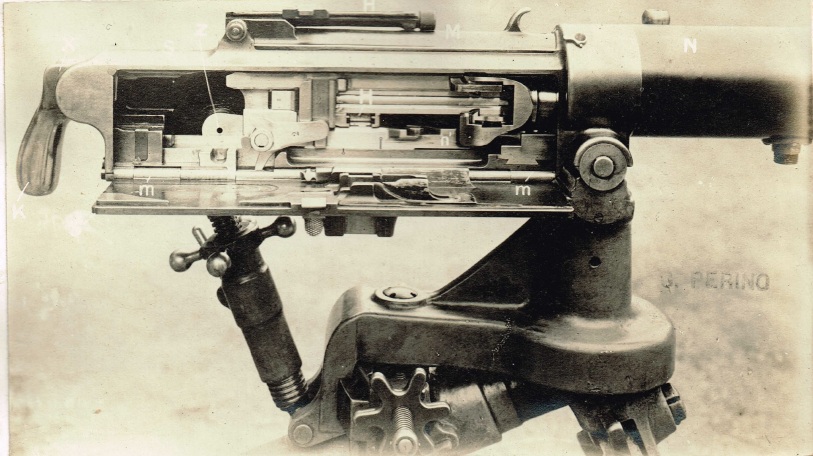
The Perino is a gun that really should have been adopted, but wasn’t. Its development began in 1901 when Giuseppe Perino (an Italian Army officer) patented the design for a recoil-operated machine gun with a novel twist. The Perino gun fed from 20-round feed strips (like a Hotchkiss), but instead of ejecting empty cases out of the gun, it replaced them in the feed strip as it was fed through the action (this concept would reappear a few decades later in the M37 Breda machine gun). When all 20 rounds were fired, the feed strip fell out the right side of the gun filled with all the empty cases. The idea behind this feature was to prevent spent casings from hitting troops and getting underfoot.
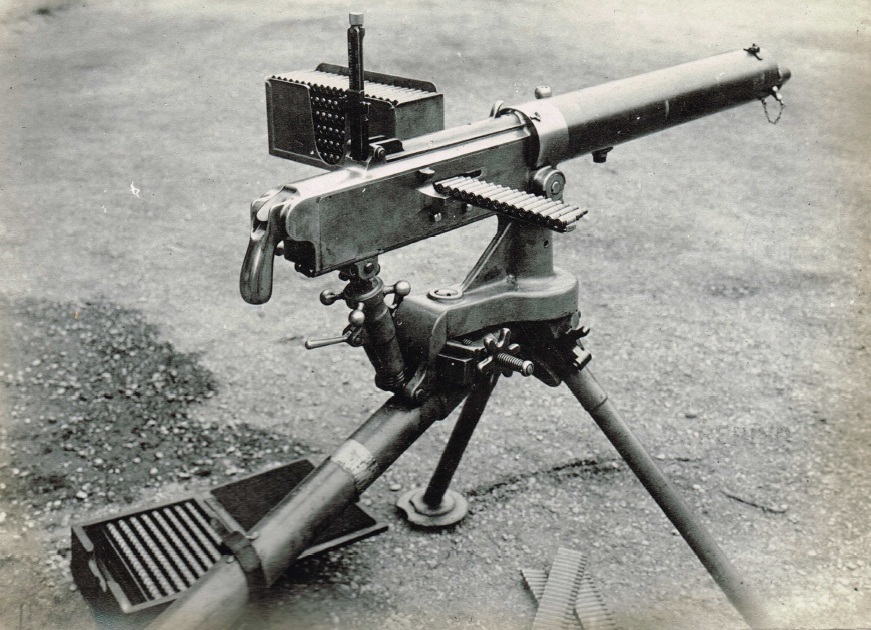
The Perino could mount a box on the left side of the receiver which held 5 loaded feed strips, pulling the bottom one in to use when firing. This made it simple for the assistant gunner to keep the weapon topped off by simply adding loaded strips to the top of the ammo box as the gun was firing. Between this and its water jacket to keep the barrel cool, the Perino theoretically could fire more continuously than any other gun available in its day (even a long ammo belt must be changed sooner or later in a Maxim).
Unfortunately for Perino, his gun was deemed Top Secret by the Italian government, to prevent its perceived advantages from being copied. The government slowly tested and developed the gun, including a successful trial against the Maxim in 1908. However, because of its secrecy it never participated in large-scale open trials and was thus never really perfected. When WWI broke out in 1914, the Perino lost out to the Fiat-Revelli machine gun, because Fiat was willing and able to put their gun into mass production immediately. A pity for the Italian soldiers who would have to use it, because I think the Perino would have been a significantly better weapon.
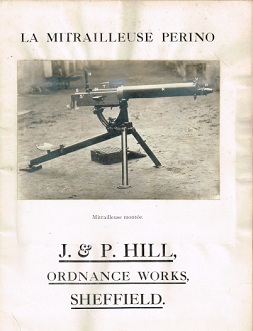
We have an original manual for the Perino in both English and French, which is an interesting read – the designers certainly thought highly of it!
I think the statement that Perino MG was deemed “secret” somehow contradicts with the fact that it was tested abroad in several countries, such as Switzerland
I wasn’t able to find much info on it beyond the manual itself – the secrecy contention came from an article on the Fiat-Revelli by Robert Segel. If you (or anyone else) have a more accurate history of the gun, I will certainly revise what I have.
Book on Swiss machine guns (“Bewaffnung und Ausrustung der Schweizer Armee seit 1817. Automatwaffen II” by Reinhart & Rhyn) has a photo of the Perino MG that was tested in Switzerland prior to WW1, about 1910, IIRC
I also have to question whether it was “top secret”. The brochure (I wouldn’t call it a manual) has “J&P Hill, Ordnance Works, Sheffield” rather prominently on the front of it. J&P Hill would have been a foreign sales agent for Perino.
The introduction also states “this gun will soon be adopted by other Governments, who have taken it into consideration, and made it the object of special study”. It further states “the Committee appointed by the Parliament to investigate matters at the War Office…”. Given the context of that statement, I would assume they mean the British War Office (as opposed to the Italian equivalent).
In other words, they seem to have been actively marketing it to everyone. There is no date on the brochure, but while it’s possible that this was a post-war sales effort, I doubt it. They state “it has been adopted by the Italian Government, and a set of 200 is not being made in the R. Arsenals”. The “set of 200” sounds like the pre-war evaluation batch referred to in the article, so I strongly suspect the brochure is pre-war.
From what little I have been able to gather about J&P Hill, they were a small non-ferrous metals manufacturer (I can only find vague reference to them as a brass button manufacturer). The translation work in the brochure is rather poor, so they don’t seem to have invested a lot of money into marketing materials.
There is an error in one of the quotes that I made above. It should be “a set of 200 is now being made”,
I have attached a link to the patent for this gun, filed in Great Britain in 1912. It was filed in other countries as well. It includes the feed mechanism and so on.
Hopefully this works better…
1901 Patent
http://worldwide.espacenet.com/publicationDetails/originalDocument?CC=US&NR=682230A&KC=A&FT=D&ND=3&date=19010910&DB=EPODOC&locale=en_EP
1913 Patent
http://worldwide.espacenet.com/publicationDetails/originalDocument?FT=D&date=19130814&DB=EPODOC&locale=en_EP&CC=GB&NR=191211475A&KC=A&ND=4
The later weapon seems a bit less complicated.
IIRC, Chinn referred to the secrecy, and this (like a lot of Chinn’s work) was plagiarised by Smith.
The ammunition box on the weapon in the photograph appears to contain six feed strips rather than five. Any ideas why?
According to Wikipedia, the weapon was adopted and used, just not on as large a scale as the FIAT Revelli. The main issue preventing the Perino from being more widely adopted was its weight. The Perino Modello 1908 seems to have been used mainly in fortifications where its weight mattered less. The English article has scant information beyond this, but the Italian Wikipedia page has more. Apparently, a lighter Modello 1910 was developed that had some reliability issues in its initial forms. A 1911 commission recommended dropping further development.
https://it.wikipedia.org/wiki/Perino_Mod._1908
I noticed the different number of strips as well, and also that the strips are less than 20 rounds in some pictures. It appears that a variety of magazine and strip configurations were tried and simply not mentioned in the manual.
A number of sources suggest the strips had 25 rounds.
Obviously the secrecy the Italian Govt set around the gun worked; nobody has any idea about it’s particulars!! Which is quite amusing since they did buy it and commented on its (relative) effectiveness a few times on official papers (I spotted a comment on Vol 1 of “L’Esercito Italiano nella Grande Guerra” recently). Plus the KuK captured some to boot.
My suspicion is the secrecy was over the earlier (heavier) gun. They then developed a lighter form which didn’t pan out and tried to hock it to whoever would take it.
Sorry for this seriously) delayed post; I only got the buzz recently.
Your style is so unique compared to other people I have read stuff from.
Thanks for posting when you have the opportunity, Guess I’ll just book mark this web site.
While researching this I found a YouTube video that helped me to understand the mechanism of the gun when firing and dissembling it.
https://youtu.be/X0mBbDTPfFo
For anyone confused by the manual’s description, this video is worth watching, as the function as written in the manual is a bit hard to understand. But, then again of course, there wasn’t internet in 1908 so I can’t blame them for it being somewhat confusing.
Though I find it extremely interesting how it functions compared to other machine guns of the time (it uses both recoil or blowback force and also gas operation force), and if the 1908 pattern wasn’t a hefty 66 pounds, it would appear as very practical.