
After World War II, the Austrian military used a mixture of Browning High Power and Walther P38 pistols – they were effective and available in large numbers so why not? However, by the early 1970s it had been decided to replace them with a new standard pistol. To fulfill the military requirements, Steyr (a preeminent Austrian firearms and heavy equipment manufacturer) designs the GB pistol.

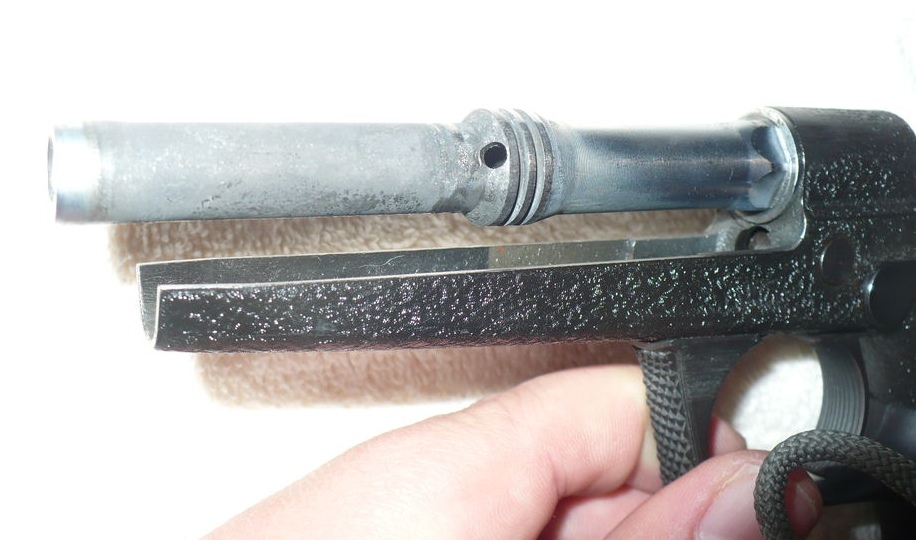
Steyr’s design was quite a good one, offering both light recoil and better than average accuracy. It did this by utilizing a gas delayed blowback system virtually identical to the last ditch German Volkssturm Gustloffwerke (VG1-5) rifle. Basically, the front half of the slide acts as a gas piston, and ports in the barrel allow gas into that piston while the bullet is still in the barrel, thus slowing down rearward movement of the slide. In the photo below, you can see the gas sealing rings machined into the barrel, to prevent that gas from venting down around the recoil spring. The piston sleeve rotates to unlock from the slide for disassembly.
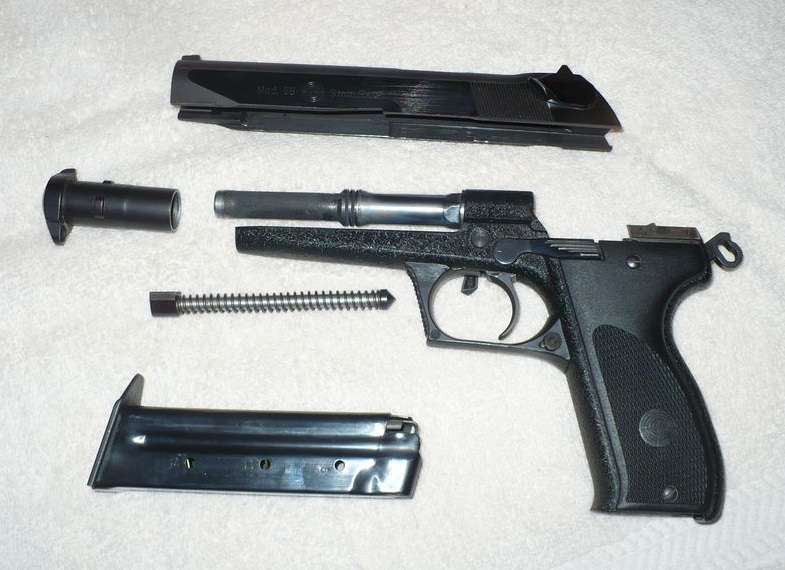
The fixed barrel necessary for this type of gas delayed action has the happy side effect of allowing very good accuracy. In most service handguns the barrel moves on firing as do the sights (being mounted on the slide), requiring two major parts to realign precisely for accurate fire. In the Steyr, only the sights move – not as good an arrangement as one where the sights are fixed to the barrel, but better than the norm. The gas delay system also slows down the recoil energy transmitted to the shooter. In conjunction with the mass of the gun (approximately 2 lb – it’s a full-size steel-framed pistol) this provides a pleasant soft-shooting feel. Italso came standard with an 18-round magazine capacity, which is large even by today’s standards.
Steyr expected the GB to be a shoo-in for the Austrian military contract, as it was well understood that a domestic Austrian design would receive preferential consideration. However, a no-name bayonet supplier named Gaston Glock appeared out of nowhere and won the military trials with his polymer-framed G17. Steyr certainly hadn’t expected that, and they proceeded to enter the GB in the 1983 US military pistol trials – where it lost out to the Beretta 92 despite many good qualities. Steyr’s management must have found all this rather unbelievable (losing to a fellow Austrian is one thing, but Austria being beaten by the Italians?) and fell back to marketing the gun to police and civilian buyers. Sales trickled in slowly, but it never gained a major official departmental sale and by 1988 they threw in the towel and stopped manufacturing the guns.
As an aside, we should note the stereotypical Germanic flair for creative naming – the “GB” stands for “gas bremse”, which translates into simply “gas braked”. Kind of like Steyr’s previous service pistol design, the 1912 Steyr-Hahn or “hammer”. In recognition of, well, the fact that it used an external hammer.
Photos
Photos kindly provided by reader Chris B – thanks, Chris!
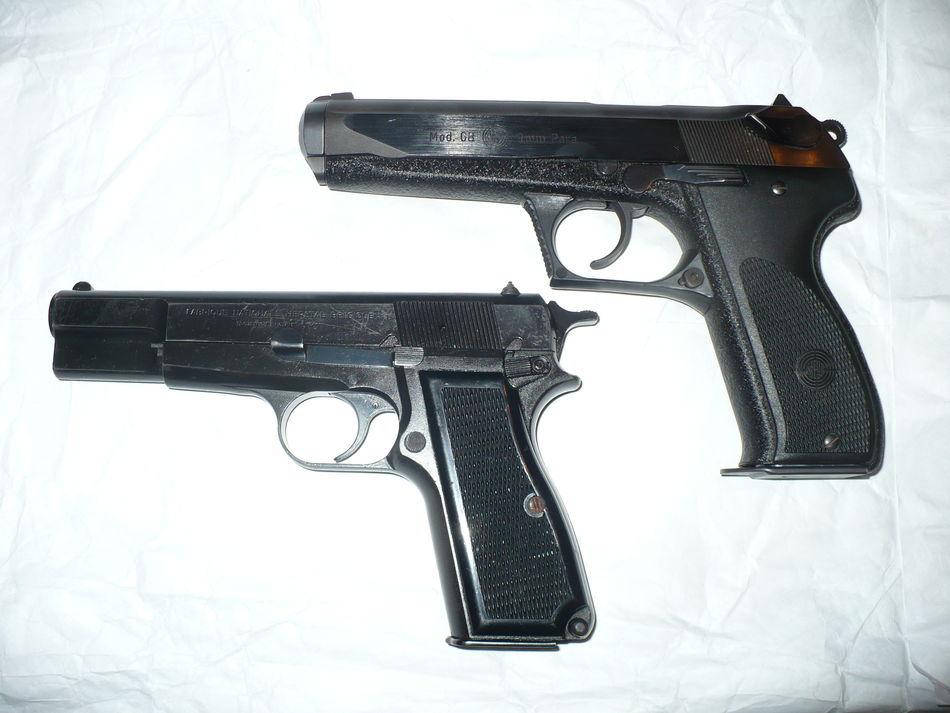
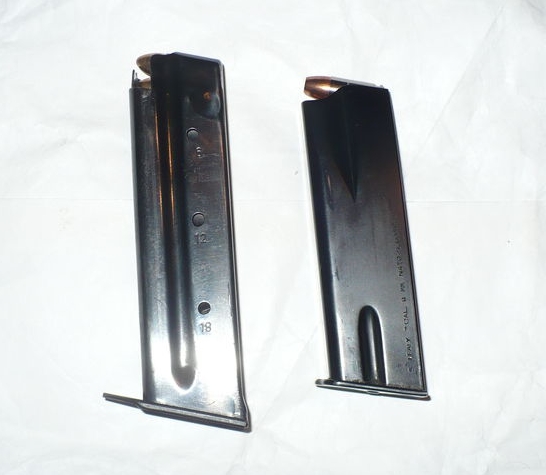
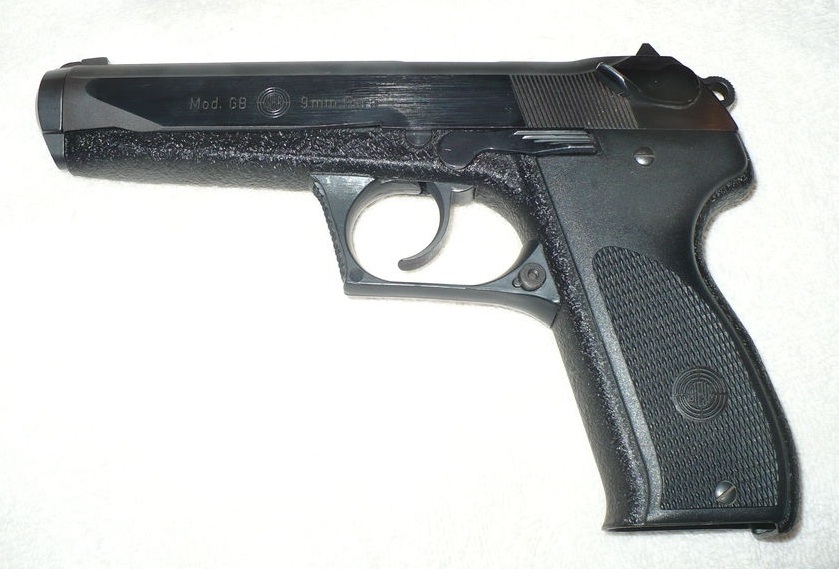
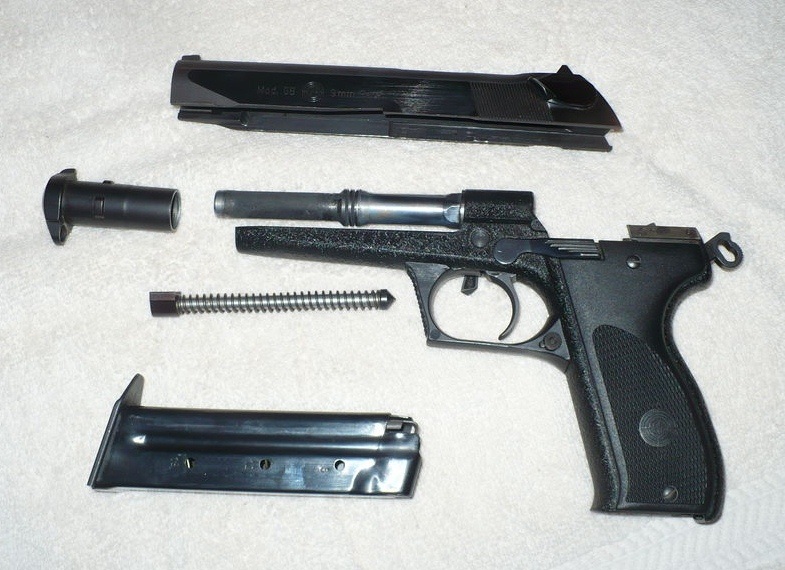
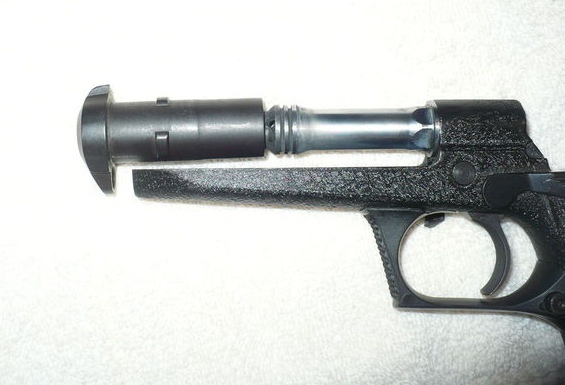
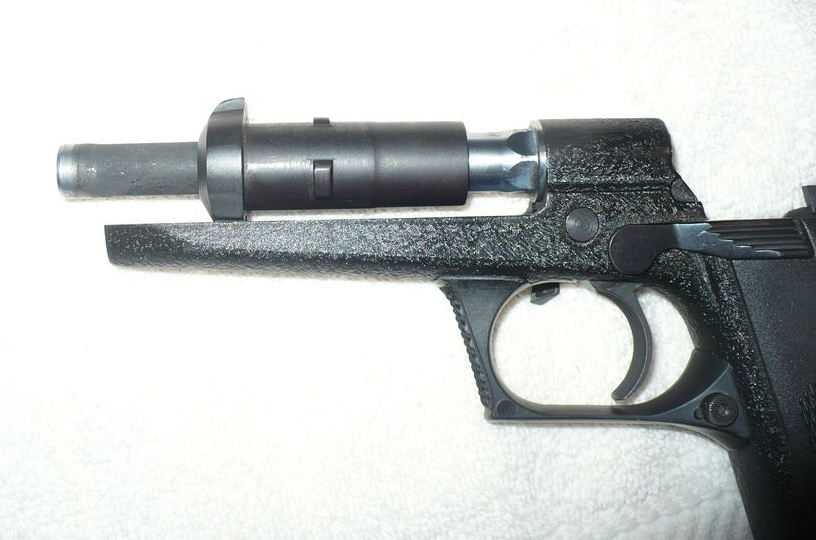
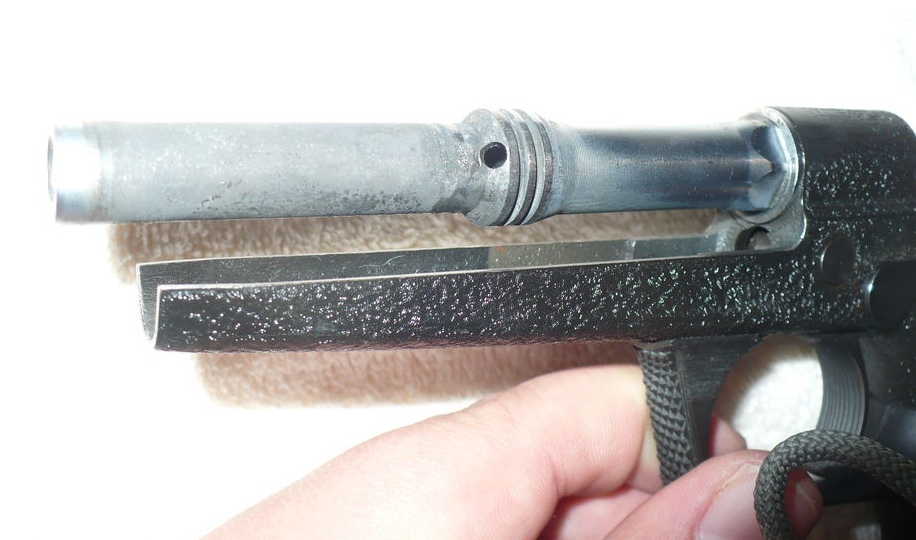
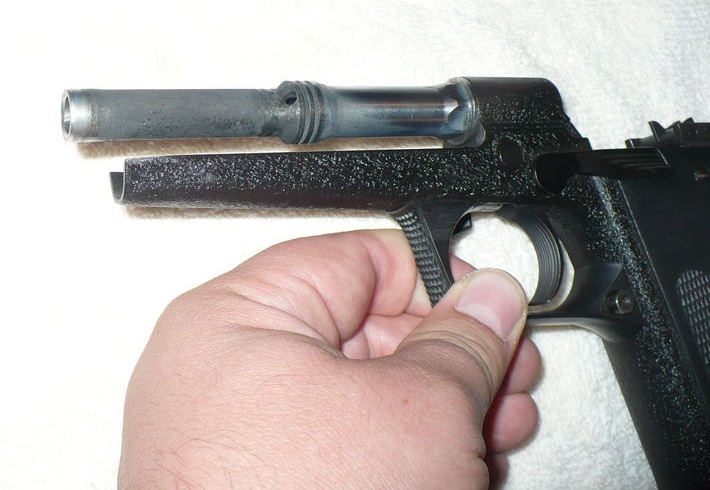
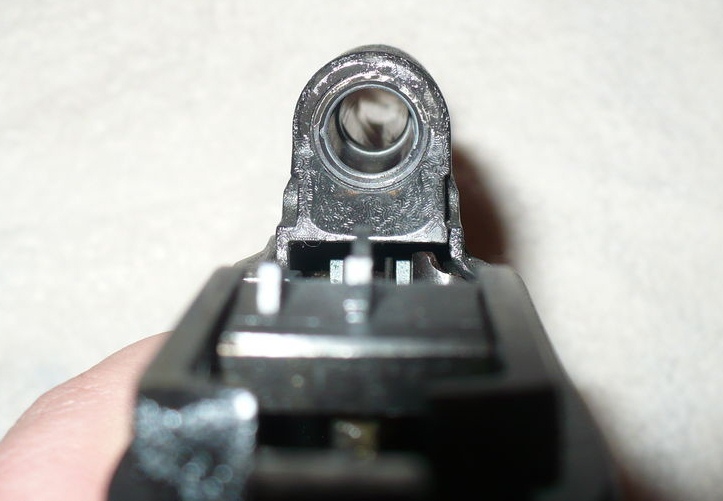
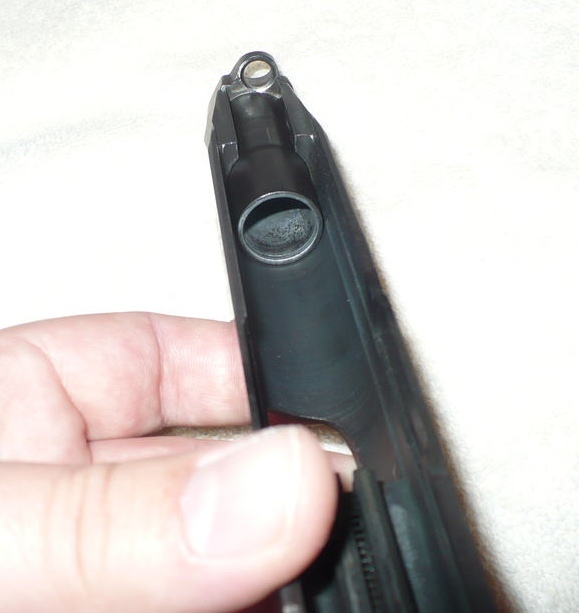
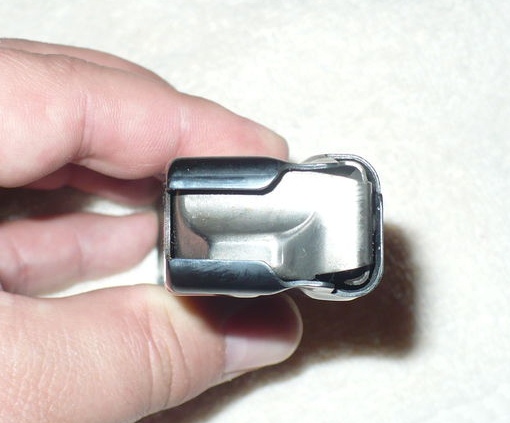
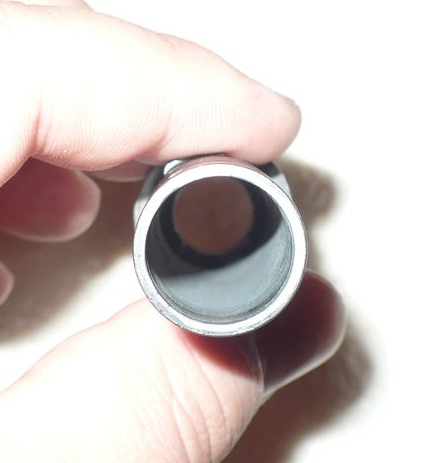
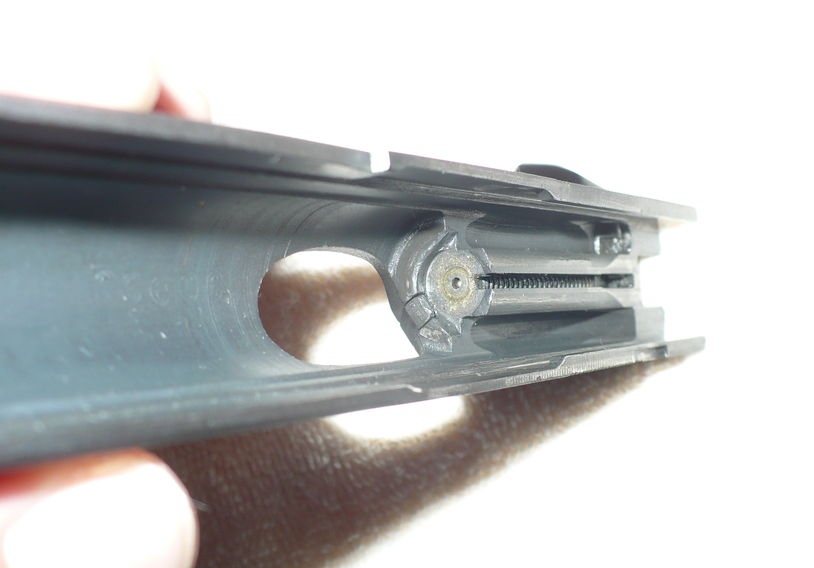
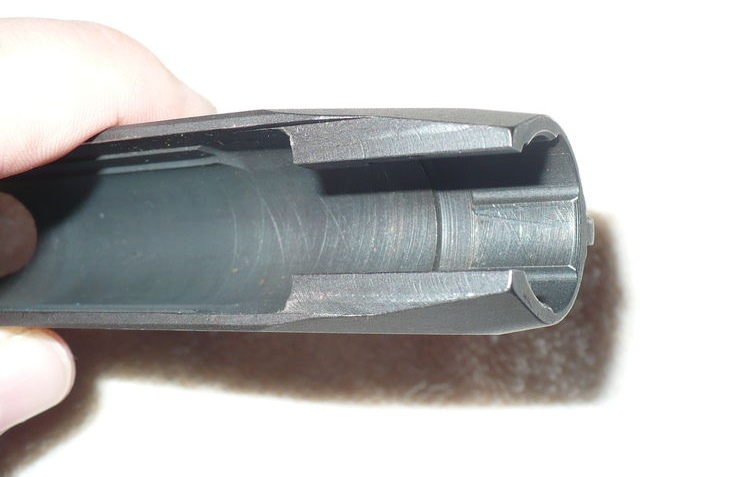
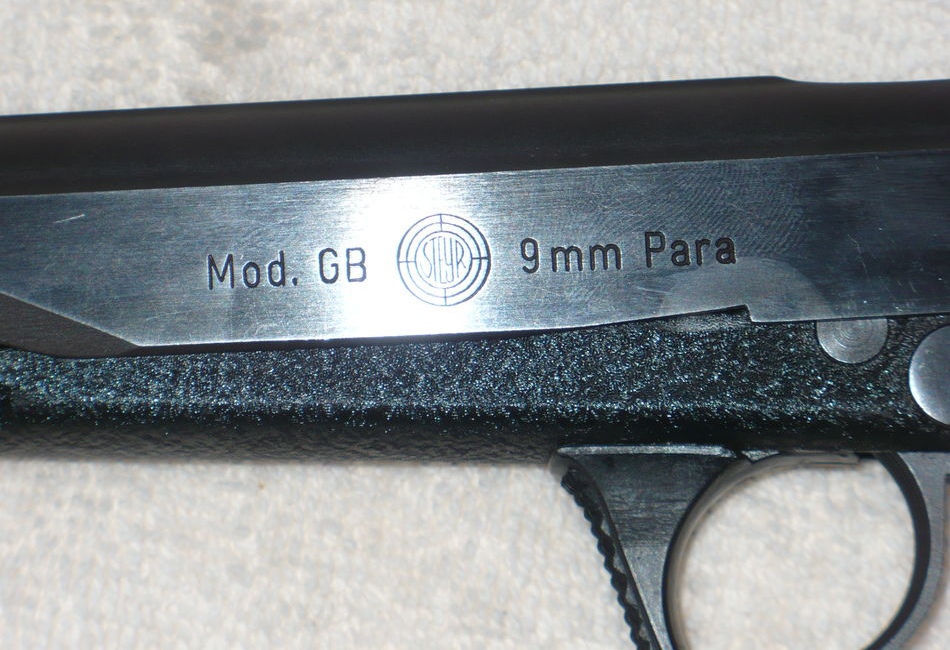
There was a offshoot of the same design marketed in the U.S. in the late ’70s(?) called the Rogak.
It was to put it diplomatically, less than enthusiastically received. “Soldier of Fortune” magazine reviewed it and were not exactly fulsome in their praise of its functioning and reliability. Included in the review was a series of photos of it being fired… or rather ATTEMPTING to be fired. The last photograph depicted the tester throwing the Rogak downrange like a boomerang…
How does the springs and hammer go back together please…..please help me
Hang tight. I should have one with the manual, cleaning kit, & box, in hand within a couple of weeks, tops. (I hope). I was stunned I won it. It was a Colorado auction, and it is illegal to transfer the GB in Colorado due to their Californication by liberals, and a 15 round magazine limit. I live in Arizona, where if you can lift a 1000 round magazine, you can use it.
One spring goes on the transverse hammer mounting pin on either side of the hammer strut. One tang catches on the cross on the hammer strut the other tang catches under the lip on the sear. How you compress them? WITH EXTREME DIFFICULTY! There has to be a special tool for doing it, and Steyr probably threw it away 12 years ago. I think you can probably fashion some sort of tool with some bar stock, a Dremel a file, and a grinding wheel. The spring tabs that catch on the sear wrap across the top of the spring coil and catch on the lip under the sear on the outside next to the frame, on either side (right and left). THIS TELLS ME THERE ARE TWO SPRINGS, A RIGHT SPRING, AND A LEFT SPRING! The tab that catches on the cross on the hammer also comes across the top of the coil wrap of the spring. The diagram in the manual does NOT show the cross tabs on the hammer strut. It shows a barrel that the springs set on. There should be two square nubs the tabs of each spring catch on on the hammer strut, about halfway between the mounting hole and the striking part of hammer itself. GOOD LUCK! It looks like it “might” be possible to mount everything then press the hammer ends of the springs down and hook them onto that cross piece, one at a time. After that, your gun should be ready to go again. AGAIN BEST OF LUCK. IF I GET ANY BETTER IDEAS, I’LL POST THEM! I am not taking apart a brand new Steyr GB. I put the first rounds down mine since the test rounds that were fired, back in 1984.
I bought a GB new just before they were discontinued in the late 80’s. I like it because it fits my hand better than any high cap semiauto I have held. It is a big gun for a nine, but that makes it a comfortable shooter. Mine has been very reliable and accurate, given this is a military piece and not a competition pistol. I would like to have another mag for it, but that seems like a dream, given all of the above.
I have one but I need to buy x clips where can I get some
Right now the only source I know of is Gunbroker, they start around $150 each and go up! The Steyr owners group has a few GB folks on it, occasionally some parts and magazines show up in their marketplace. And the only hope of new made ones is a company in Germany, I’m thinking GSG? is making a new version of it with a conventional style thumb safety and a Picatinny accessory rail. I had a talk with the potential US importer of these a few years ago and he stated the magazines are the same. Never heard back from him after that and never seen the guns or mags advertised yet. Here’s a pic of one with the weird suppressor that attaches via the rail:
https://imgur.com/gallery/KmyHJ16
I owned both the Rogak P-18 which was a fully machined frame in stainless steel and the Steyr GB just like the one pictured in this review back in the late 1970’s when the Rogak came out. They were both pigs; unreliable and poor accuracy despite the theory behind the fixed barrel and gas delayed blowback system, not to mention that they are both huge and heavy. I ditched both of them and stayed with the Browning High Power which I already had. The BHP worked much more reliably and was much more accurate even with it’s more moving parts. A few years later I got a second BHP; had it customized by the late, great Austin Behlert and own it to this day. It never fails to operate and is one of the most accurate pistols I have ever owned.
[IMG]http://i5.photobucket.com/albums/y161/vjbknife/firearms/DSC01946.jpg[/IMG]
Bring your browning any day against my Steyr gb. I shoot dimes size holes with it and i own 3 of them . The rogak is a pig but the gb is a work of art. They are not even close to using the same firing mechanism. Im a big browning fan but that weapon will not compete at least in terms of accuracy and recoil. Ps never in 20 years have i had a failure to feed or fire.
Hello All, I own a Steyr GB that I purchased used about 7 years ago, and I shoot a lot. Up front: it is a workhorse! with great precision and it has NEVER failed me. 9x19mm is a great caliber; I shot different brands, grains and bullet types, and it never gave me problems. No jams! I love the long barrel with polygonal rifling that brings out the best accuracy / bullet-speed-ratio over any regular rifling pistol barrel. The barrel is fixed to frame which also helps improve accuracy. The grips fit my hand perfectly and the “old” 18 rd mags are awesome (I do wish someone made more of these, and lower their price too). The trigger pull is good, with a small nip after let off (an over travel stop screw or a trigger shoe with such can solve that). The trigger could use the touch of a gunsmith if fired from the double action. The decocker is very well located and has a correct amount of spring pressure. The factory sights are fixed and practically large (I did see a picture of somebody’s GB with a custom adjustable rear sight). Better than other guns, I like the gas delayed blow back system; just try to avoid high residue ammo. Yes, the Steyr GB is a large buffed pistol, but it can still be concealed if you know what you are doing. The massive size of this pistol can turn it into a blunt weapon; if you need more than one mag it will be a bad day for you, but if you go through your spare mags and business isn’t yet finished, you will be having a terrible day. So, though not excesivelly heavy, since the size of the GB makes it an intimidating and persuading handgun, you can also use this gun like Thor’s war hammer to crush an oponent.
Hi All. Let me start with saying I own many firearm as In some gun shops have fewer hand guns. That said I only own One 9MM and that’s a Steyr GB. I honestly believe if Glocks had not been deveoloped we would all be using these. I like my guns made out of steel or alloy and big calibers so a 9MM as they are made today would not have be my first choice. Till I picked up a GB. For my big hands it fill them well and the GB has digested every round I have put through it with no malfuctions and it shoots straighter than I can.
The finish had to go though, so mine is finished in guncoat titanium and grey. Two tone guns are cool.
A 115gr jhp with 4.2 of reddot works very well as a reload And having 18rds. on the firing line make for some truely ragged targets. They can be found though the mags are scarey expensive 225.00. If you find one for sale. Find a GB with two mags for sale and sell one mag and that gets you a GB cheap. With 18rd.s do you really need another mag anyway?
I found one with a factory compensator. Talk about overkill. It’s only a 9mm, and a heavy soft shooting one at that. It also has the stock bushing too. You just replace the bushing with the compensator. Swapping them takes 10 seconds.
Take a spare mag, and if you need to pull the GB, you can lay some rapid fire and put the rage of God down range…
I have had it on my wish list for years , and finally got one with 3 mags.
Unconventional guns exert a particular attraction on me.
Not disappointed at all , love the system , it is brilliant because of its simplicity.
Oh Lord ! WHY didn’t they make it in 45ACP ? that would have been the ideal pistol.
The only but could be a better trigger , It’s a little scary to tinker with it because no replacement parts seem to be available if I goof.
I still have to experiment with different loads to see if the system will compensate by “locking” proportionally to how hot or mild the load can be .
I’ve got one that I traded a spare-parts AR for, and it works like a champ! I wish I had more than one mag for it, though. I saw one for sale a few years ago with three mags that was less than the three mags would have sold for separately, but I didn’t have the money for it!
It’s a truly brilliant design. If you get one that works, you see how good the engineering truly is. Fewer parts than any gun that I know of, except perhaps the Makarov (which has fewer parts than a Glock, as I recall). This is truly difficult to do. Glock has 35 parts.
The Makarov has 27. I can’t find an exact count, but I think the GB has around 30-40 parts. While this gun must have been very difficult to produce on small scale, it would have be been extremely cheap on a large scale had it been adopted.
Matt, I am looking for the plastic handgrips on either side of gun….my GB, the grips deteriorated around the holes securing them to the weapon…
do you know where i can find 2 x plastic grips?
I would find someone to either carve ,me some from hardwood or 3D print some from plastic. It will be cheaper than buying Steyr replacement grips. I know a couple of guys that carve nice hardwood grips but they will need the gun to fit them. I can probably do it too, but I will need to find my router base for the Dremel. At least I have a GB so I can use it to do the fitting.
I have owned my GB since early 80s. Now I have shot it so much I have only one mag left if anyone would like to send me the address, name , phone number to anyone that sells mags for it. Please send it to me at the info provided below. Thank you so much
Keep your eyes open! I got I think it was 4 GB magazines at an auction in Colorado, for $200 and two CZ tactical sport mags came with the lot. Right now you can get two GB mags on Gunbroker for $80 or $90 each, which is a fair price as they were fetching $250 each, and I mean selling not just sitting with that $250 price on them.
unfortunately those cheap magazines are triple k brand, people on the steyr forum have complained of counterfeit magazines that don’t work too well. I suspect these are them.
Guys, has anyone actually seen the rifling pattern of a Rogak P-18 pistol? I heard that it used a sort of polygonal rifling, which supposedly gave it a big boost in muzzle velocity, but I’ve never actually been able to see it. I looked all over the internet but I couldn’t find a single, clear image of what the rifling looks like. Can someone send me a photo or something? Thank you in advance.
WHEN I WAS A DIRTY STREET COP FOR SAN DIEGO CITY. I CARRIED THE GB OFF DUTY, ALONG WITH TWO EXTRA MAGS. I KEPT THE GB , WHEN I LEFT SDPD AND JOIN THE CHP. IT WAS A GREAT OFF DUTY SECURITY WEAPON. WHEN THE CHP WAS ISSUED S&W 40, I CARRIED 78 ROUNDS, BECAUSE I WORKED SR-78 IN SAN DIEGO COUNTY ON A MOTOR. BEFORE THAT I WORKED THE I-605 BUT OF COURSE I WAS A CAR COP THEN.
Have had a GB since ’84 and absolutely love it, and agree with most of the comments above.
It’s not blocky at all; I find it to be superbly light and well-balanced. It’s far and away the best of the hi-cap 9’s; only the CZs come close for ergonomic sweetness. The grip is large as would be expected from an 18+1 design but the gun points very well and sights are easy to pick up.
To Chris Morton: There’s a lot of confusion about the Rogak, that UPOS gave the GB a bad rep even before it came out. The LES Rogak P-18 looked like a GB but it wasn’t one. It actually was a cheaply made knock-off of an earlier version of the GB design that had been stolen from Steyr. I remember reading about it when that was discovered.
The Rogaks did truly suck and I recall that photo where the reviewer threw it away; he called the Rogak the Jam-a-matic.
But that’s not the Steyr GB by a long shot. What an outstanding gun the GB is. I always describe mine to others as the only auto I ever owned or fired that never failed or jammed, not once in thousands of rounds. Hot lead-bullet hand loads will dirty it up (a lot!!) but that dirt doesn’t keep it from shooting them just fine! It will digest any weight bullet and even shoots light target loads with the same reliability as full-house factory ammo.
It’s much more accurate than I can shoot, although as was mentioned the trigger is a mass-produced combat trigger and lacks refinement. If I ever play around with trying to tune it, I’ll make new parts rather than screw up the originals as parts are NOT available. Fortunately they are not too complex, as somebody said above this would have been cheap to produce in large quantity.
Shooting qualities of the GB vs Beretta 92? The Beretta doesn’t even come close.
I don’t intend to ever part with mine. I only wish it was common enough that you could get accessories.
Since the patents have long expired, I thought for a long time about going into business producing variants of this gun in .38 Super, .40 or .45. I think that now that the bad old Rogak stuff has long since gone downstream, this gun could enjoy a real renaissance – the design is that good.
Did you ever get the licensing to manufacture the gun. I wish some would because I can not find parts, or clips for mine.
Mine is in pristine condition. I carry it, and only load ten rounds. I think the way I shoot ten is ok. I keep it well cleaned an oiled. I like your write up. You do the GB justice.
Fred Norton
Me. Savino thank you for a job well done . I have owned my GB since the early 80’s and can attest to fact it is the most reliable 9 mm I have. I have played
/shot so much I am now looking for mags. By the way I can place an E-Type silhouette at 20-25 meters flat on the ground take my GB and stand the target up. I shoot 2-3 times a Month , that’s why I need mags for my partner. Any information given for me getting resupplied on mags would be great appreciated. Thank you so much
Hi guys,
I am from Germany and I want to buy a Steyr GB.
I was talking to Hannes Kepplinger, the developer of the GB, he is starting to build her again in association with ssd.
Here is the link to the manufacturer:
http://www.ssd-weapon.com/p-18-140mm.html
Have fun!
Lots of people commenting who have never owned or shot a GB.
I bought my GB new in 1986 (with a supply of spare magazines). In the years since I have shot everything from cast lead gun show reloads to +P+ factory ammunition, at best guess around 3000 rounds. Not once has the GB failed or jammed, it is the absolute ‘bet your life on it’ handgun.
To answer some questions: Yes, the GB has a special kind of rifling, oval grooves milled into the barrel (which is hard chrome plated). The gun hates lead ammo for accuracy, I don’t think lead bites the rifling very well. With jacketed ammunition its accuracy is exceptional. The reduced friction from this rifling and longer than normal barrel is supposed to yield a significant velocity increase over conventional handguns. That is based upon an article I read years ago, not personal chrono experience.
The trigger is good, as is the fit in the hand. The grip of a GB is wider at the web of the hand than most handguns, you need to make certain it rests there instead of against the inside of the thumb to comfortably shoot it. I would not recommend it for anyone with small hands.
Sights are single white dot front, dual white dot read. Long ago the dots were luminous, but that was lost to aging years ago.
When disassembling this handgun for cleaning, and seeing how simple the design is, you gotta wonder why every other design needs so many more parts.
If you ever have a chance to pick up a GB jump on it, it was the first and still the best of the wonder-nines.
How you doing, read your comment, and I truly agree with everything you mentioned, but further more, I’am in search of a gb magizine, anyway you can help me, willing to buy at any price. Thanks and have a nice day, if interested in selling a magizine, please inform me, at this number(via text or call) doesn’t matter. (215) 910-3098
I have owned my GB since it was new in 1984. It shoots better than I and with 3 mags should handle any day I throw at it or throw down with it. OK bluster aside, the only failures it had was from the first gun show reloads I got. The primers did not go off even though they were struck hard enough to put a pin mark in them and restriking them would eventually fire them. Never experienced that again. Gun was fine. I really do love this thing. The main issue I have is to clean the gun. Are there special tools or solvents or methods I am unaware of? One thing I tried a few times with was an application of mold release wax (used for getting fiberglass models to release from the mold) on the areas that get most dirty. I think it helped. It was not magically good.
Karl
When these guns were sold originally, they came with a cleaning kit that included a bore brush and a barrel brush. the barrel is a pain in the butt, it gets so fouled, and they all “stain” towards the muzzle after a while. A couple of times I used a wrench and took out the barrel from the frame and really worked it outside , using the barrel brush ( it was not a brass or copper type bristle…seemed like steel) this way you can get under the barrel for once. It went back just fine. I never ever used Hoppes on this , as that ancient formula seems to foul it . I used simple break free for good results.
I have owned my GB since early 80s. Now I have shot it so much I have only one mag left if anyone would like to send me the address, name , phone number to anyone that sells mags for it. Please send it to me at the info provided below. Thank you so much
Stop writing the same thing over and over again.
To the person who wrote about the rifling I was unfortunate to have the pleasure of owning one. The rifling was truly unique as it was invisible. My example had NONE NADA NIX no bs it was a true smooth bore. I am a machinist and know what polygon rifling looks like and this barrel looked like DOM tubing. This pistol also had an invisible extractor as in none. This was one of the “Wonder Nines” and it if made it through an entire magazine of 18rd without jamming it would have been a real miracle.
Willie, obviously you got a “hybrid”, as in a dead barrel and pistol missing parts, or a knockoff that someone cheated you with. It couldn’t possibly have been a true GB and being a machinist you should have known that.
I have a Steyr Model GB with 3 Magazines AND a Compensator that I’m planning on selling. Excellent condition, one owner, only had about 300 rounds through it. Anyone have any idea what it might be worth?
the compensator? no idea how that fits in. I sold my GB, unfortunately, in 2011 after having it since 1985. first and only owner. it was in very good condition, likely 1000 rounds through it. I also gave them 3 mags. I got $200.00 for it. they were figuring on selling it in the store for $300 or so. Eventually they sold it , but apparently it took awhile. I don’t know how much it went for.
Hated getting rid of it. too big to carry, really. And it was illegal in my state ( nj)
and I was afraid do to no parts available, what would happen if it broke? A clever and skilled armorer MIGHT be able to fix it, depending on what went wrong. Seemed like the time. still miss it, though. I posted a write up on it today besides this note.
Good luck. I’d be curious on the end result of this for you.
Are you still selling your GB? I have 3 GBs and would like to buy the compensator and 2 magazines!
Tony,
Sorry, not interested in selling the mags and Compemsator separately, but you are welcome to make me an offer for the entire package 😉
Have lots of photos for the GB, mags and compensator
Do you still have the GB? I’d be interested.
Jim, yes I’ve still got the GB, mags, Compemsator, and holster – still for sale.
Are the mags and comp still for sale? 636-296-6380 serious inquiry.
While in florida serving in the USAF back in 1985, I had the choice of buying from a guy a sig sauer p226 and a Steyr GB. After firing both, I chose the GB. The sig was awesome, but the GB had a wow factor in design and was insanely accurate. I had the thing till 2011. My model was the ” military” version: green(ish) parkerized rounded hammer. ” civilian” version had a normal hammer and were black with a crinkle kinda finish. I had three mags, too, which I bought thinking ahead. I carried it for a year on a tactical team, after getting an LE job in 1988. I never had a malfunction, but mostly only shot full jackets. I carried hollows in it for duty, only shooting about 50 rounds of these over the years , just to do it. whenever gun guys would see it, it brought a reaction, like ” what the hell is that, cool.” whenever someone shot it, they loved it…low recoil and the spooky accuracy. over the years there was Steve and his Steyr, like Cupid with his arrows. The only thing that I didn’t like was that the parkerization did not hold up well.
In 2011 I retired from my LE job and living in NJ. There the gun was illegal to own, so no longer a cop ( while I had dept. duty guns, I usually qualified with the GB just for the heck of it, but rarely carried it after 1995)I panicked and sold it to a gun shop across the river in PA. I had planned on leaving this unique gun to my son. Oh well. IF you get a chance to get one, or just shoot it…youll enjoy it! an interesting machine for sure.
Yes, these things may have horid triggers but damn they are crazy stupid accurate. When I took mine shooting up in Chaffee County Colorado the locals would see my out of state Arizona license plate and start giving me dirty looks, and I get it, I am NOT paying taxes there, so I’d pull out the Steyr and shoot the staples or thumb tacks off my paper target, walk over, pick it up off the ground gather up all my stuff and go look for another place to shoot in the shooting range. I had a chance to buy a GB with a compensator and kick myself for not buying it. I figure mine has appreciated in value by about 65% now. My Beretta 86FS has appreciated in value by over 200%! That is beautiful gun, uniuque and they were only imported for about 2 years as far as I know. The only other gun that has appreciated in value ahead of inflation (JUST BARELY) is a Colt Police Positive MKV that I actually kind of hate. Colt found left over high carbon steel 1980s Detective Special/Diamondback frames and with their SF already on the market they put 4 inch barrels on them, but the finish work is pure trash. Lots of machining marks, not serrating or striating on the top strap or sights for glare reduction. Rubbish workmanship!
I have owned the gb since 1986 and love this thing have owned lots including a gold cup colt 45 and nothing shoots better . I have small hands and with a proper two hand grip has never been a problem. I too have shot everything through it including both hot and target hand loads including flat point hardened lead/alloy bullets with a special anti friction coating, fires fine just needing frequent cleaning to prevent lead impeading the slide. The only thing I have ever been a little leary about is that it has no traditional safety.
You know, I think the GB or right about the time the GB was introduced, it was figured out that for a combat sidearm, the only safety really required is the trigger. Pull it, and it goes off. Drop it, hammer it, whatever, and it will not. Works fine! Love the hammer drop, too.
Karl in San Jose (oops can I say I own an 18 shot mag? Yes)
I’ll buy your gb for 350$
I have a GB I purchased new in 84. It’s like new, had about 50 rounds if that through it.
Spent most of it’s life under lock and key because of kids in the house.
Still have the box, original documentation and 2 mags.
I’ll take $1,200 for it.
Send me pics on your Steyr Gb. I’m interested.
I just saw you response, If you’re still interested I’ll photo and sen you pics.
Brian
Selling STEYR MODEL GB, CUSTOM SAFARILAND HOLSTER, THREE (3) FACTORY HIGH CAPACITY (18 ROUND) MAGAZINES, and best of all — an extremely rare and likely impossible to find COMPENSATOR! All are in great condition. Less than 300 rounds fired through the gun.
Selling for $1,500!
This is a great price as the 18 rounds magazines along sell for over $225. each! So with three mags, that’s already a $675 value… The compensator is so rare I can’t find one currently for sale, but it is easily worth over $400.
I have lots of photos to share. Email me at sellingstuff201572@yahoo.com for more info.
Ever since I 1st saw one of these at a gun show in late 80’s I have been a fan.
My dad was a gun trader and he thought I was nuts paying $700 for one in
box with 3 mags on 1st examination. Guns are just guns and never really moved
me growing up around them. But the Steyr GB stood out as exceptional and I bought
It on a rare impulse. I knew enough that it had all the right features and was ahead
Of its time. 18 rnds, double action, solid serious gun. It is beautiful for a gun
of its raw power and makes Glocks look like toys! Simple to break down and low
parts count make it a possible candidate for my ultimate pistol.
How about a GB 10mm, can you imagine that one! Unbeatable combo and I have
spent many an evening thinking of how I could pull it off? Well I still have that 1st
GB and 2 more. I have owned every 10mm made except a few which seem to expensive
now to play with. Ok I admit Glock 20 but for the 10mm double stack only, not the G..
All the GB needs to be a world beater is 10mm, rail, adjustable sights and night sights.
CZ 75 copies are more numerous than ever but you cannot beat that fixed barrel!
I don’t shoot at anything closer than 50 yards with my GB, it’s not a challenge and no
fun either. What a pistol it is! It will be made again or copied and I might be the one
to do it ….
Totally agree with your comments. Loved my GB, bought it new in 1986 or so, forced to sell it (basically gave it away!)2012 or 13. Surprisingly, while cleaning out my nj home upon its sale, I found a GB 18 ROUND MAG! Wow. Forgot I had it. Though they all went with the gun.
It was a bit big. Other than that, amazing. If someone makes them again, I’d buy it.
Hi Steve,
Would you like t sell me your mag?
benrsos@yahoo.com
Hello,
information for GB collectors: End of 1984 Steyr offered a small batch of GB´s, modified for the Italian Market. Military Calibres as 9 mm Luger or .45 ACP are prohibited for civilians, so the offer the GB in 9 mm Ultra (9 mm x 18), an ammo, first developed for WWII German Airforce 8never used) and later in the 1970s for German Police (used in small quantities, replaced by 9 mm Luger).
And about the return of the GB by SSD-Weapons: No Serial Production by SSD-Weapons, they had not been at the IWA 2016 Gun Show and answered not any single question. Seemed to be bankrupt.
I do not know what happened to the show pieces (called Pi-18).
I bought my GB used from a local gunshop about 1985 or so, I had just turned 21 and was wanting one after reading J. B. Woods glowing reviews of it. IIRC, it was about $375 with one magazine and no box. Immediately was disappointed, the hammer followed on every shot making it a DA only gun. Discovered some hack had tried to do a “trigger job” on it and had ruined the sear and hammer.
$110 in parts later it worked perfect. A few years later Gun South called me up and asked if I was interested in any magazines as they had imported the last batch they would ever get. $40 each, I thought I was paying way too much but grabbed 2. Much later I managed to find 3 more for around $100 each, which at that time seemed like a bargain! GSI provided a new owner’s manual but I am still looking for a box. The damn box sells for about what a HiPoint 9mm does…
Mine is in the mid P02000 serial number range, never seen anyone’s posted with a lower one. Mine also lacks the GSI importer markings on top, best guess it was bought by a GI in a European duty station PX and brought back with him.
It has been scary reliable, I even used it as my IPSC gun for a season. To show you how reliable it was, I was using Lee tumble lube .357 158 gr semi wadcutters to make Major. Never jammed and was surprisingly accurate with those. First time I used it the course was a row of the small round plates, my rhythm got thrown off as I was expecting to miss a few or fail to knock them over, but they just fell over one after the other! Leaded up the bbl outside terribly, but it did scrub off.
They did have a few variants. The first ones in were the “commander” style hammer in black krinkle painted frame with blue slide, like mine. Then they had a batch of the parkerized “military” ones. The last version had the spur type hammer, and apparently used different weight springs because most folks who have shot both styles say the later one is a lighter trigger. The trigger is wide and grooved, not the best for the gun’s intended purpose.
At one time Trijicon offered tritium sights for these, you sent them the slide and they drilled the factory front for a vial and installed their own rear. The factory “night sights” were just luminous paint in the three dots. You can use a small drill bit to clean out the factory stuff and refill it with a modern glow paint applied with a pin if you want to recreate the originals.
I bought the black crinkled paint civilian version new in 1984. I still have it along with the grey cardboard box with its photo on it.
Soon after, I was offered the green parkerized version with two mags, also parkerized. I remember the story behind this version.
All the spring tensions were “doubled” to survive the verdant primers used in the CZ sub machine gun ammo which it would get a steady diet of used in the region. These rounds would turn a Barretta into a “rattle trap” in 500 rounds, but this version of the GB was just getting broken in!
At the time I was a teenager. I talked my Navy veteran father into buying it. It sat unfired for 20 years. One day on a whim I took him and it out and asked him to run a mag through it, he did.
It got cleaned that day. Dad was 76. It has never left the gun safe since. Today Dad is 93. One of the few remaining of the greatest generation who served us in the Pacific theatre.
Thanks Dad….
My son, his grandson, just turned 20. He’s worthy to get both versions of the GB when the time is right. It’s a special weapon. Both versions!!!
I have a Steyr GB, with the original box, liner, magazines, all the cleaning brushes, and manual. It’s a neat gun, huge for what it is, and yes it is quite accurate.
However, the DA trigger is pretty terrible and I don’t think the gas brake actually does very much, I suspect it’s really very nearly a straight blowback pistol. Recoil with most loads is quite snappy for a 9mm. Perhaps it’s very sensitive to powder burn rate.
How does the gas seal work-like a mortar with tgrooves as labyrinth seal or with physical seal rings like a engine piston?
Also what safety has it aside of the decocker that blocks the trigger?
has it a firing pin safety or sth? or a fall safety
They are just grooves, no sealing rings. Internally, the bottom of the firing pin is exposed through a groove in the slide and a projection on the sear upper surface blocks the FP from moving forward unless the sear is rotated down by pulling the trigger. You can see the exposed FP in the pics above, and the one showing the chamber and rifling has a view of the sear projection. The one to the left of that is what the decocker pushes to disengage the sear.
i AM looking for a hammer for my P16410 btw made in Austria mod gb 9 mm PARA
Some fancy gunsmith with a full service machine shop is your best bet. Someone like Magnum Mike in Phoenix, Arizona. It won’t be cheap, but it might be a better quality part than Styer made.