
The Vault

Scaled-Down Arisaka Trainer (Video)

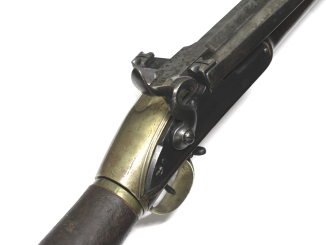
In many countries prior to WWII, it was not uncommon to begin preparing children for military service at fairly young ages, and several countries produces small-scale rifles for training boys who could not yet handle full-size weapons. These include France and Italy (with miniaturized Lebel and Carcano rifles), and also the Empire of Japan. Today we’re taking a look at a small-scale Type 38 Arisaka trainer, approximately 7/8 normal size. While most of these sorts of rifles were designed for small rimfire cartridges, this one was instead chambered for 6.5x50mm blank rounds.


Was this article worth 15 cents to you? For less than the cost of a newsstand gun magazine, you can become a Forgotten Weapons Premium Member and help support the site, as well as get some cool industry discounts and access to our Members-Only forum!

Proxibid Warning

So, just a heads-up for you guys who take part in online auctions – we’ve had some complaints about the Proxibid outfit. They allow people to remotely participate in live auctions – like the Cowans Auction of Richard Wray’s collection that happened last week. Well, the problems is that Proxibid seems to do a pretty poor job of it. One of our members in particular lost out on an item because his bid simply wasn’t recognized by Proxibid (we’re not sure why), he never got a bid confirmation, and the item ended up selling for a couple hundred bucks less than he was willing to pay. What’s the solution? I really don’t know – there aren’t a whole lot of other options. But you should at least be aware that Proxibid has a pretty mediocre track record of reviews when you go into an auction.

Perhaps we have an online auction pro in the audience who can suggest a good alternative, or a trick to getting a smooth online bidding experience?


Was this article worth 15 cents to you? For less than the cost of a newsstand gun magazine, you can become a Forgotten Weapons Premium Member and help support the site, as well as get some cool industry discounts and access to our Members-Only forum!

Vintage Saturday: Faye Schulman

04 faye w old friends LR 1019x1024 Vintage Saturday: Faye Schulman

“We must not fear our enemies, it is for them to fear us” – Faye Schulman (second from left – click to see full size)

Faye Schulman was born in the small Polish town of Lenin in 1919 to a large Jewish family. After the German attack on Russia, the town was occupied, and in August 1942 the town’s roughly 2000 Jewish residents were executed by Nazi forces – with the exception of about two dozen, including Miss Schulman. She was a photographer, and was ordered to take and develop pictures of the mass execution. She did so – including a second set in secret to keep herself – and was able to escape into the forests and join a partisan brigade of Jews and escaped Russian POWs, where she served as nurse, photographer and fighter until the end of the war.

She married another Jewish partisan and moved to Canada in 1948, where she lives to this day. She published a memoir of her war experiences Vintage Saturday: Faye Schulman, which is still in print – as she explained, “I want people to know that there was resistance. Jews did not go like sheep to the slaughter. I was a photographer. I have pictures. I have proof.”


Was this article worth 15 cents to you? For less than the cost of a newsstand gun magazine, you can become a Forgotten Weapons Premium Member and help support the site, as well as get some cool industry discounts and access to our Members-Only forum!

Arkady Shipunov and the GSh-18 Pistol

We learned (thanks, Denny) that Arkady Shipunov passed away last week. He began work at Tula arsenal in 1950, and was chief designer of its instruments bureau from 1962 until 2006 – quite the long reign! He was a prodigious inventor whose work was mostly on large machine guns and missile systems, but he was also the co-designer of the GSh-18 (Gryazev-Shipunov) pistol developed by Tula in the late 1990s.

GSh18 06 1024x682 Arkady Shipunov and the GSh 18 Pistol

Russian GSh-18 pistol

The GSh-18 is one of the more recent additions to the small fraternity of rotating-barrel handguns (see also: Roth-Steyr 1907, Obregon, CZ-24, Boberg XR9, and others). We haven’t had the chance to handle one ourselves, but the design is pretty interesting. While most rotating-barrel pistols use two or three lugs, the GSh-18 uses no less than ten, arrayed equally around the barrel. This gives the barrel a rotation arc of just 18 degrees, and gives it a very strong lockup with so much lug surface area.

GSh18 12 1024x682 Arkady Shipunov and the GSh 18 Pistol

GSh-18 locking lugs

Details about the mechanism are a bit sketchy, but we suspect the beveled set of lugs just behind the barrel are intended to seal the slide against dirt and grime getting in and fouling the locking lugs. Despite the apparent vulnerability to dirt getting in, the pistol appears to have passed Russian military trials with flying colors. The GSh-18 on paper appears to be an excellent handgun:

  • Good 3-dot sights (optionally including night sights)
  • Nice low bore axis
  • Polymer frame (for a total weight of just 16.5 ounces unloaded)
  • Reversible mag release to accommodate left-handed shooters
  • Trigger-mounted safety for simple loaded carry
  • Ejector doubles as loaded chamber indicator
  • 18+1 capacity of 9mm cartridges

In addition, the magazine of the GSh-18 is of the double-feed design, meaning that cartridges feed alternately from the left and right sides, instead of being forced into a single center column at the top of the magazine (the Stechkin APS also used double-feed magazines). This double-feed system has long been recognized as superior in submachine guns, as it reduces spring pressure on the cartridges, making for more reliable feeding and easier loading of magazines.

GSh18 25 450x300 Arkady Shipunov and the GSh 18 Pistol

GSh-18 magazine – note the widely-space feed lips to allow alternate feeding from the right and left columns of cartridges

The one concern we have about the design – and again, this is without having actually handled one – is the rather complex disassembly. The design looks great on the outside, but it has a lot of independent parts that have to come out for basic takedown. Most other modern pistols have a nice modular construction, where the slide comes off as a complete unit with no fuss, but the GSh-18 requires several sequential parts to be removed.Connecting pins, non-captive springs…it’s just not very elegant:

disassembled 450x329 Arkady Shipunov and the GSh 18 Pistol

GSh-18 disassembled

You can see a promotional video (in Russian) about the GSh-18 here, produced by Tula (where the guns were designed):

Now, there is another element to the GSh-18 that we need to talk about, and that is its ammunition. Apparently one of the design criteria for military service was armor penetration capability, and the GSh-18 was designed around a specific 9x19mm AP cartridge, designated 7N31. It operates at higher pressure than standard 9mm ball (roughly +P+ pressures, although Tula promo material would have you believe it’s higher), and throws a lightweight projectile at pretty high velocity. Specifically, a 65 grain hardened steel core bullet at 1970 fps, which will perforate NIJ Level III soft body armor, or 8mm of mild steel plate at close range. In today’s world of increasingly-standard use of good body armor by combat troops, that would seem like a reasonable requirement to have for a sidearm – although we do wonder how many combat troops would be wearing soft armor, rather than either rifle plates or no armor. However, the 7N31 case is outwardly identical to standard 9×19, so the pistol can be used with standard ammunition as well.

7n31 Arkady Shipunov and the GSh 18 Pistol

Russian 7N31 cartridge (image from IAA forums)

You can see a bunch more photos of the GSh-18 below, or download the whole set in high resolution as a zip archive:


Was this article worth 15 cents to you? For less than the cost of a newsstand gun magazine, you can become a Forgotten Weapons Premium Member and help support the site, as well as get some cool industry discounts and access to our Members-Only forum!

Book Review: International Arms Review 1

We’ve all seen the books of compiled articles at gun shows, printed by Gun Digest or other sundry magazines. I usually don’t give them a second glance, at least until now. I had a friend point out this one in particular, International Arms Review 1 Book Review: International Arms Review 1. Printed in the late 1970s, it is a lot more interesting than I would have expected, as its editor focused on unusual topics for its articles. The majority are about early breechloading systems, but it does also get into some medieval arms & armor areas and a few more modern guns.

The complete table of contents consists of:

Giant Siege Guns of Paris
History of the Pellet Gun
The Gewehr 88 and its Variants
Block-Operated Target and Gallery Rifles
The Lugers
The Dreyse Needle Gun
Shotgun Slugs
The Gun Collection in Erbach Castle, Odenwald
The Bavarian Werder Rifle, Model 1869
The Zig-Zag Mauser
From Hallmark to Proof-Mark
The Lefaucheux Pin-Fire System
Broomhandle Mauser (C96)
The Austrian Breech Loader M67
The Halberds
The Heerenbuchse
Ferlach – Ancient Home of the Austrian Gunmaker
The FG-42 Paratroop Rifle
Schwarzlose Pistol
Evolution of the Assault Rifle Since WWII
Can Pistols Stop Cars?
7.63 Astra vs C96 Mauser
The Mysterious Chamber of Nazidom
Zanotti
Belt-Buckle Pistol
A Wheel-Lock Curiosity
Collette’s Gravity Loaders
The Crossbow as Sporting Weapon
The Introduction of Firearms to Europe
The 1911 Swiss Service Rifle
Firing the Needle Gun
The Age of Armor
The Portuguese Guedes Rifle, Model 1885
Evolution of the Machine Gun in the German Army
The Norwegian Rifle With the Tip-Up Chamber
The Rheinmetall Automatic Shotgun No. 4
Granddad’s Rifle is not Dead
The Old Prussian Hussar Sabre
Nagant Gas-Check Revolver 7.62mm Model 1895
The Russian Simonov Carbine (SKS)

Few people will be interested in everything there, but I expect many folks will find a lot of the articles worthwhile. I’ve included two different Amazon links, since they point to different sellers:


Was this article worth 15 cents to you? For less than the cost of a newsstand gun magazine, you can become a Forgotten Weapons Premium Member and help support the site, as well as get some cool industry discounts and access to our Members-Only forum!

Japanese Type 97 20mm Anti-tank Rifle

Today’s article comes to us from, Christopher Bailey, who is particularly interested in finding information and photos of these kinds of antitank weapons.  He is especially interested in high-quality photos, both period and modern. If you have access to that type of information, please let us know and we will put you in contact with him.

九七式自動砲: The Japanese Type 97 20mm Anti-tank Rifle

by Christopher Bailey

In the middle part of the 1930′s, it became apparent to nearly all observers that another war was on the horizon.  Recalling the lessons of the First World War, nations around the world each began their own program to design and perfect a man-portable anti-tank weapon.  The most obvious solution at the time, and the one that most designers chose as their starting point, was the World War One German concept of an “anti-tank rifle”.  The first such gun, the Mauser 1918 Mauser T-Gewehr, was itself simply a scaled up Model 98 rifle.  Chambered for a newly developed 13mm round, the T-Gewehr was a capable and effective battlefield rifle, and further development of this line of weapons was a reasonable solution at the time.

From this prewar “arms race” came a number of competing designs, amongst them the Polish Wz-35, the German PzB 38, the British Boys Rifle as well as the Solothurn series of commercial guns.  These rifles, all using different mechanisms, show off a variety of design compromises.  Some used a small high-velocity bullet fired out of a light weight gun, while others used a large projectile fired out of an equally heavy weapon.  The middle ground (that of a medium sized round) was also employed, though it was largely overlooked by most designers  Not  to be left behind by these European developments, the Empire of Japan began its own program in 1935, culminating in 1937 with the adoption of the Type 97 Anti-tank rifle.

Picture A 1024x368 Japanese Type 97 20mm Anti tank Rifle

Type 97 as employed, with magazine and ammunition


Picture B 1024x808 Japanese Type 97 20mm Anti tank Rifle

Type 97, field stripped. Top to Bottom, left to right: Lower with adjustable legs; barrel assembly; backplate with recoil springs and guide rods; recuperator assembly; bolt carrier with bolt; receiver; charging handle; armor shield; pair of seven round magazines.

Chambered for the powerful 20x124mm cartridge, the Type 97 is a magazine fed, gas-operated weapon that fires from an open bolt.  More like a small artillery piece than a traditional self-loading rifle, the whole receiver and barrel assembly of the Type 97 actually slides front-to-back during firing.  While designed only for semiautomatic fire, there are reports of guns firing fully automatic.  These seem to be either mechanical malfunctions or simply accounts of the Type 98, a fully automatic machine cannon derived from the Type 97.

When fully assembled with its armor shield and carrying handles, the gun weighed in at an astonishing 150 pounds.  Unlike other heavy designs that came equipped with wheeled mounts or skis, the Type 97 was carried by its crew much like an injured man on a stretcher.  This heft, coupled with the guns accessories and ammunition would have certainly place a large burden on the nine man crew during cross country operations.  The barrel, which could be removed for long distance transport, was locked to the receiver using an interrupted thread mechanism.

Picture C 1024x627 Japanese Type 97 20mm Anti tank Rifle

Like the Type 92 Heavy Machine gun, the Type 97 came with a set of carrying handles. Note the large, hollow muzzle brake mounted on the end of the barrel to reduce the gun’s felt recoil.

Picture D 1024x1004 Japanese Type 97 20mm Anti tank Rifle

Front view of receiver with barrel removed. The large interrupted thread is used to secure the barrel into position with a locking collar. The two smaller holes are for the the gas system and its moving parts.

Once the gun had been carried to its destination, the crew would adjust the three legs and lower the weapon into its firing position. To cock the weapon, the charging handle located on the left side would have to be pulled fully to the rear, with a loud “click” letting the shooter know that the sear had engaged the bolt carrier.  After ensuring that both dust covers were open, a loaded magazine would then be locked into place on the top of the gun.  At this point, the gun was ready to fire.

Picture E 1024x768 Japanese Type 97 20mm Anti tank Rifle

The charging handle lacks any sort of mechanical advantage, such as a crank or a ratchet mechanism. Brute strength and the use of both hands were required to cock the gun. Note the spring-loaded dust cover, protecting the gun against the ingress of dirt and debris. Hinged dust covers were also fitted over the magazine opening and the ejection port.

Picture F 768x1024 Japanese Type 97 20mm Anti tank Rifle

In addition to a traditional trigger safety, the Type 97 was fitted with a bolt-catch safety on the right side of the gun, capable of locking the bolt in the rear position. The upper symbol is for “fire”, while the lower indicates “safe”.

Picture G 1024x324 Japanese Type 97 20mm Anti tank Rifle

The seven round magazine is of a traditional pattern, with a spring-loaded follower forcing the rounds into the feed lips.

Picture H 1024x964 Japanese Type 97 20mm Anti tank Rifle

The follower operates a bolt catch on the gun, while the magazine body has a small counter visible only from the rear of the gun. The magazine body itself features two sets of numbers. It is believed that the higher number would match the serial number of the gun, while the single digit number indicates which magazine it is within an issued set.

After loading the weapon, the gunner would lay the gun on his target.   This was accomplished using a rear peep sight and a blade front sight.  Traversing the gun was actually somewhat difficult, requiring the gunner to lift the rear of the heavy gun with his shoulder before shifting it left or right.  Elevation could be adjusted in the similar manner, or by raising and lowering the rear monopod leg via its knurled grip.  An assistant gunner would grip both forward legs to steady the gun during the firing, a position that must have been unnerving to those so assigned.

Picture I 1024x836 Japanese Type 97 20mm Anti tank Rifle

The front and rear sight, the latter of which is adjustable for both range and windage/lead. While the front sight has a winged guard, the rear is rather exposed, allowing it to be easily snagged and damaged. The gun is comfortable to sight on target, with the leather cheek rest and large sight offset permitting the wearing of a helmet.

Picture J 1024x768 Japanese Type 97 20mm Anti tank Rifle

A view from the gunner’s position on the Type 97, showing both the protection and the blind spots afforded by the 8mm thick shield. The plate exhibits no visible markings, and is of riveted construction.

Once the gun had been appropriately sighted, the trigger would be pulled firmly to the rear, releasing the bolt carrier assembly.  Driven forward by spring pressure, the bolt would strip a round from the magazine, feeding it into the chamber.  The bolt carrier, continuing forward, would lock the action by forcing a locking piece into cutouts located in the sides of the receiver.  Once fully locked, the firing pin would be struck be the carrier assembly, firing the cartridge.

Picture K 952x1024 Japanese Type 97 20mm Anti tank Rifle

Bolt carrier assembly in the locked (top) and unlocked (bottom) positions. The locking piece is forced up and down by wedge and cam on the bolt carrier. In the lower shot, the rear of the firing pin is visible between the bolt and the locking piece.

Picture L 768x1024 Japanese Type 97 20mm Anti tank Rifle

Cutaway drawing of this type of mechanism. The Type 97 actually features two gas pistons, rather than the one in this illustration. The hardened steel locking lugs in the receiver were held into place with screws, making them replaceable if needed.

As the projectile traveled down the barrel at 2,640 feet per second, some of the propellant gas was diverted into a regulated gas tube assembly located underneath the barrel.  The gas acted directly against two integral gas pistons on the bolt carrier, forcing the bolt assembly to the rear and unlocking the gun’s action.  The fired case was then extracted by the bolt and thrown out the bottom of the gun by an ejector mounted in the top of the receiver housing.  Once fully to the rear, the sear would again catch on the bolt carrier, locking the action open until the trigger was pulled once more.  Simultaneous to this internal action, the whole barreled action would cycle both forward and to the rear, its movement being slowed by the recuperator system mounted in the lower receiver.  This additional complexity served to somewhat soften the recoil experienced by the shooter.

Picture M 1024x588 Japanese Type 97 20mm Anti tank Rifle

The gas adjustment valve on the barrel of the Type 97. The gas is bled off into a pair of large gas tubes that are permanently attached to the barrel assembly. Adjustable for ammunition or battlefield conditions, the gas system featured many stainless steel parts for both corrosion resistance and durability

Picture N 1024x684 Japanese Type 97 20mm Anti tank Rifle

The adjustment nut on the recuperator assembly. The lug protruding from right side of the tube rotates up into the receiver when fully assembled, locking it onto the lower half of the gun during firing. The large opening functions as the ejection port.

Picture O 1024x724 Japanese Type 97 20mm Anti tank Rifle

The gun easily disassembles for cleaning and transport, requiring only a barrel wrench and a few punches. These were all issued in the gun’s tool kit, along with and spare parts pouch and gun cover.

Production of the gun began in 1938 at the Kokura Arsenal, a facility best known for its small arms production throughout the Second World War.  First seeing combat against the Red Army at the Battles of Khalkhin Gol in 1939, the Type 97 proved to be a disappointment to the Japanese military, with its 20mm round performing poorly against Soviet BT series tanks.  This is somewhat surprising given the fact that wartime American testing demonstrated that the projectile could pierce about 30mm of armor at 250 meters range.

When one also considers the complexity of the gun and the difficulty of manufacture, it isn’t surprising that production of the gun was terminated in 1941 after some 1100 had been completed.  As the war turned against Japan in 1943, the Nihon Seikosho Company (Japanese Steel Works) tooled up and produced another 100 guns, after which no more were made.  Despite its limitations, the Type 97 continued to be a front line weapon throughout the war in the Pacific, usually being employed in a prepared static defense position.  Very few examples of the gun survive today in either private hands or museums, almost certainly due to its bulk and great weight.

Picture P 544x1024 Japanese Type 97 20mm Anti tank Rifle

The 20×124 round, as used in the Type 97. The wooden blank on the left is believed to be for wartime training. The cartridge on the right is an armor-piercing tracer, for use against tanks and other armored vehicles. The 2500 grain projectile was propelled with approximately 585 grains of nitrocellulose. Included in the cartridge case with the powder was a small sheet of lead foil designed to help reduce fouling of the barrel. Each round was packed in its own cardboard tube before being sealed in a metal lined wooden shipping crate.

Picture Q 446x450 Japanese Type 97 20mm Anti tank Rifle

A group photo of contemporary antitank cartridges. Left to right: 20x138b (as used in the S18-1000 Solothurn), 20×124 (as used in the Japanese Type 97), 14.5×114 (as used in the Soviet PTRD and PTRS), .55 caliber round for the Boys Antitank Rifle, 7.92×10⁷ (as used in the Wz-35) and the 7.92×94 “Patronen 318″ (as used in the PzB 38 and PzB 39).

Picture R 768x1024 Japanese Type 97 20mm Anti tank Rifle

Markings visible on the subject Type 97. As read, top to bottom: “Kokura Factory, Type 97, #418, Showa 15.3 ( March 1940)” This section of the receiver also contains the mechanical bolt safety and can be removed as an assembly.


Technical Specs

Caliber: 20 x 124mm
Mechanism: Gas-operated open-bolt semiautomatic
Length, firing position: 82.5 in (2096 mm)
Length, traveling position: 99.5 in (2527 mm)
Weight, complete: 150 lb (68.1 kg)
Weight, less shield and handles: 115 lb (52.2 kg)
Barrel length: 41.875 in (1064 mm)
Rifling: 8 groove
Magazine capacity: Seven rounds
Muzzle velocity: 2,640 feet per second (866 m/s)
Total production: Approximately 1200


Was this article worth 15 cents to you? For less than the cost of a newsstand gun magazine, you can become a Forgotten Weapons Premium Member and help support the site, as well as get some cool industry discounts and access to our Members-Only forum!

Richard Wray Machine Gun Auction Followup

So, the auction of the late Richard Wray’s machine gun collection (see previous post) was yesterday, with the non-NFA guns being auctioned today. The final prices are interesting to look at, with some wallet-wrenchingly high and some great deals – at least for folks who are into the unusual.

Basically, the key was to be looking for guns that people don’t recognize. There were some great deals on really weird guns (including oddballs that aren’t necessarily poor designs), but the guns you’d recognize from major movies went for big bucks. Rule of thumb? French, Italian, and Japanese are cheap. German, British, and American are expensive.

Neat Budget Guns

Twin Darne belt-fed guns on an AA mount- $12,650 (for the pair)
M1914 heavy Hotchkiss on AA mount – $9,775
Darne single gun – $5,175
Italian Scotti fixed aircraft gun – $4,370 (cheapest machine gun sold)
Chatellerault M24/29 – $12,650 (this probably would have been my first choice, if I’d had the money to play with)
Japanese aircraft Lewis gun – $10,925

Wallet-Crunchers

Inglis MkII Bren – $51,750
8mm Bren MkI – $48,300
MG-42 – $52,900
MP-40 – $43,700
Savage Lewis gun – $41,400
Browning M1919A6 – $44,275
Colt 1921A Thompson – $42,550
Maremont M60 – $51,750

You can see all the other final prices in the auction catalog. And do you remember that gorgeous Swiss Maxim with accessories that I couldn’t stop drooling over? It went for $25,300 – I think someone got a total steal on a phenomenal historical machine gun there. Congratulations, whoever you are!

swissmaxim Richard Wray Machine Gun Auction Followup

Swiss model 1911 Maxim gun


Was this article worth 15 cents to you? For less than the cost of a newsstand gun magazine, you can become a Forgotten Weapons Premium Member and help support the site, as well as get some cool industry discounts and access to our Members-Only forum!

Guns on a Plane

We attended a symposium at the Institute of Military Technology a while back, and one of the talks was on the development of the AR-10, given by C. Reed Knight Jr. One of the neat anecdotes he shared really brought to light the change in public and political view of guns in public life.

In late 1956, Stoner was taking one of the very first AR-10 prototypes to Springfield Armory for testing – the AR10 was a late entry into ongoing rifle tests, and it was a potentially huge opportunity for Armalite (which had less than a dozen employees at the time). Stoner was running late to make his connecting flight into Massachusetts, and ran to the gate without taking the time to check his small suitcase. The suitcase which, as it happened, had a disassembled select-fire AR-10 inside.

ar10early 1024x237 Guns on a Plane

One of the very first “production” (actually handmade) AR-10 rifles. This may have actually been the one Stoner was carrying… (Photo from collection of C. Reed Knight Jr)

He made it to the plane – a small puddle-jumper – in time to get aboard and worked his way to a seat at the back of the passenger compartment, a bit out of breath and not paying attention to anyone else, simply happy to have made the flight. Throughout the flight, he got an odd feeling about two men in the front of the plane, who were professionally dressed but seemed unusually interested in watching the other passengers. Things got stranger when the plan landed, and one of the two men stood up and asked everyone else to stay in their seats until Vice President Nixon had exited the plane. Stoner didn’t say anything, and wasn’t given a second glance.

Yep, turns out he had merrily carried a machine gun onto an airplane with the #2 political official, right past a pair of Secret Service agents. It might surprise some people today to learn that such an action did not, in fact, tear a hole in the space-time continuum, much less land anyone in jail. The past isn’t perfect in many ways, but there are some aspects of it I wouldn’t mind having back…


Was this article worth 15 cents to you? For less than the cost of a newsstand gun magazine, you can become a Forgotten Weapons Premium Member and help support the site, as well as get some cool industry discounts and access to our Members-Only forum!

Czech CZ-52 Pistol Video

The CZ-52 really isn’t a forgotten weapons yet, but it is a pretty interesting gun mechanically, and well worth taking a look at. About 200,000 of them were made in Czechoslovakia from 1952 to 1954, and they served as that country’s standard military sidearm for several decades (which the rest of the Warsaw Pact bloc used the TT33 Tokarev pistol). Czechoslovakia has a long and outstanding tradition of arms design and manufacture, and they kept it going through the Cold War, developing and issuing the vz52 and vz58 rifles and the vz59 light machine gun, as well as the 52 pistol.

The CZ-52 looks like a pretty ungainly weapon, but don’t let that prevent you from giving it a chance. The grip angle is not to many peoples’ liking, but I find it to be a pretty comfortable pistol to shoot. The bore axis is relatively high and causes more muzzle jump than one would like, but the wide grip does a good job of distributing recoil energy and preventing shooter fatigue. Its single-action trigger gives a good break, and it is one of few single-action designs to incorporate a decocker as well as a manual safety (a feature I neglected to mention in the video, whoops).

Mechanically, the CZ-52 is a recoil operated, roller locked design. This is the same concept as the MG-42 machine gun, and not the roller-delayed blowback of the HK-91 family of rifles and the HK P9 pistols. It is a reliable, durable, and overall very effective design for a service pistol. You can still find CZ-52 pistols available today in the $250-$275 range, and they are an excellent deal for that price.


Was this article worth 15 cents to you? For less than the cost of a newsstand gun magazine, you can become a Forgotten Weapons Premium Member and help support the site, as well as get some cool industry discounts and access to our Members-Only forum!

Vintage Saturday: Italians in the Snow

breda m30 russian front Vintage Saturday: Italians in the Snow

Bad news, Marino – you’re shipping out to the Eastern Front. And worse news; we’re giving you a Breda.

Italian soldiers on the Russian Front, with a Breda M30 machine gun and a Carcano carbine. Thanks to Max Popenker for the photo!


Was this article worth 15 cents to you? For less than the cost of a newsstand gun magazine, you can become a Forgotten Weapons Premium Member and help support the site, as well as get some cool industry discounts and access to our Members-Only forum!