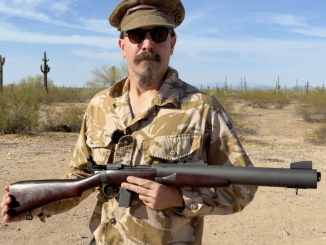
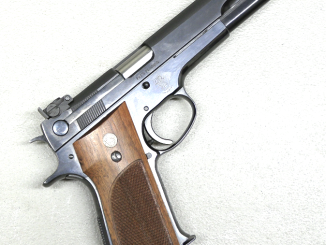
We shot a video on the Webley-Fosbery last year, but it was in a dark room and with a low-resolution camera. I’ve since had another opportunity to handle one of these very interesting pistols, and have a new video of much higher quality. More information on the gun, and a copy of the original manual to follow later this week!
Was this article worth 15 cents to you? For less than the cost of a newsstand gun magazine, you can become a Forgotten Weapons Premium Member and help support the site, as well as get some cool industry discounts and access to our Members-Only forum!
An excerpt from Guns on the Early Frontiers, on the subject of Spanish matchlock muskets in the colonial Americas:
In 1576, a Captain Solis, commander of the Garrison at San Felipe, in the vicinity of what had been the Port Royal of the French Huguenots, executed two Indians, one a chief. Also, Solis had demanded that the neighboring Cusabo bring to the garrison a quantity of of corn and other provisions. Because the food was not promptly forthcoming, the Captain dispatched Moyano and twenty-two soldiers to the Indian villages to seize the needed corn. As the party approached one of the towns, some natives came out to meet it. They explained that their women and children were terrified by the burning slow match carried with every gun, and they indicated that they would cooperate if the soldiers would extinguish their matches. Moyano complied with the request, whereupon the Indians immediately killed all but one of the Spaniards and took the captured matchlocks to the Cusabo town.
I should also point out that the Spanish were the most notorious colonists in the Americas when it came to subjugation and mistreatment of native tribes, and also the most diligent in working to prevent those tribes from acquiring firearms (weird how those go together). Of course, as one might expect, the tribes were able to acquire arms regardless…
Was this article worth 15 cents to you? For less than the cost of a newsstand gun magazine, you can become a Forgotten Weapons Premium Member and help support the site, as well as get some cool industry discounts and access to our Members-Only forum!
A solution to the MP44 handguard overheating: fight in the snow
German Skijäger troops with Sturmgewehr rifles in the Ukraine, February 1944. Note how two of the guys in the background are using ski poles as shooting sticks. If there had been more of these guys at Hitler’s disposal Russia would have been in serious trouble.
Was this article worth 15 cents to you? For less than the cost of a newsstand gun magazine, you can become a Forgotten Weapons Premium Member and help support the site, as well as get some cool industry discounts and access to our Members-Only forum!
Today we have another article by Ronaldo Olive, reprinted with his permission. This was originally published in Jane’s Defense Weekly in 1984, when the LAPA FA-03 was still more or less in prototype phase – bullpup rifles have become more widely accepted since then. Unfortunately for LAPA, the Modelo 03 was not accepted for military use, and no foreign orders were received – only this single prototype was ever built. So without further ado, read on about this Brazilian combat rifle with some interesting features. Thanks, Ronaldo!
Brazilian 5.56mm LAPA Assault Rifle Reaches Official Testing Phase
by Ronaldo Olive
The appearance of yet another 5.56mm assault rifle on the military scene may not attract much attention, unless it has the now fashionable bullpup configuration, which gives it an increased chance of receiving more than just a casual glance. And if this rifle incorporates novel and mainly useful features, then it deserves a thorough examination. This is the case of the LAPA FA Modelo 03, a newcomer to the small-caliber rifle arena, which is about to start official certification testing at Campo de Provas de Marambaia (Marambaia Proving Grounds), a branch of Brazil’s CTEx – Centro Tecnologico do Exercito (Army Technical Center). Janes Defense Weekly was recently given the chance to fire this new gun and to assess its general characteristics.
The FA (Fuzil Automatico, or Automatic Rifle) Modelo 03 was designed by LAPA – Laboratorio de Projectos de Armamento Automatico (Automatic Armament Design Laboratory), a Rio de Janeiro-based R&D concern. Initial work started at the end of 1978. After about a year, a technical feasibility prototype was completed, and its most promising characteristics led to additional prototypes to refine the design. Unavoidable snags were gradually removed and the Brazilian weapon has evolved into a working, reliable reality. Following certification, it is to enter production to meet local and foreign demand, but the company would not be specific about dates. Nor would is comment on reported approaches by foreign countries interested in licensed production agreements, but considering the hard competition in the arms business, its reticence in making some details public is understandable.
Description
The rifle’s bullpup arrangement is the result of wishing to make it as compact as possible without shortening the barrel to a point where ballistic efficiency is degraded. So, the trigger is mover forward and the firing mechanism, together with the magazine, is fitted in the hollow of the buttstock.
The body of the LAPA FA Modelo 03 is built largely of high-impact plastic, has particularly elegant contours and is pleasant to handle and carry. A well-designed straight-line configuration has in fact resulted in the rifle being able to stand balanced on its buttplate! This has also dictated the raised sights configuration: the rear sight, a two-position (200m and 400m) flip aperture, is housed within the AR-10 style carrying handle, while the front sight is a protected post on top of a stury raised metal frame at the muzzle. Radius is a generous (for the bullpup configuration) 374mm (14.7 inches). The cocking handle, which remains stationary when the gun is fired, is within the carrying handle, and the top end runs along a slot on the underside of the handle, giving it more rigidity.
Was this article worth 15 cents to you? For less than the cost of a newsstand gun magazine, you can become a Forgotten Weapons Premium Member and help support the site, as well as get some cool industry discounts and access to our Members-Only forum!
During the latter half of the 1800s, a significant fraction of the world’s military forces were being armed by the Remington brothers, and their factory in Ilion, New York. The Remington Rolling Block was one of the most durable, reliable, and effective single-shot breechloading rifles available, and became extremely popular with armies worldwide. Even after the introduction of bolt action, magazine fed repeaters, the Rolling Block continued to sell, thanks to its low cost and simplicity of use.
We can still find Rolling Blocks fairly easily here in the US, but few people know enough to determine where any given one came from. Remington generally didn’t put serial numbers, caliber markings, or even national crests on the rifles, which helped keep them cheap but doesn’t offer much help to today’s collector. George Layman’s book, however, provides a good overview of the different models, nationalities, and cartridges used in these rifles over the many decades they saw service.
http://www.youtube.com/watch?v=4gRIfi5kPq4
If you can find the 4th Edition of The Remington Military Rolling Block Rifle for a reasonable price, it is definitely worth having in your library. However, it has been overtaken by a more recent and larger book by Mr. Layman, entitled Remington Rolling Block Military Rifles of the World. While I have not read through that new version, I have no doubt that it will be a more comprehensive resource than its predecessor, so barring a find in the $5 bin, the new version would be the better buy.
Was this article worth 15 cents to you? For less than the cost of a newsstand gun magazine, you can become a Forgotten Weapons Premium Member and help support the site, as well as get some cool industry discounts and access to our Members-Only forum!
I’m sure everyone has heard a second or third hand story about someone finding a total steal on a gun at an estate sale or auction. Heck, I’ve had a few great moments that start to get close to that myself – but I’ve not yet actually found a gun at a yard sale, much less a really neat gun at one.
Well, I got an email from reader Tim looking for information about a weird pistol. That he had gotten at a yard sale. For $40. That rotten SOB.
It is apparently Chinese, and chambered for 7.63mm Mauser. It’s not a design I know anything about, so I looked it up in Bin Shih’s book on Chinese small arms, where I found photos of two very similar looking pieces, both listed as “unknown”.
The best I can do is some speculation, so let’s consider what we can tell from these photos (Tim didn’t send any pictures of the internals). First off, I think it’s a save assumption that this was a very limited production piece, if not outright handmade. The crude shaping of the trigger guard, the not-quite-parallel serrations on the slide, and the non-symmetrical grooves in the grip panels suggest that. The gun does have a 5-digit serial number, but that is not necessarily indicative of mass production, particularly in China.
The grip panels bear a lot of resemblance to those of a Mauser C96, which was a very popular pistol in China, and it is chambered for the same 7.63×25 cartridge. This chambering would have been because of the Mauser’s popularity, and it would definitely not be the more powerful 7.62×25 Tokarev. The Tokarev round would be used by the Chinese Communists later on, but this pistol most likely dates from the 1920s or early 1930s, before the Tokarev was in use anywhere.
The barrel and frame layout bear some similarity to the Mauser 1910/1914/1934 (which was also imported and known in China), and the firing mechanism is probably based on the Eibar/Ruby design (which was another very popular type of pistol in China). Those pistols have concealed hammers, but it would be a simple and desirable change to expose them, as on this design. The round-bottomed magazine, of course, if distinctive and quite unusual, probably being made simply to match the contour of the C96 style grip.
If anyone else has more information on this pistol or designs like it, we’d love to hear it!
Was this article worth 15 cents to you? For less than the cost of a newsstand gun magazine, you can become a Forgotten Weapons Premium Member and help support the site, as well as get some cool industry discounts and access to our Members-Only forum!
Reality-type TV shows about guns and shooting can be a bit of a divisive subject for gunnies, and I’m personally not a fan of any of them – with one exception. The problem is that the shows are, as a general rule, manipulated to be all about drama instead of the nominal subject matter. They rely on being flashy and doing things that will look really impressive to people who don’t really understand what is involved. Many people are of the opinion that as a result, they give a pretty negative impression of shooters and gunnies to the general population who watches. At best, they are littered with technical errors and interesting only in the “train wreck; can’t not watch” vein.
The exception to my mind is the History Channel’s show “Top Shot“. If you haven’t ever watched it, the basic premise is a marksmanship competition between 16 shooters, eliminating one each week until a single winner remains. Pretty simple. What I really enjoy with Top Shot is that there is an extremely wide array of guns used, fantastic challenging shots, and genuinely outstanding shooters. Previous seasons have used guns from flintlocks to vintage Hotchkiss breechloading cannons to tactical black ARs and everything in between (the first episode this season used an SVT-40, FAL, and AR). The shooting has involved things like Annie Oakley’s over-the-shoulder mirror shooting, blindfolded shooting, wobbly platforms, moving targets, and much more. Thanks to the production budget of the show, they can set up really amazing shooting scenarios that would be hugely impractical to replicate on a private individual range.
Anyway, lest I sound too giddy about the show, it always had some negative elements. The shooters were divided into teams, and there was always some TV-style sturm and drang over choosing who was to be eliminated from the running. But! Apparently they listened to some of the grumbling feedback, because this season that’s all gone. The setup is now that the bottom 50% of shooters in each episode (per time or accuracy, however the scenario is scored) are in danger of being eliminated. They each get a single shot at a bullseye, and the worst two shots on that target go to a head-to-head competition to determine who stays and who goes. All purely based on objective skill and performance. It looks like we’ll get the juicy fun shooting without the gum-on-the-shoe of the hyped-up drama!
This season was cast entirely from previous competitors, and I’m really looking forward to seeing new episodes each week. For the record, I’m rooting for Kelly Bachand, who has been my favorite personality on the show since I saw him in the very first season. He does a great job of demonstrating how formal bullseye competition can make a great foundation for all-around shooting. Good luck, Kelly!
(and no, I’m not writing this just as a brown-nosing attempt to get myself into the next season’s cast – unless that would actually work…)
Was this article worth 15 cents to you? For less than the cost of a newsstand gun magazine, you can become a Forgotten Weapons Premium Member and help support the site, as well as get some cool industry discounts and access to our Members-Only forum!
In the first years of the 20th century, the US military was looking for a new standard sidearm in a .45-caliber cartridge, and set up a series of trials to choose one. The entrants to the 1907 pistol trials included many of the prominent semiauto pistols of the day, like the Parabellum (aka Luger), John Browning’s design that would become the Model 1911, the Bergmann-Bayard, and the Webley-Fosbery. Among these submissions was a design from the Savage Arms Company; basically a version of their .32ACP model 1907 pistol scaled up to .45ACP.
In the initial testing, the Savage did fairly well, although it did suffer a few dozen various malfunctions over the course of 913 rounds. It was recommended for further field trials by the testing board, along with the Colt/Browning pistol. The result of these extended trials was the selection of the Colt/Browning, as it proved a more durable and reliable design than the Savage.
Having now had the opportunity to fire the Savage, I could concur with the Army decision to choose the Colt over the Savage. The Savage is a decent pistol, but inferior to the Colt 1911 in a number of ways. It has more felt recoil, it is physically larger and bulkier,and its controls are more difficult to operate. Granted, many of these things could be fixed with further refinement (as has been done with the 1911 in 106 years since the trials). As it stood in 1907, the Savage had a surprisingly stiff trigger and tiny sights, which made it difficult to shoot accurately. The magazine release was a bit awkward to use, and the slide lock was both very small and not conveniently positioned. The grip was generally good, although designed at too close to a right angle to the bore (a bit like holding a TT33 Tokarev).
Mechanics
Mechanically, the Savage is a locked action using a rotating barrel and recoil operation. However, the dwell time during which the action remains locked is very brief. As soon as the slide begins to move rearward, the barrel rotates and opens – in most other rotating barrel designs there is a bit of rearward locked travel allowed, so that pressure can drop before the breech opens. The Savage does not incorporate this. Instead, the barrel turns counter-clockwise to unlock, and the rifling spins the bullet in a clockwise direction. This causes the bullet to exert a force on the barrel clockwise, presumably preventing it from rotating until the bullet has left the muzzle. This does seem to work in practice, as still frames from the video show muzzle flash (indicating the bullet has left) while the cocking piece remains forward:
Savage .45 ACP firing – note that the slide has not moved rearward yet, but the bullet has clearly left the muzzle
However, the unlocking does occur faster than in other locked-breech handguns. When looking at the frame-by-frame shooting footage, I was treated to this impressive display of flash emanating from every opening of the gun as it cycled. If the action stayed closed a bit longer, this unburned powder would presumably have blown out the muzzle instead of the breech…
Holy unburned powder, Batman!
After the Trials
Over the course of the field trial, many of the Savage pistols were returned to the company for repair, and at the end of the period they were all factory refurbished. The guns were later sold back to Savage as surplus (for $6 each, compared to the original price of $65), since the design had not been adopted. Happily, this allowed them into the civilian market – which is why they can still be found today.
Was this article worth 15 cents to you? For less than the cost of a newsstand gun magazine, you can become a Forgotten Weapons Premium Member and help support the site, as well as get some cool industry discounts and access to our Members-Only forum!
Speaking about his time leading a group of Arab soldiers in Libya prior to his involvement in the LRDG:
We also obtained captured Italian machine guns: these weapons of a new design of extreme ingenuity, light, pleasant to handle and of a good appearance, had only one fault: they wouldn’t fire. I tested many: under the best of conditions, when spotlessly clean and oiled precisely to the right degree, they couldn’t be relied upon to fire more than a burst or two…
From Popski’s Private Army. Presumably he is talking about the Breda M30, although I would maybe take issue with the “good appearance” part…
Was this article worth 15 cents to you? For less than the cost of a newsstand gun magazine, you can become a Forgotten Weapons Premium Member and help support the site, as well as get some cool industry discounts and access to our Members-Only forum!
So, ah, my hands are full with these ammo cans, Private…so you need to carry the other thing.
A Soviet M1910 Maxim (early version, without the snow cap) on the Mannerheim Line, 1940.
Was this article worth 15 cents to you? For less than the cost of a newsstand gun magazine, you can become a Forgotten Weapons Premium Member and help support the site, as well as get some cool industry discounts and access to our Members-Only forum!
New Season of Top Shot
Reality-type TV shows about guns and shooting can be a bit of a divisive subject for gunnies, and I’m personally not a fan of any of them – with one exception. The problem is that the shows are, as a general rule, manipulated to be all about drama instead of the nominal subject matter. They rely on being flashy and doing things that will look really impressive to people who don’t really understand what is involved. Many people are of the opinion that as a result, they give a pretty negative impression of shooters and gunnies to the general population who watches. At best, they are littered with technical errors and interesting only in the “train wreck; can’t not watch” vein.
The exception to my mind is the History Channel’s show “Top Shot“. If you haven’t ever watched it, the basic premise is a marksmanship competition between 16 shooters, eliminating one each week until a single winner remains. Pretty simple. What I really enjoy with Top Shot is that there is an extremely wide array of guns used, fantastic challenging shots, and genuinely outstanding shooters. Previous seasons have used guns from flintlocks to vintage Hotchkiss breechloading cannons to tactical black ARs and everything in between (the first episode this season used an SVT-40, FAL, and AR). The shooting has involved things like Annie Oakley’s over-the-shoulder mirror shooting, blindfolded shooting, wobbly platforms, moving targets, and much more. Thanks to the production budget of the show, they can set up really amazing shooting scenarios that would be hugely impractical to replicate on a private individual range.
Anyway, lest I sound too giddy about the show, it always had some negative elements. The shooters were divided into teams, and there was always some TV-style sturm and drang over choosing who was to be eliminated from the running. But! Apparently they listened to some of the grumbling feedback, because this season that’s all gone. The setup is now that the bottom 50% of shooters in each episode (per time or accuracy, however the scenario is scored) are in danger of being eliminated. They each get a single shot at a bullseye, and the worst two shots on that target go to a head-to-head competition to determine who stays and who goes. All purely based on objective skill and performance. It looks like we’ll get the juicy fun shooting without the gum-on-the-shoe of the hyped-up drama!
This season was cast entirely from previous competitors, and I’m really looking forward to seeing new episodes each week. For the record, I’m rooting for Kelly Bachand, who has been my favorite personality on the show since I saw him in the very first season. He does a great job of demonstrating how formal bullseye competition can make a great foundation for all-around shooting. Good luck, Kelly!
(and no, I’m not writing this just as a brown-nosing attempt to get myself into the next season’s cast – unless that would actually work…)
Was this article worth 15 cents to you? For less than the cost of a newsstand gun magazine, you can become a Forgotten Weapons Premium Member and help support the site, as well as get some cool industry discounts and access to our Members-Only forum!