
Greek soldiers practicing antiaircraft fire with a model 1926 Hotchkiss LMG – note the AA extension on the tripod. Thank to Di for the photo!
Was this article worth 15 cents to you? For less than the cost of a newsstand gun magazine, you can become a Forgotten Weapons Premium Member and help support the site, as well as get some cool industry discounts and access to our Members-Only forum!
In the early 1930s, France adopted a new standard pistol and a new cartridge to go with it – the MAS 1935 and the 7.65x20mm, closely patterned on the us M1918 Pedersen Device cartridge. They were well acquainted with the 9×19, but as always the French military marched to the slightly offbeat tempo of it’s own drummer. So with the new pistol cartridge in hand, they started testing submachine gun designs. The arsenal at St Etienne provided the best candidate in 1934, and after several years of testing and improvements, it was adopted as the M1938.
Production began in 1939, and very few had gotten into service when German forces overran the factory in 1940. Production continued after the war, but it wasn’t long before the French switched over to the 9mm Parabellum, and the MAT-49 replaced the MAS-38. The MAS did see some use in Indochina, and was used to equip police forces and other secondary units.
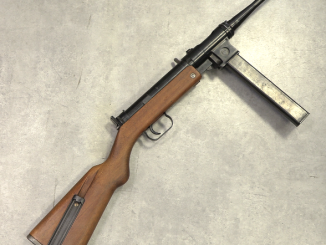
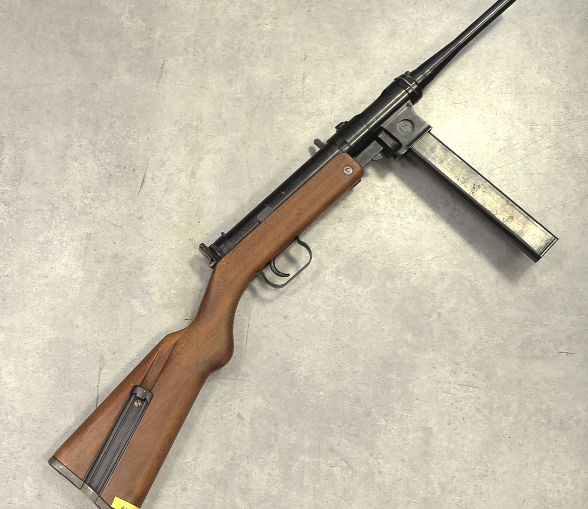
One element that is not necessarily apparent from photographs is just how compact the MAS-38 really is. The whole gun is just a hair over 24 inches long, and the barrel is a scant 8.7 inches. The receiver is narrow, and there are very few projections to snag on anything. (even the rear sight folds flush into the top of the receiver). The whole thing weighs in at about 6.5 pounds. That would make for controllability issues with many subguns, but the mild recoil from the rather weak 7.65×20 cartridge allows the gun to be pretty easy to handle. Of course, it lacks stopping power compared to just about any other subgun on the battlefield.
MAS38 cutaway drawing (click to enlarge)
Mechanically, the MAS-38 is a simple blowback action, firing full-auto only from an open bolt. The unorthodox element to its design is how the barrel and bolt travel are not parallel – the bolt travels downwards as it goes back, relative to the barrel. The breechface is cut at a matching angle to fit fully against the chamber mouth. This angle is partly to slow down the bolt (and thus the rate of fire) and partly an attempt to reduce felt recoil by using vertical travel of the bolt to compensate for it (this was also done on the Finnish Jatimatic and modern Kriss carbine to a more extreme degree).
The bolt handle is non-reciprocating, and stays in the rearward position once the gun is charged. It can be manually pushed forward and will latch in the fully forward position, acting as a dust cover over the ejection port. Another folding dust cover is pinned to the front of the magazine well for closing off that opening when no mag is in use. There is no selector switch since the action is full-auto only, and the manual safety is actually built into the trigger. When pushed forward, the trigger will snap into a more or less horizontal position, and in the process lock the bolt in place (whether it is forward or back). You can see how this mechanism works by looking at parts 22 and 23 in the diagram above.
Note closed magazine well and bolt handle which doubles as an ejection port cover.
The sights on the MAS-38 consist of a triangular front post and a pair of independent flip-up apertures for the rear sight. The apertures are set for 100m and 200m, and the sights are offset slightly to the left side of the gun. The magazines have a 32-round capacity, and are of the double-feed design.
MAS38 rear sight (200m aperture folded; 100m aperture in use)
MAS38 magazine
Despite begin a pretty simple mechanism, the MAS38 is not a really simple weapon to manufacture. Its bolt is round in profile despite the square receiver, and runs in a round channel bored in the receiver. This channel also houses the recoil spring, and runs back into the wooden stock (and for this reason a folding-stock model was not made). Other than small pieces like the ejection port cover, the MAS38 was made with all missed steel components. As World War II would soon prove, subguns could be made much faster and at less cost by using mostly stampings.
Disassembly, however, is very straightforward. Depress a spring-loaded catch under the front of the buttstock, and rotate it 90 degrees. The stock will then slide off the receiver, allowing the recoil spring and bolt out. The trigger frame can then slide out the back of the receiver (it runs in a pair of slots inside the receiver).
You can see the rest of our photos here (please note that this particular example has been deactivated, which required welding the barrel on and cutting the boltface at a 45 degree angle): MAS38 photos as high-res zip archive
We haven’t had the chance to fire a MAS38 ourselves (yet), but we did find these short clips from American Rifleman TV:
We also have a manual for the MAS-38 (specifically, a parts identification list, in French):
MAS Mle 1938 Nomenclature (French, 1951)
Was this article worth 15 cents to you? For less than the cost of a newsstand gun magazine, you can become a Forgotten Weapons Premium Member and help support the site, as well as get some cool industry discounts and access to our Members-Only forum!
One of my favorite books to just flip through at random is Dolf Goldsmith’s The Devil’s Paintbrush: Sir Hiram Maxim’s Gun. Every time I open it, I find another detail of information that I had overlooked or under-appreciated before – it is a wealth of information on the Maxim gun in all its forms. Better yet, the heavily expanded 2002 edition is still available at the cover price (about $80). Among the 200 pages of material added are appendices focusing specifically on the British, German, and Russian Maxims, plus a section on Maxim’s early automatic pistol designs (with a bunch of photos from the Geoffrey Sturgess collection).
The Maxim was hugely influential in machine gun development and warfare in general, and you won’t find a better reference work on it. Copies are available on Amazon, so head over and grab one!
Was this article worth 15 cents to you? For less than the cost of a newsstand gun magazine, you can become a Forgotten Weapons Premium Member and help support the site, as well as get some cool industry discounts and access to our Members-Only forum!
As you may be aware, one of the very first prototype FAL designs was build for the German 8x33mm cartridge. The FAL was originally intended to be an intermediate-cartridge assault rifle along the same lines as the StG44, and it was only US stubbornness on keeping .30-06 ballistics that led to the FAL being scaled up to 7.62mm NATO.
Well, we found a couple archived photos of the 8mm Kurz prototype. We’d like to find more, but here are the two we have for the moment:
Note the removable sideplate, a feature of the earliest FAL designs (click to enlarge)
In this limited side view, we can see a bunch of design elements that would stay through to the final mass-production FAL rifles. The mag catch, bolt stop, and takedown lever are all basically unchanged. The detachable sideplate, of course, would be dropped. It is also worth noting that while the rifle was chambered for standard 8×33 ammunition, it used a proprietary FN mag and not the German StG magazine. The FAL receiver design isn’t wide enough to accommodate the German magazine.
8mm Kurz FAL prototype, top view. Not the forward charging handle and hybrid rear sight (click to enlarge)
The top view shows us some thing that would definitely not survive to mass production. Most notably, the charging handle was located up front on the gas tube, like later H&K rifles. The stripper clip guide would disappear later into development, and the muzzle brake design would change substantially. The rear sight is also interesting, with an aperture much like the final FAL but mounted on a WWII-style leaf for range adjustment (click on the photo to blow it up much larger). The rear sight starts at 50m and goes out to 500m in 50m increments – a much more realistic scale than the 1000m+ scales in widespread use on rifles at the time. FN actually understood the assault rifle concept, it would appear.
BTW, if you look closely at the top view, you can see that the rifle is marked serial number “1″ just in front of the FN logo on the front of the receiver. Cool!
Interested in more of the FAL story? Here are some related posts you may not have seen:
Was this article worth 15 cents to you? For less than the cost of a newsstand gun magazine, you can become a Forgotten Weapons Premium Member and help support the site, as well as get some cool industry discounts and access to our Members-Only forum!
As you may have noticed, Defense Distributed has been in the news quite a bit in the last few days since the State Department decided that their posting of single-shot pistol plans violates ITAR regulations. I love the idea of a 3D-printed functional firearm, but I don’t expect many of the folks reading Forgotten Weapons have 3D printers to tinker with. What I would expect more of you to have in the garage are small lathes…so who’s interested in a cool gunbuilding project using old tech?
Thanks to Keith, we have a copy of a really neat article from “The Model Engineer and Amateur Electrician” magazine. Printed in England in 1900, it is a set of drawings and instructions for building a .22 caliber model of a Hotchkiss-style quick-fire cannon (just like the designs covered in A Gun For All Nations). The model design is fully functional, of course, and includes a recoil and automatic ejection mechanism. As drawn, it uses a smoothbore barrel about 14″ long, so it would be an NFA item (just like the DefCad Liberator, interestingly). Of course one could lengthen the barrel a few inches without trouble to avoid that legal complication (or scale the whole thing up to, say, .38 Special size).
I think it would be a very educational project to take on, because it is written with the expectation that the builder will be making all the parts, not like most modern kit projects where you start with most of the work already done. The article includes directions on making the springs, screws, nuts, bolts, barrel, and patterns for casting some parts. And yet, this is all done with technology from 1900 – the tool list consists of a set of calipers, a small lathe (4′ bed), good set of files, and a solid vise (plus casting equipment, if you don’t want to outsource that work).
So…great end product, pretty low starting cost…all you need is patience and time. What are you waiting for?
And anyone does decide to take this on, please send me photos – I know I speak for everyone else reading when I say that we would love to see your construction process and finished product!
You can download the article with its drawings here, as a 3MB PDF file: Quick-Fire Model Article.
Was this article worth 15 cents to you? For less than the cost of a newsstand gun magazine, you can become a Forgotten Weapons Premium Member and help support the site, as well as get some cool industry discounts and access to our Members-Only forum!
Well, here are a couple things we’ve noticed that you could use to alleviate that problem.
Boris Karpa (who did a great job translating Dror testing reports for us a little while back) is running a Kickstarter to translate “The Soldier and Squad in Night Combat”, a WWII Soviet manual on night fighting without modern night-vision gear. It’s a neat subject, and we’d like to see a copy ourselves, so we chipped in a few bucks. A $10 contribution will get you an early copy of the finished product.
A guy on The AK Forum (we don’t know him or have any ties to the sale, so caveat emptor) is selling a Chinese ZB-26 kit that has been converted to 7.62x39mm. It’s pretty beat up, and apparently missing some small parts, but the receiver looks like a pretty decent candidate for a reweld, the barrel is intact, and he’s only asking $500 for the kit.
Another fellow, who has sent us a bunch of photos, has decided to sell his G41(M) and G41(W) rifles over at GunBoards. They’re not cheap, at $10k and $6k respectively, but they do look to be in pretty nice shape.
Was this article worth 15 cents to you? For less than the cost of a newsstand gun magazine, you can become a Forgotten Weapons Premium Member and help support the site, as well as get some cool industry discounts and access to our Members-Only forum!
A little nostalgia for today – I was out at the range with some friends, and this came out of a range bag. It’s a Savage Model 101, in .22 LR, and I thought it was just too neat not to do a quick little video on (I like things that appear to be one thing but are actually another). Savage introduced it in the 1960s, almost certainly to appeal to the growing Old West appeal from television programs.
Beyond the neat-o factor, the 101 is actually a pretty nice shooter. The trigger is pretty good, operating the gun is smooth and easy, and it really would make a very effective starter pistol for a child.
Was this article worth 15 cents to you? For less than the cost of a newsstand gun magazine, you can become a Forgotten Weapons Premium Member and help support the site, as well as get some cool industry discounts and access to our Members-Only forum!
Steve G sent us this video, a digitized copy of a training film made in 1936 by the Los Angeles Sheriff’s Department. It’s a bit long at 15 minutes (and originally silent, now with a longer piano solo than you really want), but shows some interesting things – not the least of which being the reloading facility located right on the shooting range grounds, which includes equipment to recast reclaimed lead into new bullets. A few other observations that came to mind…
You know how we make fun of the Chinese over range safety? Well, how about getting a cigarette shot out of your mouth? (1:20 – and the guy nearly gets an ear piercing at 1:24)
Full Sabrina as a competitive ready position (7:22)
We may have improved training practices a lot since 1936, but pasting targets hasn’t changed a bit (8:56)
IPSC deja vu – some things haven’t changed at all (10:34 – though the hop-skip-and-a-jump isn’t really a good idea)
How many ranges would allow massed walking fire today? (15:13)
Of course, while I would like to think we have much better overall practices today, there are still some pretty cringe-worthy trainers out there today (take it away, Rick Taylor!).
Was this article worth 15 cents to you? For less than the cost of a newsstand gun magazine, you can become a Forgotten Weapons Premium Member and help support the site, as well as get some cool industry discounts and access to our Members-Only forum!
Bipod? Check. Vertical forward grip? Check. Shoulder thing that goes up? Check. Drum magazine? Check. All it needs is a laser sight!
Finnish soldiers, photo found by Leszek at the Finnish Winter War Archive. The fellow on the left has a holstered Lahti L35 pistol, while the gent on the right has an early Suomi m/31 SMG.
Was this article worth 15 cents to you? For less than the cost of a newsstand gun magazine, you can become a Forgotten Weapons Premium Member and help support the site, as well as get some cool industry discounts and access to our Members-Only forum!
We have a reprint of an article on the Argentine Halcon SMG written by Ronaldo Olive today, originally published in Gun Tests in the early 90s. These are pretty tough guns to find information on (especially for us norteamericanos), and Ronaldo has done an excellent job of explaining the different models and their development – thanks Ronaldo!
Argentine SMGs
Called the “Falcon” family, these little-publicized subguns are still on duty with local polices forces
by Ronaldo Olive; photos by Ronaldo and Felipe Olive
Countless nations around the world have, of course, submachine guns in the inventories of their respective military and police forces. But not that many can boast possessing weapons of really indigenous design and manufacture. Among the lesser known of this group is the South American country of Argentina.
It is a sure bet that the mention of Argentina may prompt the average reader to think of fine beef or the charming tango dance, as opposed to guns in general, and even less submachine guns. Still, for the last half century or so the Argentines have not only been designing but actually producing subguns for their own use.
Author shooting a Halcon ML63
The whole thing kicked off in 1930, when Juan Lehnar put together the very first SMG to be devised in that part of the world. It was a selective-fire weapon employing 9mm Parabellum ammunition fed by a curved magazine on the left side of the receiver (the magazine well could be turned upwards to make the gun flatter, for transport). The metal stock could be swung forward, thus reducing the gun’s length from 700mm/27.5″ to 290mm/11.75″, and the wood foregrip could be moved to lie flat under the forward end of the receiver. A single prototype was built.
First Factory
A whole decade would elapse before things got started again. In 1941, Fábrica de Armas Halcón (Falcon Gun Factory) was established in Buenos Aires to develop a number of small arms projects, including that of submachine guns. They varied considerably in appearance, but have been generally referred to as the Halcónes (Falcons).
Was this article worth 15 cents to you? For less than the cost of a newsstand gun magazine, you can become a Forgotten Weapons Premium Member and help support the site, as well as get some cool industry discounts and access to our Members-Only forum!
Need a Gunsmithing Project?
As you may have noticed, Defense Distributed has been in the news quite a bit in the last few days since the State Department decided that their posting of single-shot pistol plans violates ITAR regulations. I love the idea of a 3D-printed functional firearm, but I don’t expect many of the folks reading Forgotten Weapons have 3D printers to tinker with. What I would expect more of you to have in the garage are small lathes…so who’s interested in a cool gunbuilding project using old tech?
Thanks to Keith, we have a copy of a really neat article from “The Model Engineer and Amateur Electrician” magazine. Printed in England in 1900, it is a set of drawings and instructions for building a .22 caliber model of a Hotchkiss-style quick-fire cannon (just like the designs covered in A Gun For All Nations). The model design is fully functional, of course, and includes a recoil and automatic ejection mechanism. As drawn, it uses a smoothbore barrel about 14″ long, so it would be an NFA item (just like the DefCad Liberator, interestingly). Of course one could lengthen the barrel a few inches without trouble to avoid that legal complication (or scale the whole thing up to, say, .38 Special size).
I think it would be a very educational project to take on, because it is written with the expectation that the builder will be making all the parts, not like most modern kit projects where you start with most of the work already done. The article includes directions on making the springs, screws, nuts, bolts, barrel, and patterns for casting some parts. And yet, this is all done with technology from 1900 – the tool list consists of a set of calipers, a small lathe (4′ bed), good set of files, and a solid vise (plus casting equipment, if you don’t want to outsource that work).
So…great end product, pretty low starting cost…all you need is patience and time. What are you waiting for?
And anyone does decide to take this on, please send me photos – I know I speak for everyone else reading when I say that we would love to see your construction process and finished product!
You can download the article with its drawings here, as a 3MB PDF file: Quick-Fire Model Article.
Was this article worth 15 cents to you? For less than the cost of a newsstand gun magazine, you can become a Forgotten Weapons Premium Member and help support the site, as well as get some cool industry discounts and access to our Members-Only forum!