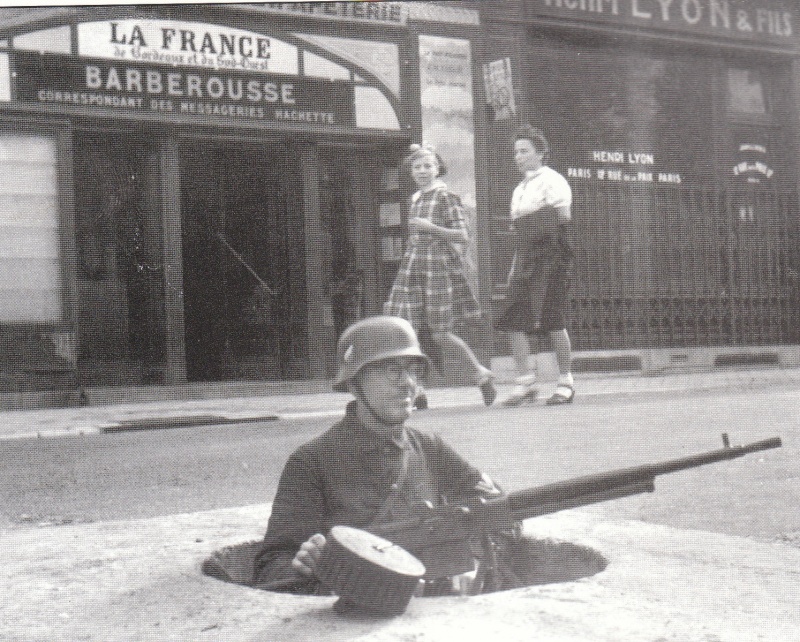
The gun is a Modele 1931 “Reibel” – basically a Chatellerault 24/29 converted for vehicle and fortification use. Photo provided by Max Popenker – thanks Max!

The gun is a Modele 1931 “Reibel” – basically a Chatellerault 24/29 converted for vehicle and fortification use. Photo provided by Max Popenker – thanks Max!
“Chassepot to FAMAS: French Military Rifles 1866-2016” is in stock and shipping now: https://www.headstamppublishing.com/purchase The rarest pattern of factory-made Chassepot is the fusil modèle 1866 pour la cavalerie d’afrique – the Model 1866 rifle for […]
We took a look at the history and mechanics of the G41 yesterday; now it’s time to actually try it out on the range… It, ah, did not go so well. But I did get […]

German soldiers training with a Czech CZ30(t) machine gun, a refined Vickers gun used mostly for air service. Thanks to Beryl for the photo!
© 2024 Forgotten Weapons.
Site developed by Cardinal Acres Web Development.
Very funny!
And Max’s website is definitely one of my faces. I’ve been unable to find the source for this photo, though.
Any help?
Sheesh. I don’t know what he did to piss off his sergeant, but it must have been a masterpiece.
Sewer system or not, the buried, reinforced concrete structure box that surrounds the manhole trunking to the actual sewage piping below makes for a very good protected foxhole. Also, sewer systems are typically buried several feet below existing grade, so the soldier in the photograph is probably standing on an improvised platform in the access riser well above the water level.
A real danger in manning such a position is the possibility of spark or static ignition of flammable / explosive sewer gases, and also asphyxiation from high concentrations of those gases and / or low oxygen content.
I did get a really good laugh from Ian’s and Joel’s remarks, though :).
Just remember, we are all in the $#!t, it’s only the depth that varies …
If I have the choice between a couple sandbags and a concrete structure with covered escape tunnel, I take the sewer hole any day. Of course, the pedestrians in the background seem to indicate a non-combat situation, and as a long-term position this seems less than desirable. Unless you compare sewer fox hole in France vs. Ostfront, and in this case there’s probably 3 million German soldiers who’d trade with him in a blink of an eye.
Looking at the looks of this soldier (glasses, slightly “not too young”, strange non german standard issued firearm) it is obvious that mostly second grade troops were reserved for maintaing order in occupied countries like France (where also was not so great “partisan” or resistance activity like in some parts of South or Eastern Europe).
Maybe it isn’t sewer hole but a concrete bunker called Tobruk or Ringstand 58. Here in Polish wiki: http://pl.wikipedia.org/wiki/Ringstand_58c This one looks a little different, but there was some versions and sub-versions of Tobruk.
A very interesting application that would have fit quite nicely into the protected position shown in the photo in this article. Thanks for sharing this with the rest of us!
The Tobruk / Ringstand 58 also appears to be a pre-fabricated reinforced concrete structure. If so, the users would simply have had to excavate an opening in the ground of the appropraite size, emplace the structure, and backfill and compact the soil around the structure to have a prepared defensive position.
@Storm – This is an odd case. The man does not have shoulder boards, a breast eagle or collar litzen, but does have an Obergefreiter’s chevrons on his left arm. His helmet still has the national shield on it as well. A very odd uniform combination, even for a garrison division. From my research, it seems to me that the German army was pretty good about keeping their insignia straight, even as things got bad later in the war. Most of the pictures that you see of people without these kinds of insignia are HIWIs or other auxiliary types, not actual Heer or SS soldiers. I’m now more interested in who this guy belonged to, rather than the firearm.
The caption for this photo is as follows from the Bundesarchive
German soldier of the IR 855 of the 344 ID in a street of BIARRITZ, in 1943
I miss the Vintage Saturday photos, bring them back!
I think this is a “Ringstand” type of pre-made fortification, not a sewer manhole. Also, my guess is that this road is harbor or otherwise sea-facing so that his position is an anti-invasion position, part of “Festung Europa / Fortress Europe.” Biarritz is southern France on the Atlantic coast, a low invasion risk location so a third tier unit in defense makes sense.